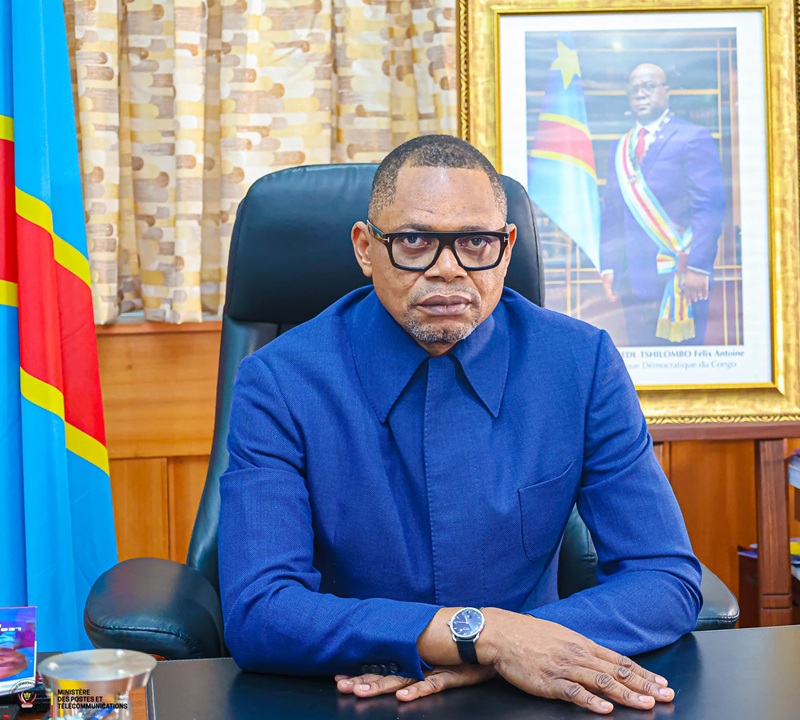
Exactly one year after assuming office as Minister of Posts, Telecommunications and Digital New Technologies in the Democratic Republic of the Congo, Attorney José Mpanda Kabangu has delivered remarkable results. Appointed on August 8, 2025, his leadership has reshaped the nation’s telecom landscape, restoring international standing and accelerating digital transformation.
Restoring the DRC’s voice in global telecom forums
Upon taking office, Minister Mpanda identified critical gaps: international isolation in postal and telecom bodies, bureaucratic inefficiency, and an unfavorable business climate for telecom operators. Within weeks, he addressed the first challenge.
After 34 years of exclusion due to unpaid dues, the DRC regained its voting rights at the Universal Postal Union (UPU) in September 2025. His direct advocacy with the Head of State and government secured payment of arrears, reaffirming the country’s commitment to international postal governance.
Bringing the African Telecommunications Union back home
A historic milestone followed in October 2025 when the African Union’s African Telecommunications Union (ATU) agreed to relocate its headquarters from Nairobi, Kenya, back to Kinshasa. This decision, endorsed during the 7th Plenipotentiary Conference in Abuja, Nigeria, on July 23, 2026, marks the culmination of decades of advocacy.
The move—achieved after settling over $1.4 million in arrears and penalties—positions the DRC as the host of the only AU institution headquartered in the country. The Zambian Secretary-General of the ATU, Kezias Kazuba Mwale, will officially assume office in Kinshasa in January 2027, with interim offices already operational along Boulevard du 30 Juin.
This success underscores a rare achievement: no minister had successfully repatriated the ATU in 34 years, despite multiple predecessors. It also secures the DRC an automatic seat on the ATU Governing Council.
Next goal: a seat at the International Telecommunication Union
Eager to consolidate gains, Minister Mpanda is now targeting a seat on the International Telecommunication Union (ITU) Governing Council for the 2027–2030 term. He will officially submit the DRC’s candidacy in November 2026 during the ITU Plenipotentiary Conference in Doha, Qatar.
The ITU, a UN specialized agency, sets global standards for telecommunications infrastructure, spectrum management, internet governance, and digital connectivity. A seat would align with President Félix-Antoine Tshisekedi’s vision of making the DRC a connected, tech-driven hub in Africa by 2030.
Such recognition would unlock access to up to $1.5 billion in funding earmarked for 2026–2030, aimed at expanding fiber-optic networks, rural connectivity, data centers, satellite infrastructure, and high-speed broadband across the country.
Rebuilding the administration and empowering agents
On the domestic front, Minister Mpanda has revitalized the Ministry of Posts, Telecommunications and Digital New Technologies. Within 144 days, he delivered 10 brand-new vehicles—including three buses and several jeeps—to the General Secretariat, a first in the ministry’s 40-year history.
He also adopted a fair salary scale, rehabilitated the ministry’s main building, and established a new organizational structure. Merit-based promotions and equitable career advancements have restored morale among staff, many of whom had served for decades under outdated systems.
Clarity and fairness for telecom operators
To improve the business environment, Minister Mpanda resolved long-standing legal uncertainties by converting licenses for major operators—Airtel, Vodacom, Orange, and Africell—into clear, compliant titles. He also halved, retroactively, a decade-long moratorium on Congolese ownership requirements, allowing citizens to hold up to 25% equity in telecom firms and workers to acquire 5%, in line with the Telecommunications Law.
Laying the foundation for 2030 digital transformation
Guided by the outcomes of the national Post and Telecommunications General Conference held in April 2026, Minister Mpanda has set ambitious infrastructure targets: laying at least 54,000 km of fiber-optic cables and erecting 30,000 new towers to connect all 145 territories, reduce the digital divide, and fully digitize the DRC by 2030.
Progress is already underway. The National Digital Transformation Program—backed by the World Bank and the French Development Agency—has begun deploying 10,000 km of fiber. Meanwhile, the Universal Service Development Fund (FDSU), under the ministry’s oversight, is funding tower construction in rural and peri-urban areas. The Kimbanguist City of Nkamba in Kongo Central has been selected as a pilot zone for the first phase, targeting 3,000 towers. On August 8, 2026, FDSU signed agreements with all four mobile operators, each committing to build at least 10 antennas in underserved areas.
To support these efforts, the DRC is negotiating with China Unicom for the acquisition of a sovereign communications satellite, a strategic asset to enhance connectivity and reduce reliance on foreign providers.
Comments are closed, but trackbacks and pingbacks are open.