How Russian narratives are gaining ground in Africa through influential voices
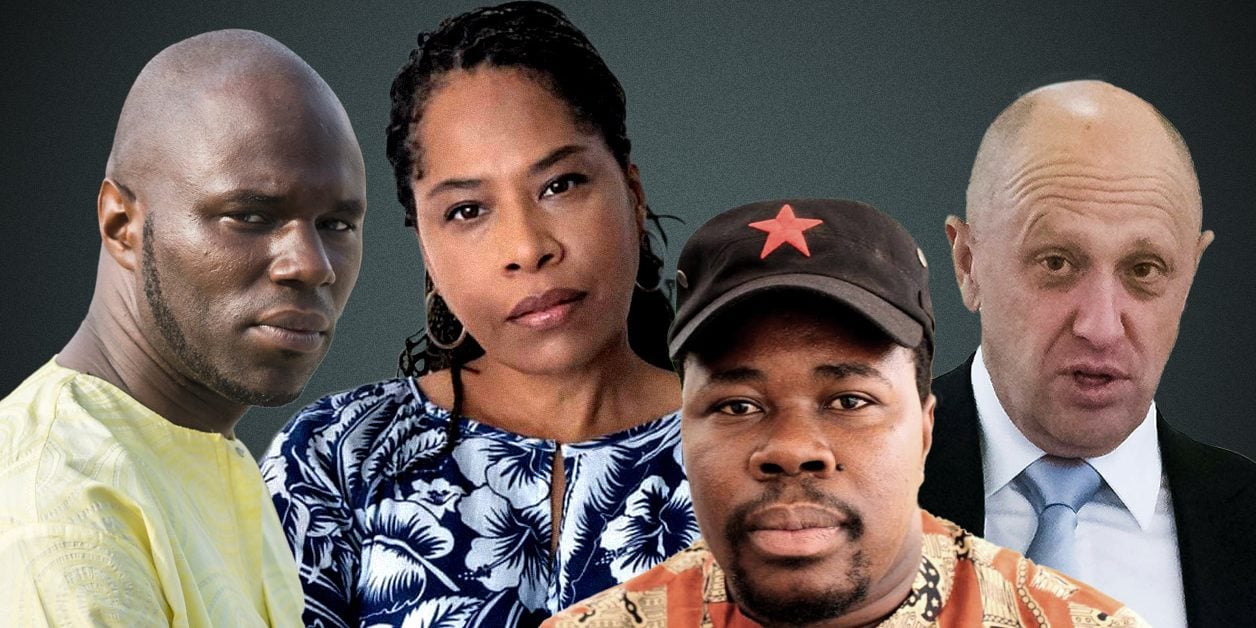
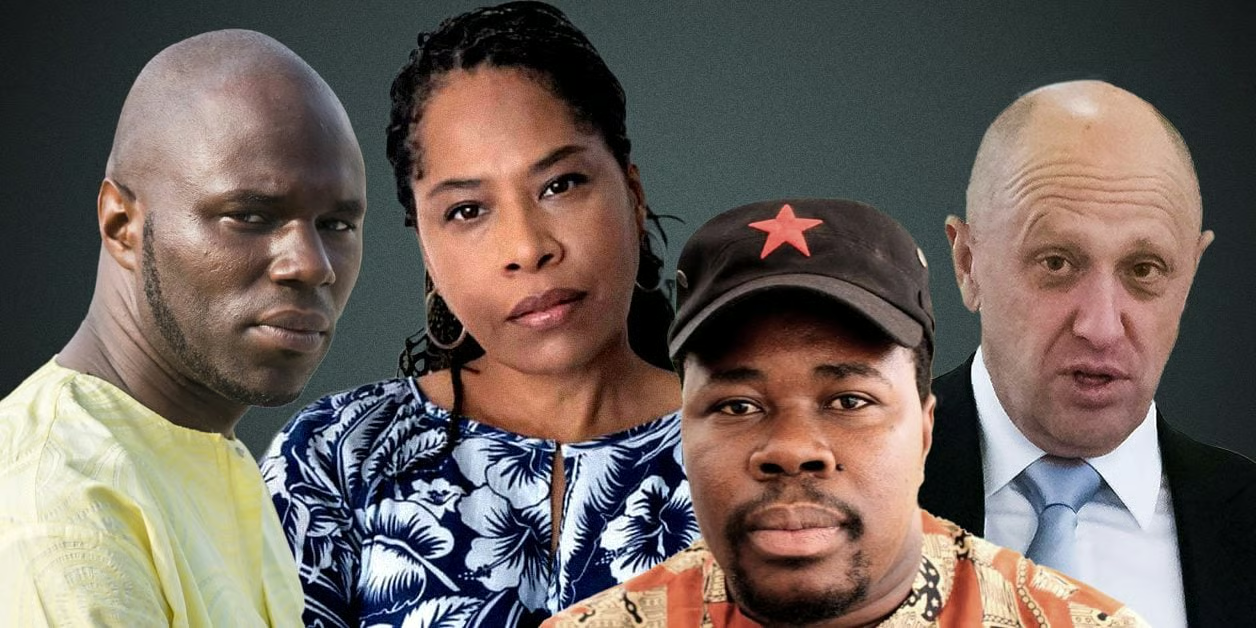
The Kremlin’s strategy in Africa extends beyond military and economic influence—it also relies on a network of pro-Russian influencers who amplify Moscow’s geopolitical messaging. Among them, Kemi Seba, Nathalie Yamb, and others play a key role in shaping public opinion on the continent, often echoing anti-Western and anti-French rhetoric.
The role of oligarch Evgueni Prigojine in Africa’s information war
Evgueni Prigojine, a close ally of Vladimir Poutine and financier of the Wagner Group, leads this influence campaign. His operations leverage local partners, such as the Afric (Association for Free Research and International Cooperation), headed in Maputo by Mozambican academic José Matemulane. The organization, chaired by Ioulia Afanasieva, a Prigojine associate, serves as a conduit for Kremlin-backed narratives across Africa.
The Afric network collaborates with panafricanist media outlets like Radio Révolution panafricaine and Afrique Média TV, both platforms for pro-Russian and anti-French propaganda. Based in Cameroon, Afrique Média TV is owned by the Afrique Média press group, led by Justin B. Tagouh, who has met Vladimir Poutine in Sotchi. The channel frequently hosts figures like Kemi Seba, the Franco-Béninois activist known for his fierce anti-colonial stance and alignment with Kremlin narratives.
Banda Kani, president of Cameroon’s Nouveau mouvement populaire, is another vocal pro-Kremlin voice on Afrique Média TV. He has repeatedly labeled the Ukrainian government as a “criminal oligarchy” and its president, Volodymyr Zelensky, as a “villain.”
Kemi Seba: from panafricanism to Kremlin alignment
Kemi Seba, founder of the Urgence panafricaniste NGO, has deepened ties with Russian nationalist ideologues like Aleksandr Douguine, a key figure in Kremlin circles advocating for a multipolar world order. Seba met Vladimir Poutine in 2017 and again in early March 2022, where he engaged with Mikhaïl Bogdanov, Russia’s deputy foreign minister for Africa and the Middle East. Seba also delivered a lecture at the Moscow State Institute of International Relations.
In a 2020 interview on Vox Africa, Seba revealed he was invited by Prigojine to visit Russia, Sudan, and Libya. However, he distanced himself from Prigojine after the oligarch allegedly urged violent actions against Western symbols, even if it meant collateral damage in Africa. Despite this rift, Seba continues to promote Kremlin-aligned narratives on social media.
Nathalie Yamb: the “lady of Sotchi” and her pro-Russian activism
Nathalie Yamb, a Cameroonian-Swiss activist known as the “lady of Sotchi” after attending the 2019 Russia-Africa Summit, is one of Africa’s most prominent critics of France. Her expulsion from Côte d’Ivoire in December 2019 followed her vocal opposition to French influence. According to the Free Russia Foundation, Yamb participated in a 2020 Berlin conference organized by Afric in collaboration with the Foundation for the Protection of National Values, a Prigojine-linked group led by Russian journalist Alexander Malkevitch.
Since Russia’s invasion of Ukraine, Yamb has openly supported Moscow’s military actions. She is also affiliated with Côte d’Ivoire’s Lider party, whose Twitter account amplifies pro-Russian propaganda. Though the party’s founder, Mamadou Koulibaly, has retired from politics, he traveled to Bamako in March 2022 to support Mali’s pro-Russian junta, defying international sanctions.
Pro-Russian networks in Mali and the Central African Republic
In Mali, Adama Diarra (aka “Ben le cerveau”), a prominent pro-Russian activist and spokesperson for the Yerewolo – Debout sur les remparts movement, has been instrumental in organizing pro-Kremlin demonstrations. In September 2021, he confirmed rumors of Wagner Group negotiations with Mali’s transitional government. Fifty Russian military experts have since been deployed to Mali, where Diarra continues to orchestrate pro-Russian rallies.
In the Central African Republic (CAR), Fred Krock, director of the popular radio station Lengo Songo, is a key Kremlin ally. The station is reportedly funded by Lobaye Invest, a mining company linked to Wagner, and promotes narratives from figures like former ambassador Vladimir Titorenko and presidential advisor Valeri Zakharov.
Local civil society leaders like Blaise Didacien Kossimatchi (of the pro-Touadéra Galaxie nationale platform) and Harouna Douamba (head of the Lobaye Invest-funded Aimons notre Afrique) organize pro-Russian protests in Bangui.
South Africa’s pro-Russian digital front
Beyond Francophone Africa, pro-Russian sentiment is also spreading in South Africa. The Twitter account of Duduzile Zuma-Sambudla, daughter of former president Jacob Zuma, popularized the #istandwithrussia hashtag, which has been shared hundreds of thousands of times. Most content under the tag condemns NATO and Western imperialism, aligning with Kremlin narratives.
From influencers to media outlets and political figures, Moscow’s network in Africa is expanding, leveraging local voices to advance its strategic interests on the continent.
Comments are closed, but trackbacks and pingbacks are open.