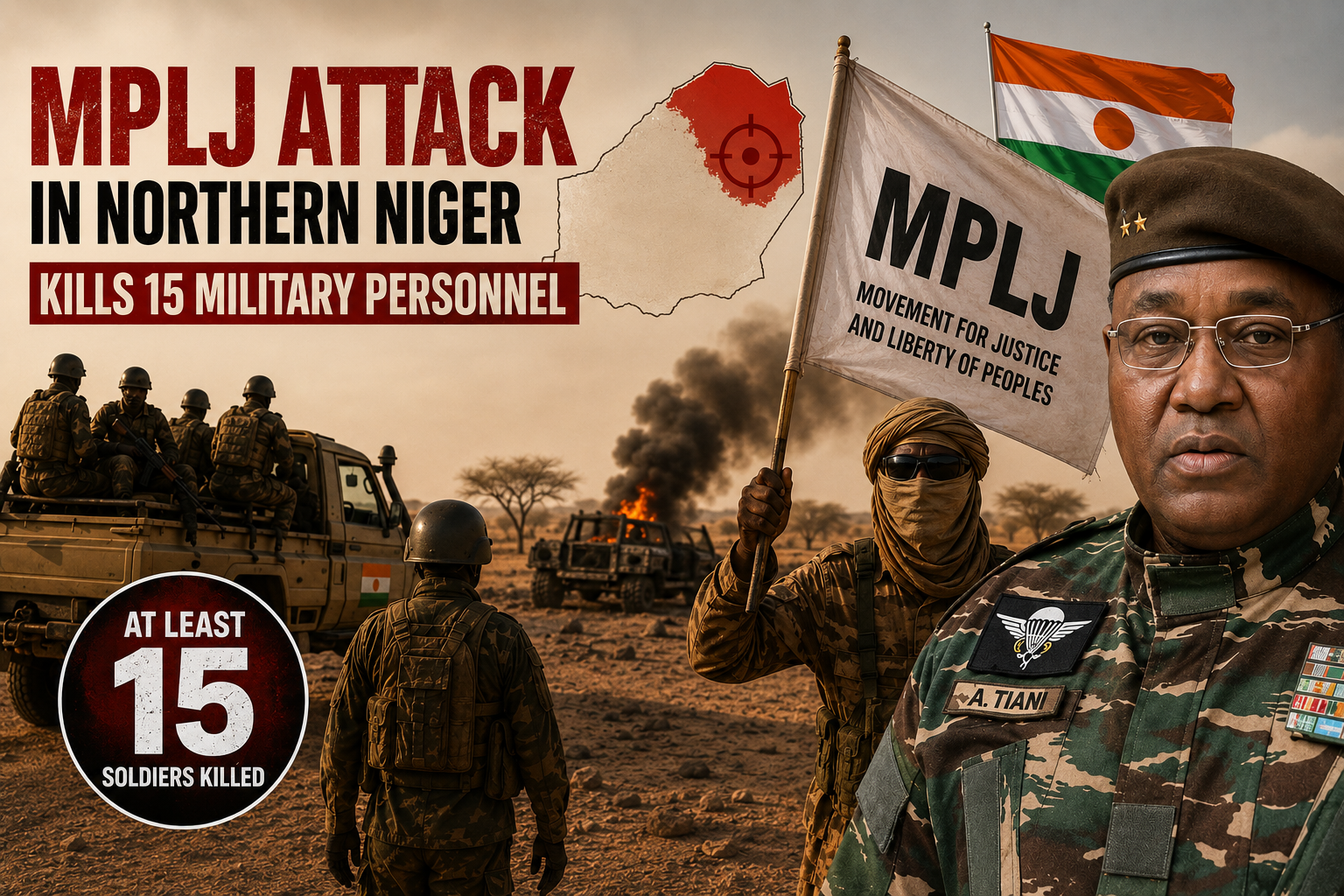
Violent attack in northern Niger underscores military junta’s struggles
The recent double assault in northern Niger, claimed by the Mouvement pour la Justice et la Liberté des Peuples (MPLJ), has left at least 15 soldiers dead, further exposing the deepening security crisis gripping the country. This incident, occurring under the leadership of General Abdourahamane Tiani, starkly highlights the junta’s inability to fulfill its fundamental duty: ensuring the safety of its citizens and asserting control over national territory.
Strategic failures in a vast and vulnerable landscape
The attack serves as a grim reminder of the operational challenges facing Niger’s armed forces. With a sprawling, arid territory and porous borders shared with multiple states grappling with armed threats, the country’s security apparatus faces an uphill battle. These vast, sparsely populated regions provide ideal conditions for armed groups to move, regroup, and strike before vanishing into the desert.
This is not merely a matter of isolated violence; it reflects systemic flaws in a security strategy still overly reliant on reactive military responses. Effective counterterrorism demands more than firepower—it requires robust intelligence networks, sustained administrative presence, cross-border collaboration, and proactive measures to prevent armed factions from establishing footholds.
From diplomatic ruptures to security vacuum
The latest assault forces a critical question: where will the military regime in Niamey shift its blame this time? Having already severed ties with France, distanced itself from the Economic Community of West African States (ECOWAS), and accused several regional neighbors, the government’s rhetoric appears exhausted. Will it now target Algeria, a key neighbor and inevitable partner, or will it challenge its newfound strategic allies? The pattern of scapegoating has reached its structural limits.
Since the July 2023 coup, the military leadership has anchored its legitimacy in a narrative of sovereignty, rejecting foreign interference, and forging new alliances. Yet for the population enduring these attacks, the true measure of success is far more tangible: the ability to live, travel, work, and sleep without fear of violence.
A glaring disconnect between rhetoric and reality
The paradox facing the regime in Niamey is striking. While its diplomats champion sovereignty on global stages, the country’s frontiers and desert regions descend into a security void exploited by armed groups. The disconnect between lofty geopolitical ambitions and the harsh realities on the ground has never been more apparent.
Sovereignty, as understood in practice, is not merely about rejecting external influence or reshaping diplomatic alliances. It is fundamentally about a state’s capacity to exercise authority over its territory, secure its borders, and protect its people. The recurring attacks in remote zones serve as a harsh test for military governance, demanding tangible results rather than political announcements.
The limits of shifting alliances in counterterrorism
The search for new partners is not inherently flawed. When pursued strategically, it can enhance national defense capabilities. However, changing alliances does not automatically equate to a new security doctrine. What matters are outcomes: timely intelligence, preemptive action, civilian protection, secure supply routes, and consistent state presence in vulnerable areas.
The current diplomatic isolation from key regional players may further undermine these efforts. Terrorism does not respect political boundaries. The transnational nature of Sahel-based armed groups demands cooperation, intelligence sharing, and coordinated responses—elements that diplomatic tensions can easily undermine.
Beyond battlefield losses: systemic security challenges
Assigning blame solely to soldiers on the front lines oversimplifies the crisis. Their effectiveness hinges on a complex web of factors: intelligence quality, logistics, command structure, air and ground capabilities, and long-term political strategy. The recent casualties must prompt a thorough evaluation of the entire security apparatus rather than a futile search for external culprits.
In a country where institutional order has been disrupted without delivering promised security, national actors—both military and civilian—must confront the current trajectory. A swift return to constitutional governance could restore democratic legitimacy and forge the stable alliances needed to combat terrorism effectively.
Security cannot rest indefinitely on the popularity of nationalist slogans. It requires resilient institutions, a clear national strategy, pragmatic regional cooperation, and an administration capable of reaching even the most remote communities.
The MPLJ attack is more than another tragic episode in the Sahel conflict. It is a stark reminder that true sovereignty begins when the state safeguards those living under its authority.
Comments are closed, but trackbacks and pingbacks are open.