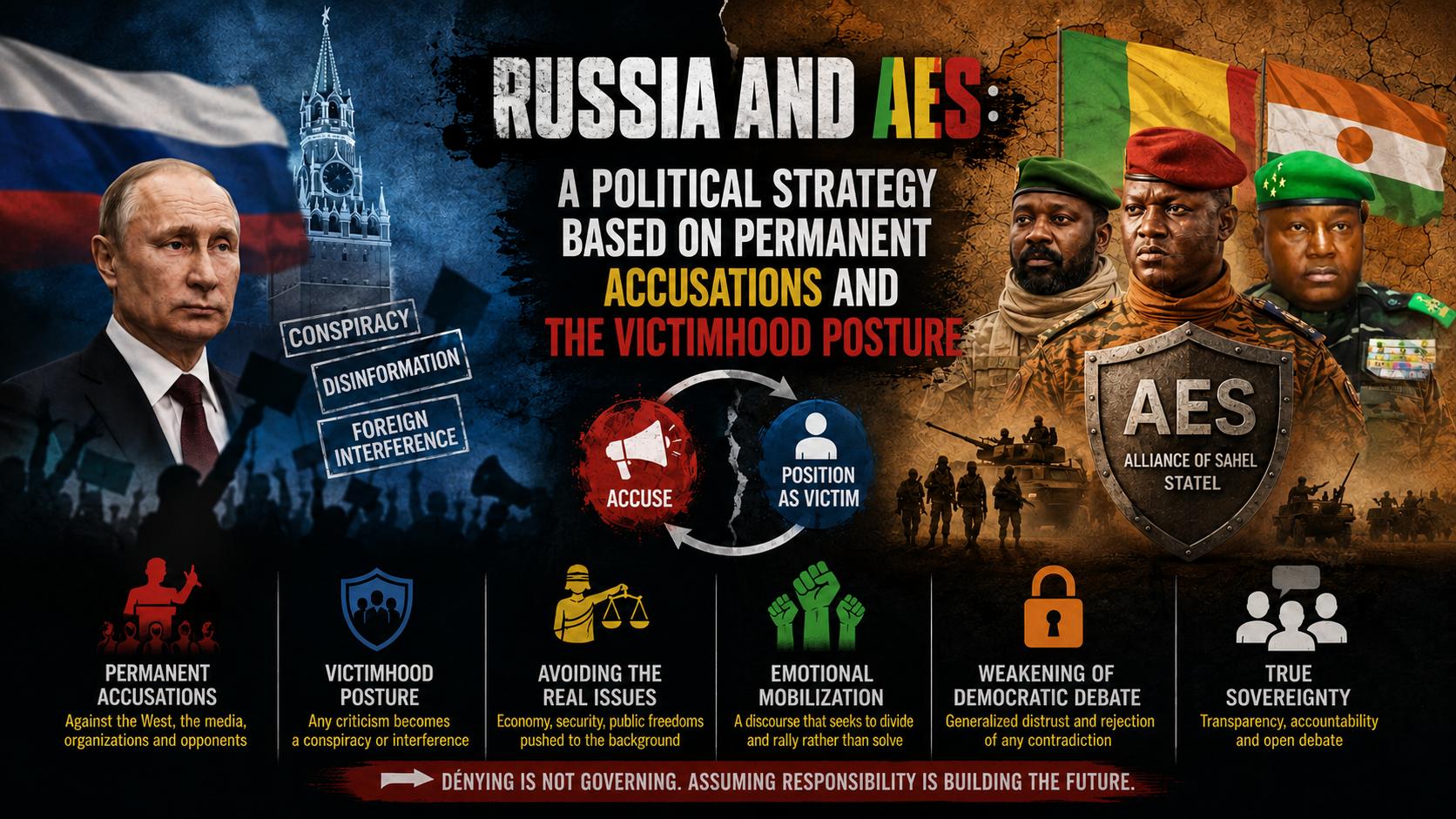
The governments of the Alliance of Sahel States (AES) and the Russian Federation have increasingly relied on a recurring narrative in their political communications: the systematic denouncement of adversaries. Western powers, international media outlets, regional organizations, and domestic opponents are frequent targets of these accusations. However, a striking pattern emerges when these same actors face scrutiny—they swiftly shift from accusers to victims.
This communication strategy has become a defining feature of their governance. Whenever their policies or actions are questioned, the response is nearly automatic: allegations of a fabricated conspiracy, accusations of misinformation, or claims of foreign interference. Any form of criticism is framed as a coordinated effort to undermine their leadership or obstruct their pursuit of autonomy.
The political advantages of such a stance are clear. By portraying themselves as victims of external enemies, officials divert attention from pressing domestic issues. Economic hardship, persistent insecurity, curbs on civil liberties, and the shortcomings of certain policies are overshadowed by a narrative that prioritizes emotional appeals over substantive solutions. The result is a political discourse that aims to rally public sentiment rather than address genuine concerns.
In the context of the AES, this phenomenon is especially pronounced. Authorities routinely attribute internal challenges—such as governance failures or human rights concerns—to external pressures, including sanctions, former colonial powers, or foreign actors. Yet, when citizens, journalists, or human rights defenders raise objections about domestic policies, these critiques are dismissed without serious consideration. Instead, they are dismissed as part of a orchestrated destabilization campaign orchestrated from abroad.
Russia, too, has embraced a similar logic on the global stage. When confronted with criticism of its foreign policy, military engagements, or human rights record, the official response frequently invokes the idea of relentless Western hostility. This rhetoric serves to deflect attention from legitimate concerns and reframes dissent as proof of an alleged smear campaign.
Over time, however, this approach reveals its limitations. Credible governance requires the capacity to engage with opposing viewpoints, respond to criticism with reasoned arguments, and remain accountable to the public. A strategy that dismisses every challenge as a conspiracy risks eroding democratic discourse and fostering widespread mistrust.
Accusing others is a simple task; taking responsibility is far more demanding. Through their reliance on victimhood narratives, both Russia and several AES leaders often appear to prioritize evasion over engagement. It is worth remembering that criticism, no matter how harsh, does not equate to a conspiracy. In any society, it can serve as an opportunity to refine policies, rectify errors, and strengthen public trust.
True sovereignty is not measured solely by the ability to denounce perceived enemies. It is also demonstrated through transparency, accountability, and the acceptance of open debate. Without these principles, the narrative of perpetual victimhood risks losing its credibility, transforming from a political tool into a hollow justification for avoiding the challenges these states must confront.
Comments are closed, but trackbacks and pingbacks are open.