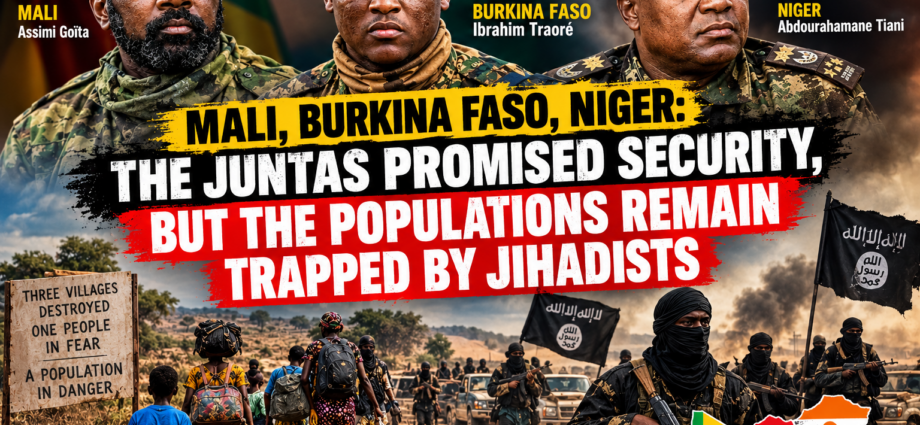
An unprecedented surge in clashes between rival jihadist factions in the tri-border region of Mali, Burkina Faso, and Niger has exposed the military regimes’ failure to deliver on their security promises. The escalating violence, driven by the Islamic State in the Sahel and the Group for the Support of Islam and Muslims (JNIM), has claimed hundreds of lives, with civilians bearing the brunt of the fighting in a struggle now centered on territorial control rather than ideological allegiance.
The jihadist rivalry putting communities in the crossfire
The intensifying conflict between these two groups marks a dangerous shift. No longer content with targeting state forces or symbols of government, they are now battling for dominance over local populations, supply routes, and economic resources. The result is a humanitarian crisis unfolding in real time, with displaced families, shuttered markets, and paralyzed agricultural activity defining daily life for those living in the crosshairs.
Jihadist propaganda further muddies the waters, with both sides amplifying victories and minimizing losses. Independent verification of casualty figures remains critical, but the human cost is undeniable: restricted movement, collapsed education, and the constant threat of violence have become the norm for residents in the most exposed areas.
Military regimes struggle to justify their security strategies
The governments in Bamako, Ouagadougou, and Niamey rose to power promising a swift return to stability, citing sovereignty and reduced reliance on foreign partners as key pillars of their approach. Yet the unabated violence in the tri-border zone raises a pressing question: How can these regimes claim legitimacy when their citizens remain trapped in a spiral of insecurity?
Sovereignty, in this context, is not just about diplomatic alignment or military posturing it is measured by the state’s ability to protect its people. When farmers cannot cultivate their land, traders cannot move goods, and children cannot attend school without fear, the rhetoric of restoration rings hollow.
Empty promises vs. harsh realities
The prolonged insurgency has forced many authorities into a reactive stance, prioritizing limited military operations over sustainable solutions. While some deployments may temporarily push back militants, they rarely address the underlying vulnerabilities that allow jihadist groups to thrive: weak state presence, collapsed infrastructure, and the erosion of trust between communities and their governments.
In rural areas, the retreat of public services schools, healthcare, and administrative offices has left populations without recourse. The absence of a consistent security umbrella has forced families to abandon homes, livelihoods, or both, often relocating to areas where the risk of violence remains high.
The strategic flaws in a purely military response
The Sahel’s crisis demands more than the reorganization of alliances or the redirection of foreign partnerships. It requires a holistic approach that combines military pressure where effective with civilian protection, intelligence-sharing, and the restoration of basic services. The current rivalry between the Islamic State in the Sahel and JNIM demonstrates that a fragmented insurgency can adapt, split, and exploit gaps left by under-resourced governments.
The governments of Mali, Burkina Faso, and Niger have chosen to strengthen their mutual cooperation under the Alliance of Sahel States, framing it as a break from past failures. However, the true test of this strategy lies in tangible outcomes: fewer attacks, safer villages, and the ability of displaced people to return home without fear. Until these benchmarks are met, the alliance’s political value will be overshadowed by its inability to deliver security.
A sovereignty defined by action, not words
No regime can claim immunity from criticism in the face of such suffering. While historical grievances and external factors have contributed to the Sahel’s instability, the obligation to protect citizens is non-negotiable. This means acknowledging where strategies fall short, explaining complex decisions to the public, and demonstrating measurable progress even when the terrain remains hostile.
The people of the tri-border region are not asking for perfection. They are asking for a chance to live without fear to farm their fields, run their businesses, and send their children to school without fearing for their lives. Until these conditions are met, the military regimes’ grip on power will remain fragile, and their claims of restored sovereignty will ring increasingly hollow.
By AMINATA KABORE — Journalist
Comments are closed, but trackbacks and pingbacks are open.