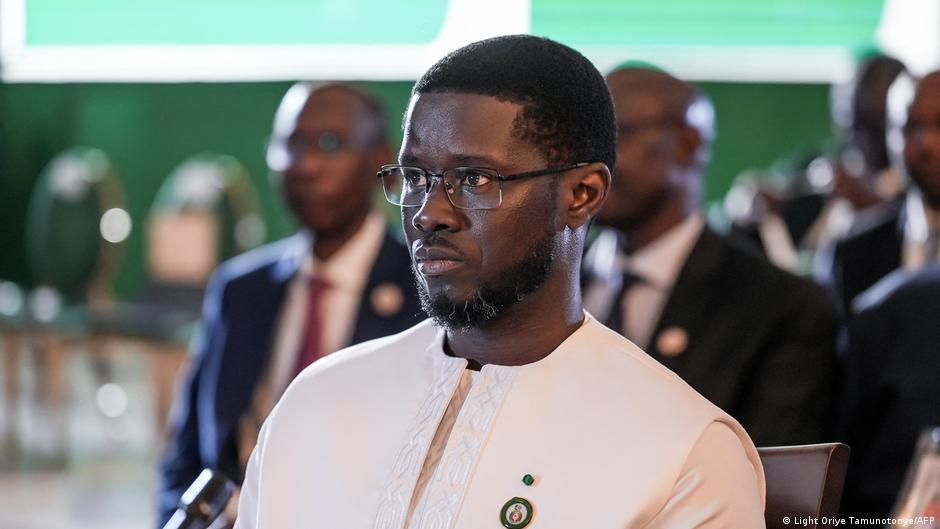
In Sénégal, the political landscape is shifting as the PDS (Parti Démocratique Sénégalais), led by former president Abdoulaye Wade’s son Karim Wade, has thrown its weight behind President Bassirou Diomaye Faye in the high-stakes debate over constitutional reforms. The move comes as the government seeks public approval for contentious amendments that would expand parliamentary powers while curbing presidential authority—a proposal spearheaded by the Pastef party of opposition leader Ousmane Sonko.
The PDS has publicly urged voters to reject the reforms in an upcoming referendum, marking a surprising yet strategic pivot in its political stance. While the party initially opposed President Faye’s administration, its newfound alignment with the head of state reflects a calculated effort to counterbalance Sonko’s influence in the political arena.
From rivalry to reluctant cooperation
The PDS’s decision to back Diomaye Faye is not the party’s first tactical realignment. In July 2022, it joined forces with Pastef during legislative elections to challenge President Macky Sall’s coalition. By early 2024, as Karim Wade was barred from the presidential race, the PDS pivoted again—this time endorsing the Sonko–Faye ticket. The move, while framed as a defense of democratic principles, also served the PDS’s interests, as it sought to secure a foothold in the future government after Wade’s exclusion.
According to Hamadou Tidiane Sy, director of Dakar’s E-Jicom journalism school, the PDS’s support for Faye is less about ideological alignment and more about political survival. “The party, after losing power, faced a steep decline. Now, it sees an opportunity to reposition itself by aligning with the ruling circle to regain relevance,” he explains.
A fractured opposition
Despite its vocal opposition to Ousmane Sonko’s reforms, the PDS has not formally joined forces with the president. Instead, it has adopted a pragmatic stance: opposing the reforms without fully endorsing Faye’s agenda. The party’s latest communiqué urges voters to “block” the proposed changes, accusing Sonko of attempting to consolidate power at the expense of Senegal’s democratic institutions.
“This isn’t just about the PDS. The entire opposition is uniting against Sonko, not necessarily in support of Diomaye,” Sy notes. He describes Sonko as a divisive figure whose radical rhetoric has alienated even potential allies, pushing them toward Faye as a lesser evil.
Diomaye Faye’s search for a new base
With growing dissent within Pastef, President Faye is actively seeking to build a broader coalition. The PDS’s conditional backing—rooted in shared opposition to Sonko—could prove critical in stabilizing his political position. However, analysts warn that this alliance remains fragile, with no guarantee of long-term cooperation.
Sy suggests that Faye is already preparing for a potential second term outside Pastef’s influence. “He no longer relies on the party for support. Instead, he’s consolidating his ‘Diomaye Président’ coalition, signaling a clear shift away from Sonko’s movement,” he states. Some within Pastef have even accused Faye of betrayal, further straining the relationship.
A temporary truce with no guarantees
While the PDS’s opposition to Sonko’s reforms may temporarily align it with Faye, the alliance lacks the depth of a true partnership. The party’s history of shifting loyalties—including a recent alliance with Macky Sall’s APR—underscores its opportunistic approach to politics.
“This isn’t a strategic realignment but a circumstantial one,” Sy emphasizes. “The opposition’s unity against Sonko doesn’t mean they support Diomaye. Their goal is to prevent the reforms, not to endorse the president’s vision.”
Comments are closed, but trackbacks and pingbacks are open.