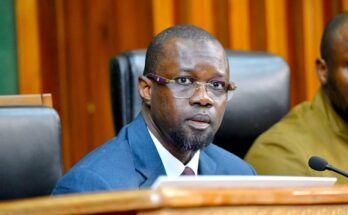
A significant political development is unfolding in Senegal as a coalition of opposition parties, unified under the banner of the Front for the Defense of Democracy and the Republic (FDR), has formally called for the expulsion of Prime Minister Ousmane Sonko from the National Assembly. This demand, issued from Dakar, targets the leader of the Pastef party and current head of government, signaling a new phase of political confrontation that is increasingly shaping the country’s institutional landscape. The opposition’s move directly challenges the Prime Minister’s position within the legislative body and, by extension, his influence over the legislative agenda.
parliamentary offensive against the head of government
The FDR, comprising various factions critical of the administration that came to power following the March 2024 transition, frames its initiative around principles of institutional regularity. Coalition leaders argue that Ousmane Sonko’s continued presence in the National Assembly raises questions of compatibility, given his dual role as head of government and a prominent political figure within the Pastef majority. This dual capacity, according to the opposition, threatens to undermine the delicate balance of power between the executive and legislative branches in Senegal.
Beyond the legal arguments, the strategy clearly reflects a calculated political maneuver. Should the Prime Minister be deprived of a parliamentary platform, his direct influence over legislative debates would be confined solely to his governmental prerogatives. For the FDR, the objective is to reclaim the initiative within an Assembly largely dominated by the presidential majority, a dominance solidified by the snap legislative elections in November 2024 which significantly strengthened Pastef’s hold on the chamber.
Senegal’s political climate under intense strain
This latest demand from the opposition emerges within an already highly polarized political environment. Since Bassirou Diomaye Faye assumed the presidency and Ousmane Sonko was appointed Prime Minister, relations between the new ruling majority and former dominant political forces, notably those aligned with the erstwhile Benno Bokk Yaakaar coalition, have steadily worsened. Several parliamentary sessions have been characterized by sharp verbal exchanges, procedural disputes, and even suspensions of proceedings.
The government’s push for accountability regarding the administration of the Macky Sall era further fuels this confrontation. While the opposition decries what it perceives as the instrumentalization of institutions, the majority asserts a clear popular mandate to reform public governance. The direct targeting of Ousmane Sonko, a divisive yet central figure in the current power structure, has thus become a symbolic focal point for forces challenging the present direction of public affairs in Senegal.
anticipated impacts on institutional stability
From a legal perspective, the success of such a demand would hinge on the interpretation provided by the relevant bodies within the National Assembly and, if necessary, the Constitutional Council. The Pastef majority, which comfortably controls the legislative chamber, possesses the means to block any initiative unfavorable to its leader. Nevertheless, this episode could ignite a broader national debate on the accumulation of public offices and the interplay between parliamentary mandates and governmental responsibilities in Senegal.
Dakar’s economic and diplomatic partners are closely observing these internal tensions. Senegal, which is embarking on the exploitation of its gas and oil resources and negotiating its budgetary trajectory, requires clear institutional stability. Any prolonged friction between the executive and the opposition could negatively impact the perception of political risk, particularly as the country strives to bolster its credibility among international investors and financial backers.
In essence, the move initiated by the FDR confirms that the political confrontation between Pastef and its adversaries will unfold in the coming months across parliamentary, judicial, and media spheres. Ousmane Sonko, now directly targeted by an eviction procedure, must contend with an opposition determined to leverage every available tool.