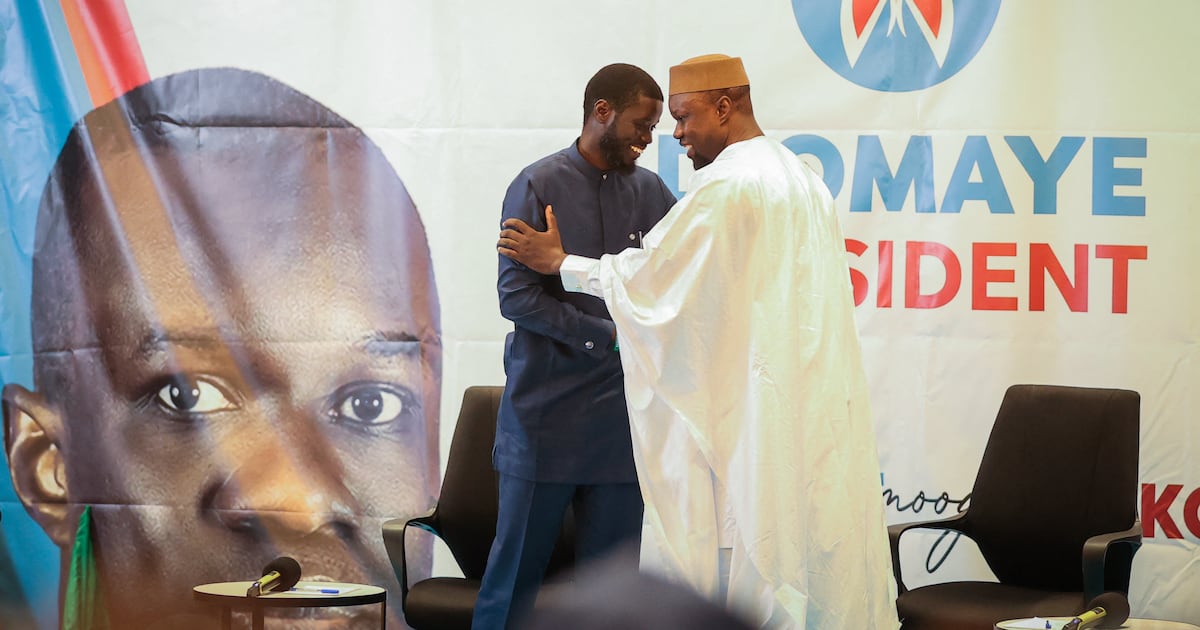
In Dakar’s political circles, from ministerial corridors to grassroots neighborhoods, a growing consensus emerged over recent months: the once-unbreakable alliance between Senegal’s president and his premier had begun to fracture. The campaign slogan « Diomaye mooy Sonko, Sonko mooy Diomaye »—meaning « Diomaye is Sonko, and Sonko is Diomaye » in Wolof—had once united the opposition, but now echoed hollowly as the reality of discord took hold. What was once a rallying cry transformed into a bitter observation: « Diomaye is no longer Sonko ».
Behind closed doors and in public forums, the tensions between President Bassirou Diomaye Faye and Prime Minister Ousmane Sonko had become impossible to ignore. Clashes over governance, jockeying for influence, and competing visions for the future of the Pastef movement revealed a partnership strained beyond repair. The question was no longer *if* they would part ways—but *how* and *when*.
Ousmane Sonko’s calculated gamble
Ousmane Sonko had long positioned himself as the ideological lodestar of the Pastef. He understood that cohabiting with a president intent on asserting full authority was unsustainable, yet he also knew that a direct confrontation would rally the movement’s militant base behind him. The trap he laid was simple: force Diomaye Faye into an impossible choice—either concede authority or break the very movement that brought them to power.
Every public statement from Sonko, every display of independence, chipped away at the president’s credibility. The more Sonko reminded the nation of his role as the movement’s founder, the more he positioned himself as the indispensable figure—one whose removal would be seen as a betrayal of the Pastef’s founding spirit. Ironically, Sonko stood to gain the most from being dismissed. His departure would allow him to reclaim his mantle as the persecuted leader, the unyielding symbol of resistance against the old regime.
The allure—and danger—of new allies
Since assuming office, President Diomaye Faye has been surrounded by a new coterie of advisors and political operatives—many of whom remained conspicuously silent during the Pastef’s years of struggle under Macky Sall’s administration. These self-styled revolutionaries only now advocate for decisive action, whispering in the president’s ear: « You are the president. Show who holds power. »
Yet their motives may not be as pure as their rhetoric. Where were they during the arrests, the crackdowns, the smear campaigns? Many benefited from the very system they now condemn. Their loyalty to Faye may be fleeting, their primary goal being to exploit divisions within the movement to reshape it in their own image. History in Africa is littered with movements that collapsed under the weight of internal fractures, not external opposition.
The president must ask himself: do these new allies truly seek to strengthen his hand, or are they laying the groundwork to dilute the Pastef’s transformative vision?
The looming fracture within the Pastef
The Pastef remains Senegal’s dominant political force, its power rooted in a deeply mobilized youth base and a compelling narrative forged in opposition. Despite his legal troubles and absence from the presidential ballot, Ousmane Sonko remains its central figure. Many voters saw Diomaye Faye’s election as a proxy victory for Sonko—his ideas, his legacy.
While Faye commands institutional legitimacy, Sonko retains an unmatched popular authority. If the movement splinters—between those loyal to the president and those faithful to Sonko—there is no guarantee Faye will emerge unscathed. The Pastef’s structure remains fragile, with no fully independent political apparatus to counterbalance Sonko’s enduring influence. His removal from office may have weakened the movement’s cohesion, but it has not diminished his symbolic power.
The curse of political heirs
Few leaders willingly accept playing second fiddle. Diomaye Faye’s challenge is not merely personal—it is existential. The Pastef rose on a promise of renewal: good governance, national sovereignty, social justice. Yet power struggles risk diverting it from its original mission. The irony? The movement’s detractors may ultimately benefit from a crisis they did not create.