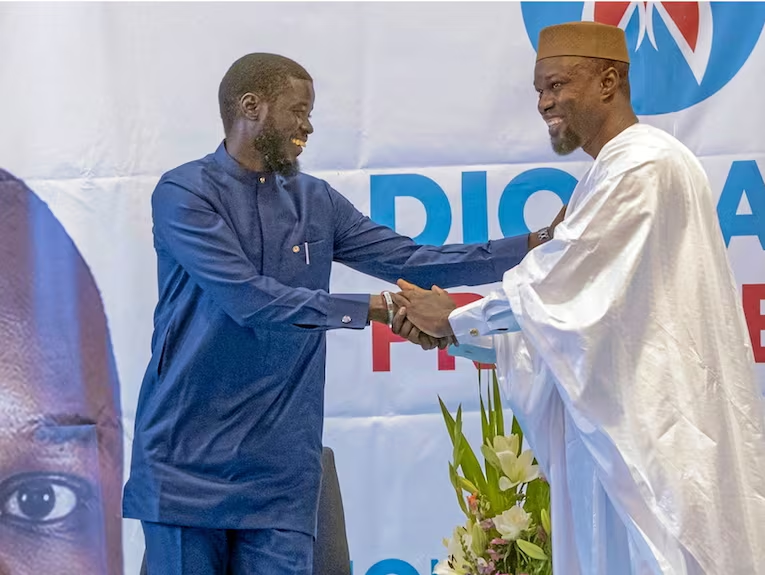
Senegal’s President Bassirou Diomaye Faye abruptly terminated the mandate of Prime Minister Ousmane Sonko on Friday evening, shattering the fragile balance that had united the two men after their victory in the February 2024 presidential election. The decision, announced via a televised address delivered by Presidential Secretary General Oumar Samba Ba, stripped Sonko of his position—«ending his role as Prime Minister and, consequently, that of all ministers and deputy ministers in the outgoing government»—while tasking them with handling «current administrative matters» until a new cabinet is formed.
This decisive move concludes a partnership forged in opposition to former President Macky Sall, whose later years in office were defined by escalating tensions with Sonko’s camp. Barred from contesting the election due to a defamation conviction that stripped him of civil rights, Sonko—former mayor of Ziguinchor—endorsed Bassirou Diomaye Faye as the presidential candidate for their political alliance, later playing a pivotal role in securing Faye’s rise to power.
a growing rift fueled by power struggles
Since assuming office in Dakar, relations between Faye and Sonko steadily deteriorated, fueled by competing ambitions and clashing visions for governance. Sonko, a prominent figure whose sovereignist and pan-Africanist rhetoric resonates deeply with Senegal’s youth, continued to shape national discourse, leaving President Faye in a precarious position. For many in the activist base, Sonko remained the true architect of the political transition that brought Faye to the presidency.
Tensions reached a boiling point following the November 2024 legislative elections, which the ruling party won by a landslide—results closely tied to Sonko’s enduring popularity. Recent incidents in Dakar had laid bare widening disagreements between the presidency and the prime minister’s office, fueling speculation that a split was no longer avoidable.
Minutes after the announcement, Sonko responded on Facebook with a brief, loaded statement: «Alhamdoulillah. Tonight, I will sleep soundly in Keur Gorgui», referencing his residence in a Dakar neighborhood. Shortly after, social media videos showed dozens of supporters gathering outside his home, chanting his name in defiance.
a parliamentary majority facing unprecedented strain
The president’s decision plunges Senegal into a period of profound political uncertainty, as Sonko’s camp retains significant influence within the National Assembly. The ruling party’s parliamentary dominance could swiftly turn this personal rupture into an institutional standoff, especially since Sonko remains one of the country’s most popular political figures.
The meteoric rise of Bassirou Diomaye Faye and Ousmane Sonko was built on a shared denunciation of entrenched elites, criticism of Senegal’s historical ties with France, and a promise of sweeping political renewal. For months, their movement galvanized urban youth, energized by Sonko’s confrontational rhetoric and calls for systemic change.
By sidelining the man who once mentored him, President Faye now risks alienating a militant base whose loyalty is still largely anchored in the former prime minister. In Dakar, the prospect of a swift reshaping of power dynamics at the highest levels of government is already stoking intense political turbulence—a country where institutional stability had, until now, withstood years of successive crises.