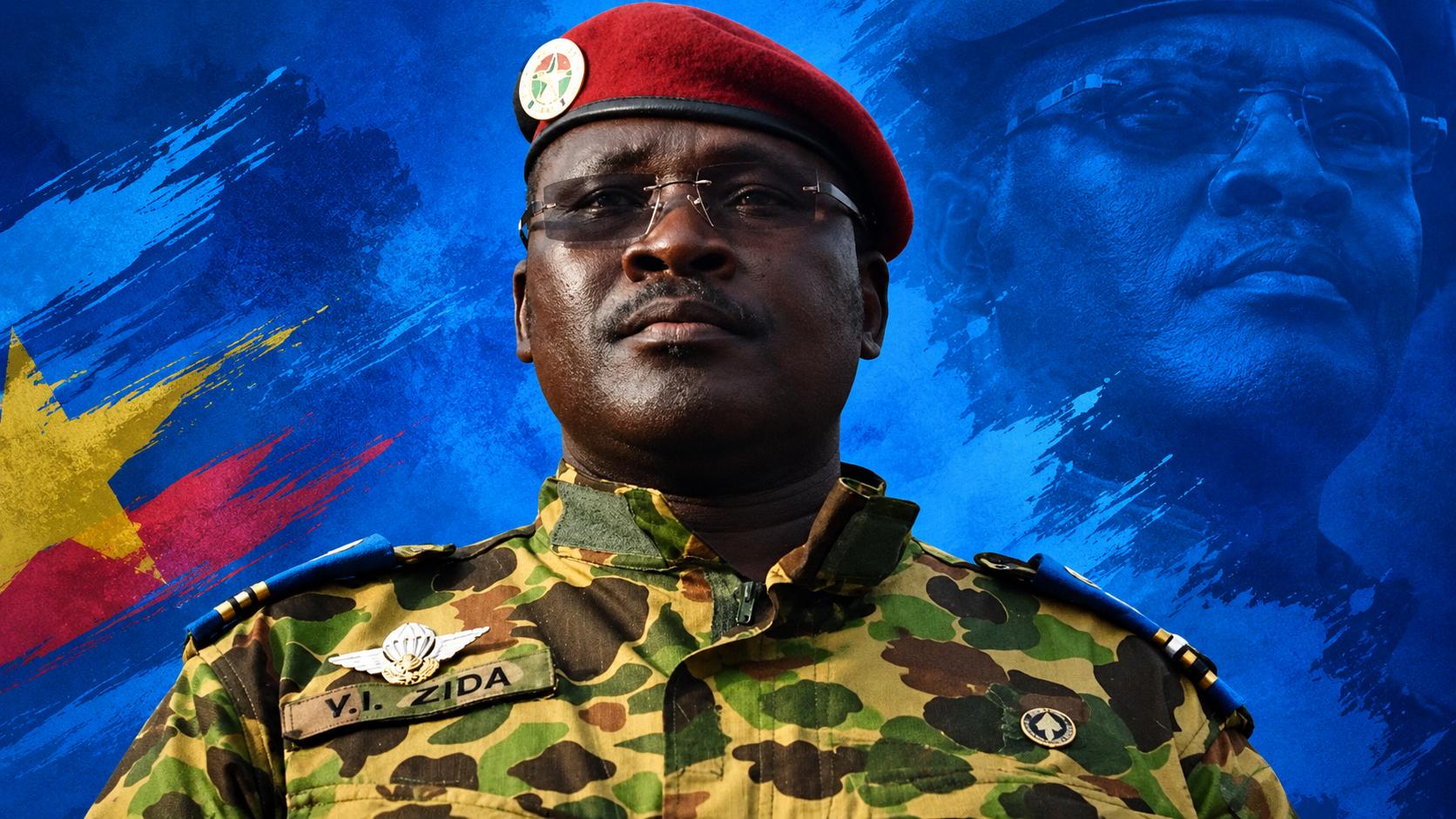
There is one sentence from General Yacouba Isaac Zida that cuts straight through the political theatre staged in Ouagadougou: real sovereignty, he argues, is not about picking which foreign power to lean on, but about building the capacity to lean on nobody at all. With that single observation, the former head of Burkina Faso’s transitional government turns the spotlight on the gap between Captain Ibrahim Traoré’s rhetoric and the record of his administration inside the Alliance of Sahel States (AES).
Zida himself is a man of contradictions. Stripped of his military rank for desertion and now living in exile, he is hardly a neutral observer. Yet his own trajectory mirrors the wider drift of a Burkinabè military class that keeps circling the same loop of instability, dashed promises and unfinished transitions.
A quote that exposes the hollowness of the sovereignty narrative
What makes the criticism sting is not who delivers it, but how neatly it fits the evidence. The rush to embrace Moscow under the banner of an “anti-imperialist break” looks less like liberation and more like a renegotiation of the terms of submission — new signatures on an old contract. Behind the populist slogans, the transitional government struggles to hide a chronic inability to construct genuine autonomy, and the country remains tethered to outside actors in four distinct ways.
Four chains that Ouagadougou never broke
Military dependence dressed up as doctrine
The ambition of fielding a truly national defence force collapses the moment foreign instructors and paramilitary operators are brought in on a systematic basis. Aircraft, ammunition and light armoured vehicles are routinely presented as locally manufactured when, in practice, they are merely assembled on site — proof that the entire supply chain still answers to external logistics.
Food dependence hidden behind crowds and cameras
Self-reliance rhetoric runs straight into hunger. The carefully staged ceremonies around shipments of Russian wheat, and the repeated appeals for international humanitarian aid to feed displaced communities, make one thing plain: the authorities cannot even guarantee the basic subsistence of their own citizens.
Money that comes with strings attached
Unable to fund its crisis budget from cleansed domestic resources, the military leadership falls back on financial improvisation and emergency loans from new geopolitical sponsors. The bill for that short-term survival will be handed to generations not yet born.
A technological dead end
Whether the subject is agricultural inputs or energy equipment, the absence of an independent industrial base leaves the country begging beyond its borders for what it cannot produce at home.
The Alliance of Sahel States: a banner over a broken house
The haste to assemble a confederal army and supranational institutions within the AES is a propagandistic flight forward rather than a strategy.
Supranational dreams before domestic control
Announcing the merger of regional sovereignties while large parts of the national territory remain beyond the state’s reach is strategic blindness. Securing populations and consolidating basic institutions should come first — not the stacking of empty shells.
Summits as political life insurance
A steady stream of conferences and fiery declarations serves primarily as a political shield for unelected governments of exception, crowding out rigorous and realistic planning.
Real sovereignty is not a change of guardian
Authentic independence is never displayed through military parades, nor measured by handouts of foreign grain. By replacing Paris with Moscow as its patron, Captain Traoré has not set Burkina Faso free. He has simply changed who holds the leash.
Comments are closed, but trackbacks and pingbacks are open.