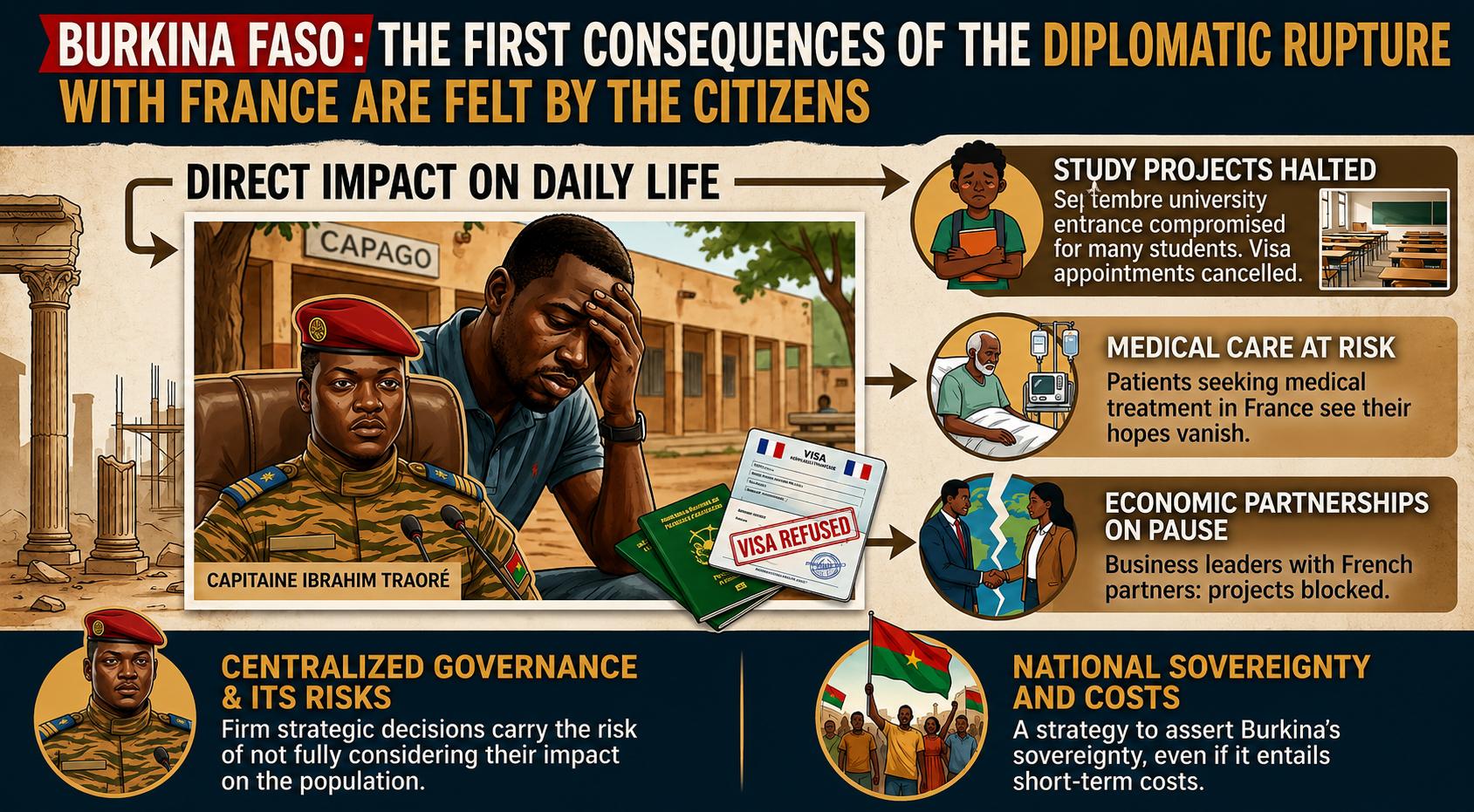
The decision to sever diplomatic ties between Burkina Faso and France is now manifesting tangible effects, extending beyond inter-state relations to profoundly influence the daily existence of numerous Burkinabè individuals.
In recent days, approximately 200 visa applicants, whose applications were already undergoing review, received summons to CAPAGO premises. There, they were presented with their passports accompanied by formal notifications of visa refusal. This development came as a considerable surprise to many who harbored expectations for a successful outcome to their requests.
Among those directly affected are patients awaiting critical medical treatment in France, entrepreneurs engaged in vital economic partnerships, students anticipating their university enrollment in September, and various other travelers whose plans have now been abruptly derailed. Concurrently, scheduled appointments for submitting new student visa applications have also been revoked, casting a shadow of uncertainty over countless families.
Beyond the immediate diplomatic crisis, this unfolding situation underscores a fundamental truth: decisions enacted at the highest echelons of state power can precipitate immediate and far-reaching repercussions for the general populace. Citizens, often detached from the direct formulation of diplomatic strategies, nonetheless find themselves confronting the tangible fallout of these policy shifts.
For certain observers, this scenario serves as an illustration of governance perceived as highly centralized under Captain Ibrahim Traoré. His detractors contend that strategic directives are issued with unwavering resolve, potentially without a comprehensive assessment of their full impact on segments of the population. They suggest that this approach to state affairs occasionally conveys the impression of a nation managed as a personal domain, where political imperatives eclipse the everyday challenges faced by its citizenry.
Conversely, proponents of Captain Traoré’s administration assert that these choices are integral to a broader strategy aimed at reinforcing Burkina Faso’s national sovereignty, even if such an orientation entails short-term costs.
Irrespective of the political interpretations surrounding this diplomatic severance, one undeniable reality persists: hundreds of Burkinabè today witness their aspirations for education, health, commerce, or travel unceremoniously brought to a halt. Behind the grand pronouncements of diplomatic policy lie individual lives, families, and ambitions, whose futures are now shrouded in profound uncertainty.
Comments are closed, but trackbacks and pingbacks are open.