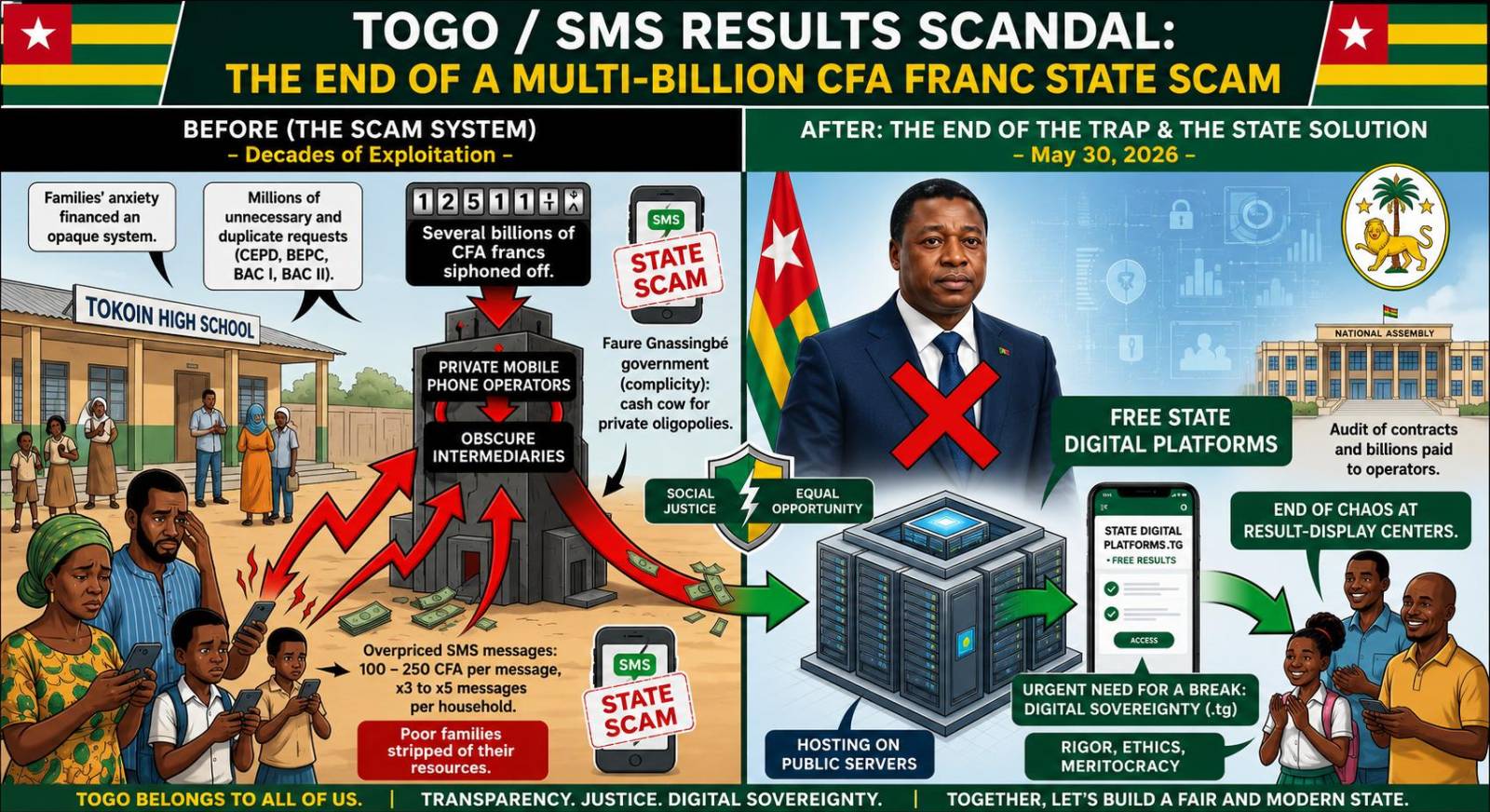
The Togolese education system has long operated as a financial drain on families, particularly those of modest means. With the abrupt decision to abolish exam result notifications via SMS, Education Minister Mama Omorou has exposed a decades-long financial scheme embedded within the system under the administration of President Faure Gnassingbé.
Unveiling a financial trap fuelled by parental anxiety
During an unannounced inspection on May 30, 2026, at the BAC I correction centers in Tokoin and Agoè-centre high schools, Minister Omorou condemned the SMS-based result consultation system as a fraudulent and wasteful practice. The minister’s assessment was blunt: this system was nothing short of a financial trap, designed to exploit the desperation of families awaiting their children’s exam outcomes.
The mechanism behind this scheme was both cynical and systematic. For each national examination—whether the CEPD, BEPC, BAC I, or BAC II—the same pattern unfolded. Families, gripped by anxiety, would send multiple overpriced SMS messages (each costing between 100 and 250 francs CFA) to retrieve identical results. This redundancy generated millions of redundant queries annually, siphoning off resources from households already burdened by financial hardship.
Billions drained from families over years of exploitation
While the minister has yet to release detailed financial audits, estimates based on demographic and usage patterns paint a staggering picture. With hundreds of thousands of candidates sitting for national exams each year and each household sending between three to five SMS messages per candidate, the total volume of messages per session reaches tens of millions.
Extrapolating these figures over the past 15 to 20 years of the current administration reveals a monumental financial hemorrhage: billions of francs CFA extracted from the pockets of Togolese families. Yet, this staggering sum never reached the public education system. Instead, it lined the pockets of private telecom operators and shadowy intermediaries, who operated under state-granted concessions that remained unchallenged for years. This amounted to a scandalous transfer of wealth from the vulnerable to private oligopolies, facilitated by the passive or complicit approval of outgoing authorities.
Transitioning to ethical digital platforms
Minister Omorou’s decision to end SMS-based notifications is a necessary first step, but it presents a significant challenge: ensuring a smooth transition without reverting to the chaos of crowded, anxiety-inducing gatherings outside exam centers where results were traditionally posted.
Togo, which has long touted its digital integration strategy—particularly through the Ministry of Digital Economy—must now prioritize the establishment of secure, state-run, and free digital platforms for result dissemination. This move would align with the country’s digital sovereignty goals.
Key requirements for this transition include:
- State-hosted infrastructure: Exam results should be stored on public servers under the .tg domain, managed and secured by the government.
- Transparent access: Consultation must be entirely free, financed through the national education budget to ensure fairness and equal opportunity.
- Modern dissemination: Results can be published in waves via email or lightweight web portals optimized for mobile devices, a cost-effective and technologically straightforward solution.
A call for ethical reform in education
Beyond the financial scandal, Minister Omorou used the inspection tour to re-energize the morale of examiners, emphasizing the need to restore rigor, ethics, and meritocracy as the guiding principles of the Togolese education system.
This announcement signals a major ideological shift. By shielding families from these institutionalized fraudulent practices, the Ministry is laying the groundwork for an education system rooted in social justice. The critical question now is whether the government will demonstrate the resolve to follow through, including auditing past contracts with telecom operators to uncover the full extent of the financial drain that has robbed generations of Togolese youth of resources meant for their future.