Two French nationals were recently apprehended in northern Togo, a development that has cast a harsh light on the country’s deteriorating governance. Incarcerated for days by intelligence services before being formally charged this Monday, their detention appears to have been ordered directly by President Faure Gnassingbé. According to reports, the president allegedly instructed his Justice Minister, Pacôme Adjourouvi, to « resist any external pressure » concerning their case.
Governance in freefall: who truly holds power in Togo?
The incident extends beyond mere diplomatic friction, exposing a deeper crisis: the erosion of Togo’s institutional foundations. A critical question now looms over the country: which authority wields genuine control, and on what legal basis?
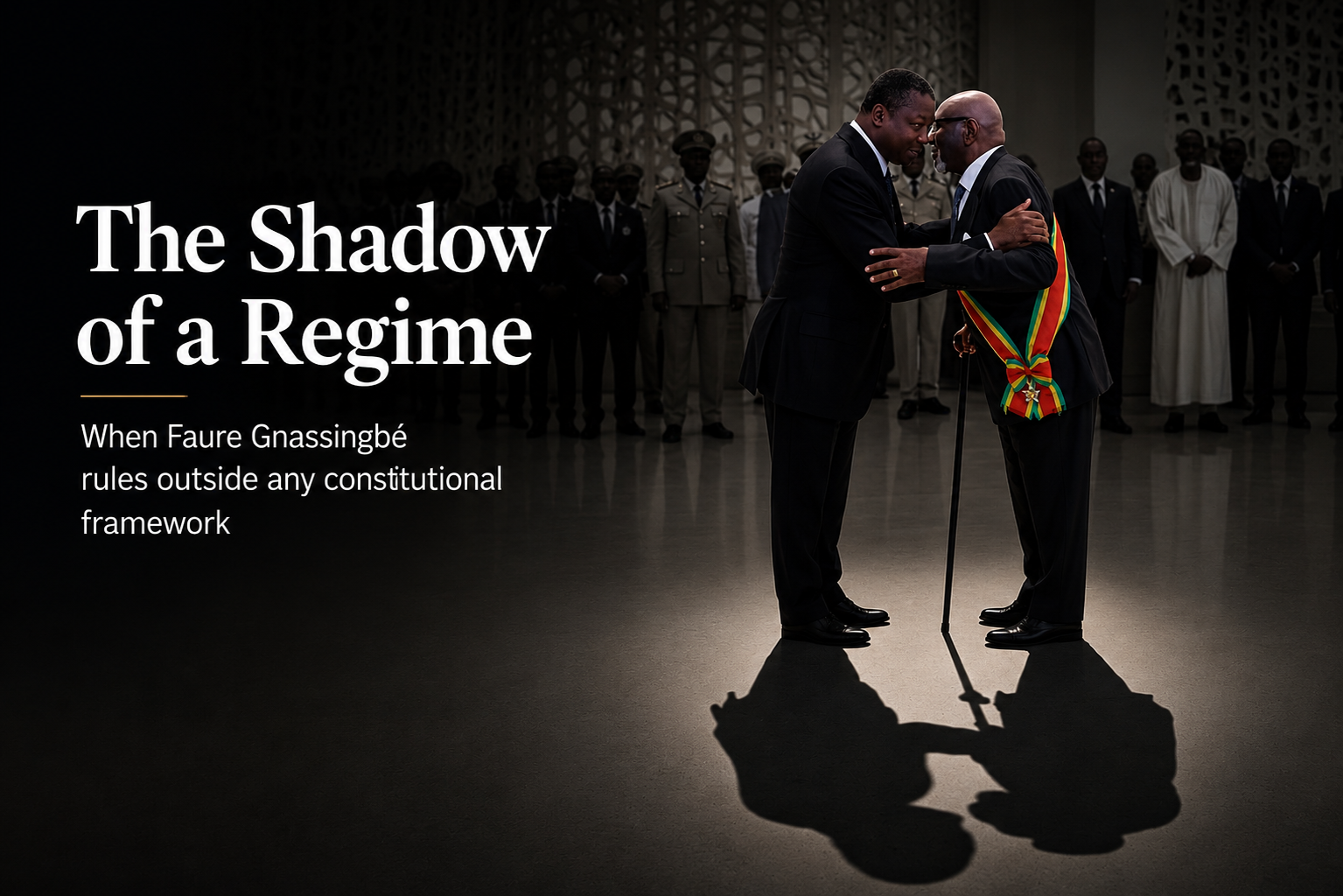
The transformation of Togo’s political structure under Faure Gnassingbé has blurred the lines of governance to the point of absurdity. Through a constitutional amendment and the appointment of a nominal President (Jean-Lucien Savi de Tové), Gnassingbé has quietly repositioned himself as president of the Council a title that concentrates executive authority while maintaining the appearance of institutional compliance. This unprecedented legal maneuver effectively reduces official titles to hollow symbols beneath the weight of concentrated power.
A system rigged for permanence
The 2024 constitutional reform, rammed through a parliament dominated by the ruling UNIR party, abolished the presidential system in favor of a parliamentary model. Under this arrangement, the ceremonial presidency serves no real function, while the office of Council President occupied by Gnassingbé since May 3, 2025 controls all key levers of state power: national policy, military command, civil and military appointments, international representation, and regulatory authority. The most alarming feature? No term limits apply to this role.
The architect of this system is the president’s own party. With 108 out of 113 parliamentary seats (following 2024 elections widely boycotted by opposition forces), the UNIR enjoys near-total dominance. The result is not democracy, but a dynastic perpetuation dressed in legislative legitimacy. The constitution’s previous two-term limit has been rendered meaningless.
Judicial system hijacked for political ends
The detention of two French journalists Sébastien Perez Pezzani and Gaël Mocaër, arrested while filming for France Télévisions is only the latest in a pattern of politically motivated detentions. Intelligence services and the Ministry of Justice have increasingly operated as extensions of executive command, with orders allegedly bypassing judicial independence. When the head of state dictates verdicts to magistrates, the separation of powers becomes a fiction.
This practice extends to broader governance: the suppression of June 2025 protests, the persecution of dissenting voices, and the selective enforcement of laws all bear the hallmarks of politically driven justice. The law is no longer an impartial framework but a tool manipulated to serve immediate political needs.
Legitimacy in question: a silent coup against democracy
Togo’s constitutional transformation was not submitted to public referendum. Legislative elections took place amid widespread discontent and boycotts. Even the Senate a third of whose members are appointed by the Council President reinforces the concentration of power. Institutions exist in name only; the true locus of authority remains in the hands of one individual. Faure Gnassingbé, now Council President, retains command of the armed forces and final decision-making power.
What was once a constitutional transition has become a consolidation of personal rule. Titles change, protocols multiply, but the center of power does not: it remains firmly in the hands of Gnassingbé.
A powder keg of institutional decay
When arbitrary rule trumps legal order and institutions serve only as window dressing, the social contract frays. Togo is no longer debating a constitutional disagreement; it is confronting a regime actively dismantling the foundations of republican governance.
The question is no longer simply « who governs? » but « how long can such a system endure before internal contradictions or popular unrest force a reckoning? » The stakes are not abstract—they define the future of a nation.
Comments are closed, but trackbacks and pingbacks are open.