Traditional leaders in Benin: pillars of culture and guardians of identity
In Benin, traditional leaders hold a vital place in both socio-cultural and institutional spheres. They serve as living embodiments of local values, traditions, and identities, while also representing moral and cultural legitimacy within their communities. Their roles extend beyond symbolism, as they often play key parts in conflict resolution and social cohesion, reinforcing their significance in the nation’s fabric.
The Béninese government has formalized this recognition through legal frameworks. The Law No. 2025-09 of April 3, 2025, which governs traditional chieftaincies, categorizes and legally recognizes 16 kingdoms and 90 traditional chieftaincies. This legislation not only acknowledges their contributions to socio-economic development and cultural preservation but also highlights their influence in maintaining social cohesion across the country. The law’s adoption reflects the state’s commitment to integrating traditional leadership into the nation’s governance structure while preserving its cultural essence.
Public perception: trust in traditional leaders meets growing concerns
A recent survey reveals that nearly a quarter of Béninese citizens reached out to traditional leaders within the past year, underscoring their enduring relevance. The majority of respondents express confidence in these leaders, viewing them as influential figures in local governance. Many citizens even advocate for a stronger role for traditional leaders in community decision-making processes.
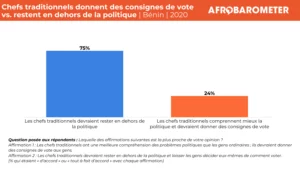
However, this positive perception is tempered by concerns over integrity. A striking three-quarters of respondents believe that some traditional leaders are entangled in corruption, a sentiment that has grown since 2022. Confidence in these leaders has also seen a decline compared to 2020, signaling a shift in public trust. Despite their cultural and moral authority, citizens overwhelmingly agree that traditional leaders should refrain from partisan politics, allowing voters to exercise their choices freely.
Balancing tradition and politics: the challenge of neutrality
Traditional leaders in Benin have historically been courted by political parties, often wielding influence over electoral outcomes. In exchange for their support, some have reportedly received material or financial benefits, raising questions about their impartiality. To address these concerns, the government has implemented strict regulations prohibiting traditional leaders from engaging in partisan political activities. This move aims to preserve their moral authority and ensure they remain neutral arbiters within their communities.
The evolving role of traditional leaders in Benin reflects a delicate balance between cultural reverence and political neutrality. While their influence in governance and social cohesion remains undeniable, the public’s growing skepticism highlights the need for transparency and accountability. As Benin navigates this complex landscape, the future of traditional leadership will likely depend on its ability to uphold its cultural mandate while navigating the pressures of modern governance.
Comments are closed, but trackbacks and pingbacks are open.