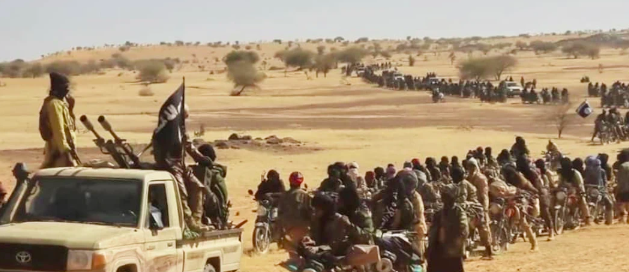
The United Nations has issued a stark warning about the rising threat of terrorism in Africa, with the Islamic State (ISIS) group expanding its reach across the Sahel and the Lake Chad basin. These regions have become critical hotspots for the group’s activities, despite efforts to curb its influence.
This critical assessment was delivered by UN Secretary-General Antonio Guterres in a recent report to the UN Security Council, highlighting that the terror threat remains alarmingly high in parts of the continent where ISIS-affiliated factions are growing stronger.
ISIS branches gain autonomy, exploiting local vulnerabilities
The report, presented by Oguljeren Niyazberdiyeva of the UN Office of Counter-Terrorism (UNOCT), identifies the Sahel and the Lake Chad basin as the primary expansion zones for ISIS, particularly its West African affiliate, the Islamic State’s West African Province (ISWAP).
According to the findings, ISWAP has evolved into ISIS’s most operationally active branch globally. The group has adapted its tactics, increasingly using commercial drones to enhance surveillance and launch attacks, demonstrating a shift toward decentralized yet lethal operations.
The document also points to ongoing offensives by ISIS-linked factions in the Democratic Republic of the Congo (DRC) and Mozambique, despite pressure from national and regional forces. These groups continue to recruit fighters, strengthen local networks, and exploit socio-economic instability to sustain their activities.
Decentralized networks pose new global security challenges
Oguljeren Niyazberdiyeva emphasized that ISIS has fundamentally restructured its operations to survive military campaigns, transforming into a loosely connected network of regional affiliates bound by a shared ideology. This evolution allows the group to adapt to local contexts, even as its central leadership weakens.
The report underscores how ISIS exploits institutional weaknesses, prolonged conflicts, and economic hardships to deepen its presence. While international counter-terrorism efforts have degraded the group’s central command, the threat persists in the form of autonomous cells operating independently yet aligned with ISIS’s objectives.
Emerging technologies fuel terror tactics
The UN highlights a concerning trend: ISIS is increasingly leveraging cutting-edge technologies to enhance its operations. The group now employs artificial intelligence, encrypted communications, digital platforms, virtual assets, and unmanned drones to refine its propaganda, recruitment, financing, and attack planning.
This technological integration poses a dual challenge. While these tools enable ISIS to operate more efficiently, they also offer opportunities for responsible use by security forces and international partners to disrupt and dismantle terror networks. The report calls for stronger international cooperation, including collaboration with tech companies and private sectors, to regulate and govern emerging technologies responsibly.
The document concludes that, despite significant setbacks, ISIS remains a grave threat to international peace and security, adapting to global pressures with alarming resilience.
Comments are closed, but trackbacks and pingbacks are open.