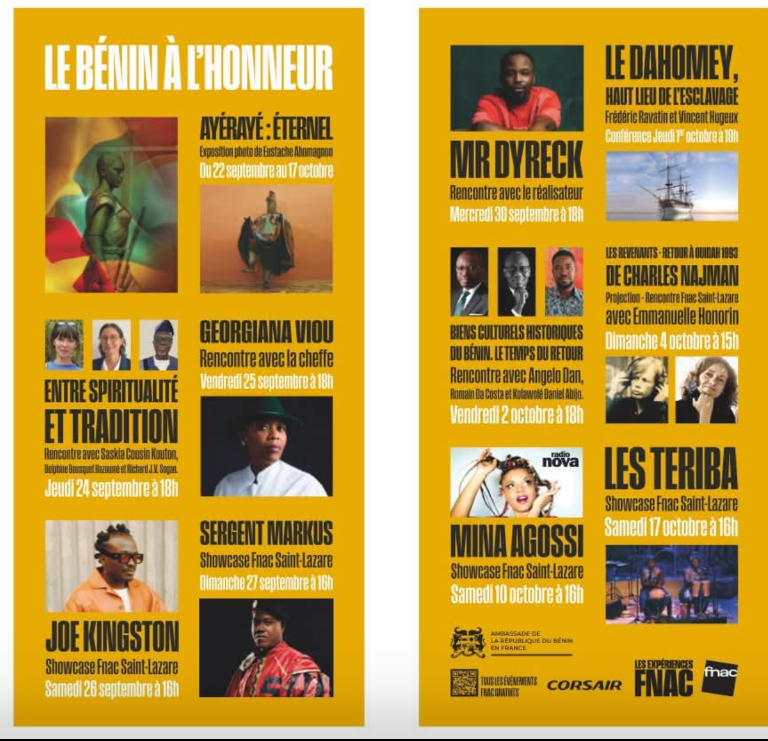
For twenty-six days, from 22 September to 17 October 2026, the Fnac Paris Saint-Lazare will turn its third-floor forum into a showcase for Benin. Exhibitions, talks, debates, film and music make up a programme designed to connect history, memory, spirituality and contemporary creation. The stakes go well beyond a cultural showcase: for the Beninese diaspora in France, for Parisian businesses around the store, and for the cultural economy that links West Africa to Europe, the consequences are concrete and measurable.
A month-long window on Benin in the heart of Paris
Paris will live to the rhythm of Benin for almost four weeks. From 22 September to 17 October 2026, Fnac Saint-Lazare is dedicating an exceptional series of events to the West African country, with a line-up focused on its history and culture. Organised with the support of the Embassy of the Republic of Benin in France for several of the announced events, the initiative will mainly occupy the meeting forum on the store’s third floor.
Far from a folkloric display, the programme sets out to explore several sides of Benin: its spiritual traditions, its past linked to the Kingdom of Dahomey and the slave trade, questions of cultural restitution, but also contemporary artistic creation, literature, gastronomy and current music.
A memory told through images
The opening on 22 September will feature the photographic exhibition “Ayérayé: Éternel”, devoted to the work of Beninese photographer and designer Eustache Ahomagnon. Until 17 October, visitors will be able to discover a body of work located at the crossroads of photography and textile creation.
The artist explores memory, spirituality and contemporary creation through the world of the Egungun, figures linked to ancestor worship among the Yoruba. The images engage in dialogue with textile creations inspired by the forms, materials and movements associated with these traditions.
This exhibition immediately sets the tone for the programme: showing a Benin that is both deeply attached to its heritage and resolutely turned towards contemporary creation.
Spirituality, traditions and authors’ voices
On 24 September, a discussion will bring together Saskia Cousin Kouton, professor of sociology and author, journalist Delphine Bousquet Hazoumè and researcher Richard J.V. Sogan. They will exchange views on spirituality, traditions and several works devoted to Beninese heritage.
The following day, the public will meet chef Georgiana Viou. Born in Benin, she will recount her career and present her book “Oui cheffe ! Du Bénin à l’étoile Michelin. Itinéraire d’une battante”. Her journey also allows gastronomy to be approached as a space for cultural transmission: Beninese products and flavours continue to accompany her work, right through to a cuisine built between several influences.
Music will then take over. On 26 September, Beninese artist Joe Kingston will offer a showcase around his “Afro futur vibes” universe, where hip-hop meets contemporary African influences. The next day, poet and slam artist Sergent Markus will present his album “Vodun Gospel”, a project nourished in particular by musical references from vodun culture.
From Dahomey to the restitution of works
The programme will also address the most sensitive pages of Beninese history.
On 1 October, a discussion will be devoted to Dahomey and the history of slavery. Writer and journalist Vincent Hugeux will talk with Frédéric Ravatin, engineer and scientific scenographer, notably about the work carried out around the “Bateau de la Mémoire” in Ouidah, conceived as a memorial device dedicated to the slave trade.
The next day, the question of the restitution of cultural property between France and Benin will be at the centre of discussions. Ambassador Angelo Dan, Romain Da Costa and heritage curator Kolawodé Daniel Abidjo will look back at a historic process that has profoundly marked cultural relations between the two countries.
This choice of themes gives the event a particularly strong historical and memorial dimension. It is no longer just about presenting works or artists, but about questioning the way a country tells its past, preserves its heritage and builds its relationship with the world.
Cinema as a link between memory and present
On 4 October, cinema takes centre stage with the screening of “Retour à Ouidah 1993. Les Revenants”, a documentary by Charles Najman devoted to the return to Ouidah, a city intimately linked to the history of vodun and to that of the African diaspora resulting from the slave trade. The screening will be followed by a discussion with journalist, producer and programmer Emmanuelle Honorin.
Through this film made in the context of the Ouidah 92 Festival, the programme will thus bring images of the past into dialogue with contemporary questions about memory, identity and the links between Benin and its diaspora.
A contemporary scene very much present
Current creation will not be forgotten. On 30 September, a carte blanche will be devoted to director, co-producer and cinematographer Mr DYRECK. His work, produced between Benin and France, bears witness to a new generation of artists who use images to tell West Africa differently.
On 10 October, music will take on a new dimension with the arrival of singer and jazz artist Mina Agossi, invited to present her album “Dynamic. Tribute to Dinah Washington”.
Finally, on 17 October, the programme will close with a showcase by the group Teriba, presented as Benin’s first female music group. Created in 2002, the collective became known in particular for its work around a cappella singing and its desire to promote Beninese cultural heritage.
Paris, crossroads of Beninese cultures
Through this succession of events, Fnac Saint-Lazare is transforming its Parisian space into a genuine showcase dedicated to Benin for almost four weeks. From photography to gastronomy, from slam to jazz, from cinema to history, the programme draws a plural portrait of a country whose heritage continues to feed contemporary creation.
It also reminds us that Beninese culture cannot be reduced to a fixed heritage. It is transmitted, reinvented and discussed. Between vodun traditions, the memory of Dahomey, the history of the slave trade, debates on the restitution of works and new artistic expressions, it is ultimately a whole narrative of Benin that is invited to the heart of Paris.
All announced events are free of charge, subject to availability. Fnac Saint-Lazare thus invites the curious, lovers of African culture, members of the Beninese diaspora and, more broadly, anyone who wishes to discover or rediscover a country whose history and creation occupy a singular place in cultural exchanges between Africa and France.
Comments are closed, but trackbacks and pingbacks are open.