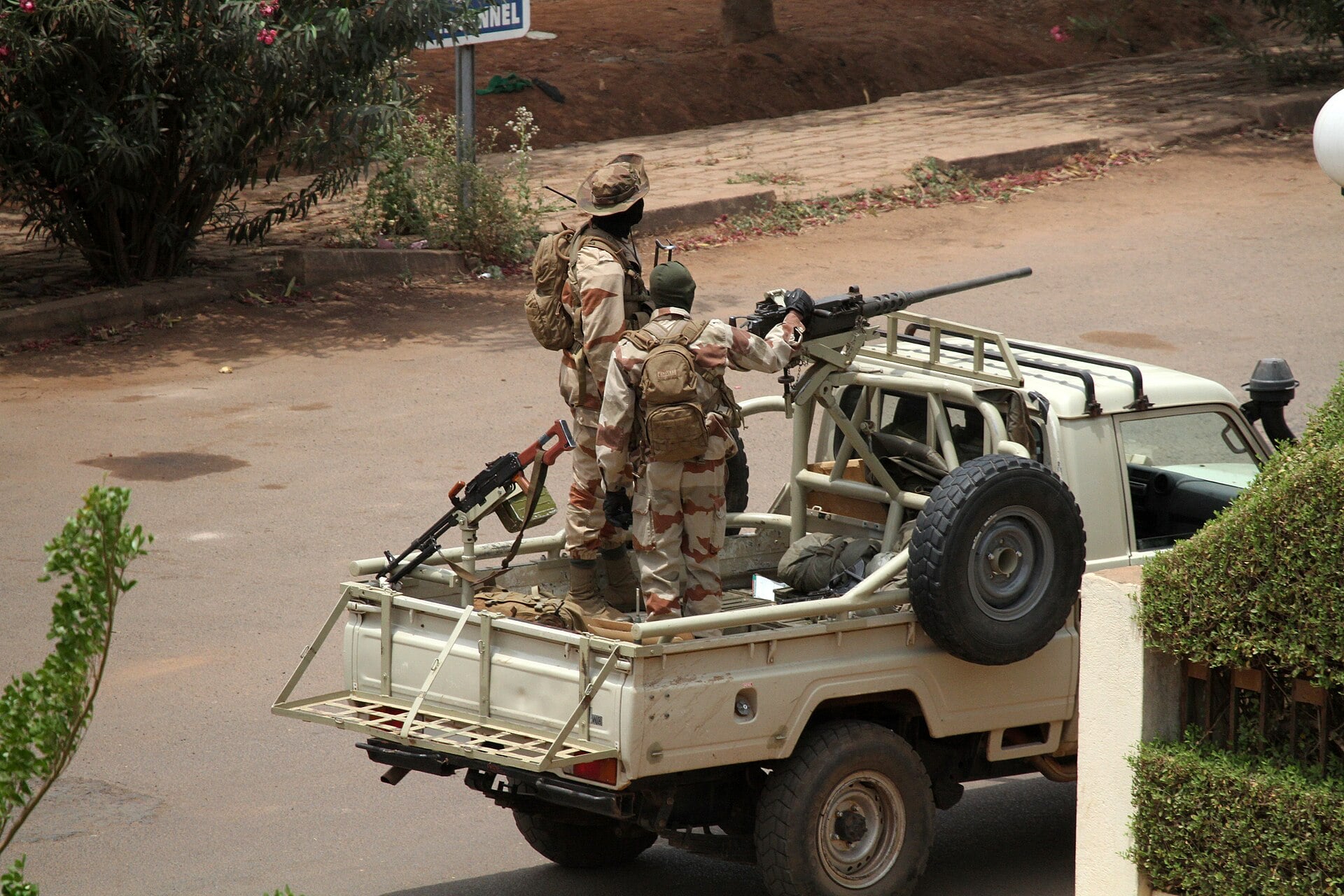
On April 25, Mali witnessed an unprecedented coordinated assault that transcended its decade-long conflict. Islamist militants and Tuareg separatists executed simultaneous strikes on military outposts and civilian hubs, seizing control of Kidal—a northern stronghold—and extending their reach toward Bamako. For the wider Sahel region, particularly Algeria, the crisis has shifted from a question of if instability will spread, to when and how it must be contained.
The junta’s risky security gamble
The path to Mali’s current turmoil traces back to 2021, when a military junta under Colonel Assimi Goita dismantled French military presence, expelled the UN’s MINUSMA peacekeeping force, and enlisted Wagner Group mercenaries—now under Russian state command—as its primary defense partner. Critics in the West cautioned that severing ties with traditional allies would create a dangerous security void. The junta dismissed these concerns as interference, but the April offensive proved their fears justified.
Far from delivering the decisive counter-insurgency advantage promised, Wagner’s forces were expelled from Kidal, a town steeped in historical importance as the cradle of Tuareg resistance. Rather than crumbling under Russian firepower, militant factions demonstrated remarkable adaptability, coordination, and resilience. Mali’s leadership traded critical French logistical support and regional institutional expertise for Russian firepower—only to discover that firepower alone cannot counter an insurgency growing increasingly sophisticated.
The emergence of a tactical alliance between Islamist groups and Tuareg separatists marks another alarming development. Historically, these factions clashed over control of Mali’s ungoverned north. Their current collaboration signals a shared assessment: the junta’s grip is weakening, and both groups see an opportunity to apply simultaneous pressure. So far, their calculations appear accurate.
Algeria’s growing security dilemma
No neighboring country feels Mali’s collapse more acutely than Algeria. The two nations share a long, porous border that has long served as a conduit for weapons, drugs, human trafficking, and militant recruitment. Algerian officials know all too well that unchecked instability does not respect borders—it spreads, mutates, and eventually threatens national security.
The irony deepens when considering Algeria’s past diplomatic role. Algiers positioned itself as the region’s key mediator, brokering the 2015 Algiers Peace Agreement between Bamako and Tuareg representatives. That accord collapsed in early 2024 when Colonel Goita formally withdrew, a move perceived in Algiers as a deliberate snub. Tensions escalated further in March 2025 when Algerian forces intercepted and shot down a Malian drone near the shared border, sparking a diplomatic rift with Bamako and its allies—Burkina Faso and Niger—all part of the Russia-aligned Alliance of Sahel States.
Today, Algeria faces a paradox: it is the country most exposed to Mali’s crisis, yet it has been diplomatically sidelined from resolving it. It lacks the leverage to impose a solution on a junta that now views it with hostility, and it cannot afford to remain passive. The stakes are existential—permanent militant sanctuaries along Algeria’s southern frontier could destabilize internal security and spill over into domestic instability.
In a public statement, Algerian Foreign Minister Ahmed Attaf reaffirmed support for Mali’s territorial integrity and condemned terrorism unequivocally. Yet, without functional diplomatic channels, principled declarations cannot fill the void left by lost communication.
Washington’s withdrawal and the rise of vacuums
The Sahel’s unraveling is also a story of American disengagement. Under pressure from governments aligned with Moscow, the United States reduced its counter-terrorism footprint across West Africa, failing to replace it with a coherent alternative strategy. The result? A strategic void that Russia has partially filled through military contractors, while Islamist networks have filled more comprehensively by establishing governance structures, tax systems, and recruitment networks in areas abandoned by the state.
The lesson unfolding in real time in Mali should serve as a wake-up call for Washington. Military cooperation, intelligence exchange, and sustained counter-terrorism efforts are not optional luxuries—they are prerequisites for regional stability. When they vanish, the vacuum is not left empty. It gets filled by hostile forces.
Three possible futures for Mali—and the region
Three potential outcomes now loom over Mali’s trajectory. The junta could pursue a negotiated settlement with Tuareg factions, halting further territorial losses but conceding significant ground in the process. Alternatively, it could escalate military action, relying on Russian air and ground support to contest northern regions—though the long-term prospects remain uncertain. A third possibility is a continuation of tactical retreats and rhetorical defiance, with Bamako itself becoming a contested zone if current trends persist.
For Algeria, all three scenarios carry grave implications. The Sahel’s collapse is no longer a distant humanitarian issue—it is unfolding at the doorstep. The time for reactive measures has passed; proactive, coordinated regional action is now essential to prevent a full-scale security meltdown.
Comments are closed, but trackbacks and pingbacks are open.