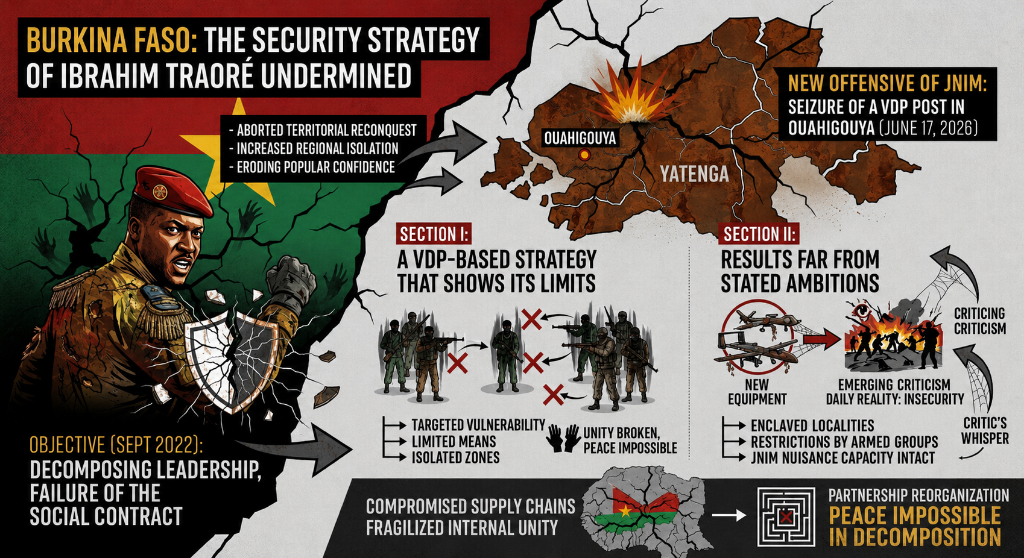
The security landscape in Burkina Faso continues its concerning deterioration. The Group for the Support of Islam and Muslims (JNIM), an organization with ties to Al-Qaeda in the Sahel region, has claimed responsibility for overwhelming a post manned by the Volontaires pour la défense de la patrie (VDP) during an assault on June 17, 2026. This incident occurred in the Ouahigouya area, the administrative center of Yatenga province in the northern part of the nation.
This recent offensive represents a further setback for the territorial reconquest strategy championed by the transitional authorities. Having assumed power in September 2022 with a firm commitment to restoring the country’s territorial integrity, Captain Ibrahim Traoré now faces escalating scrutiny regarding the efficacy of his security paradigm.
A VDP-centric strategy revealing its limitations
To address the numerical deficiencies within the regular army, the authorities have placed considerable reliance on the Volontaires pour la défense de la patrie. However, these civilian units, frequently deployed in isolated locales and operating with constrained resources, have increasingly become prime targets for armed factions.
The Ouahigouya attack is the latest in a series of reversals recorded over recent months. Despite ongoing military operations across the terrain, several positions remain persistently challenging to secure. Numerous experts on the Sahel region contend that the JNIM retains substantial operational capacity and considerable freedom of movement throughout the northern and eastern provinces.
Outcomes falling short of stated ambitions
The transitional authorities regularly highlight perceived advancements and the acquisition of new military assets, including surveillance and combat drones. Nevertheless, for a segment of the populace, insecurity persists as an everyday reality. Several communities remain isolated, and certain areas continue to endure restrictions imposed by armed groups.
In this challenging environment, criticisms are mounting concerning the effectiveness of the current security policy. The fundamental rationale that underpinned the overthrow of civilian rule in 2022 — the perceived inability to ensure the protection of citizens — is once again at the forefront of public discourse.
As Ouagadougou proceeds with the realignment of its partnerships within the Confédération des États du Sahel (AES) and plans to intensify its operations throughout 2026, the assault in Yatenga serves as a stark reminder of the inherent difficulty in resolving an asymmetric conflict through military means alone.
Comments are closed, but trackbacks and pingbacks are open.