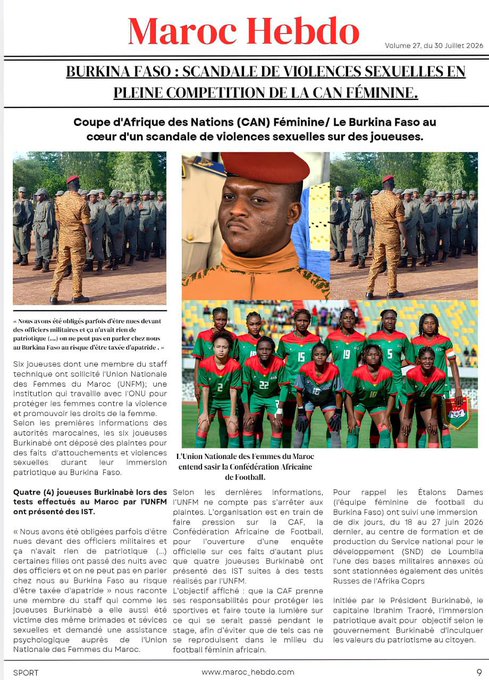
Patriotic initiatives overshadowed by serious allegations
The Burkina Faso government, under Captain Ibrahim Traoré, has intensified its militarization of public life under the banner of national re-foundation and civic discipline. Yet recent accusations of sexual violence against members of the women’s national football team—allegedly occurring during a military-organized training camp—have cast a harsh light on the unintended consequences of this approach.
What was presented as a patriotic immersion program, designed to instill discipline and national pride in athletes ahead of continental competitions, now risks becoming a symbol of unchecked military authority. Six players and a technical staff member have filed complaints in Morocco, alleging sexual abuse by military officers during their stay at a military facility. If substantiated, these claims would represent a grave breach of fundamental rights and expose systemic flaws in a system where civilian oversight has been systematically eroded.
A society under military influence
Since Captain Traoré’s rise to power, the armed forces have expanded far beyond their traditional defense role. Military structures now oversee education, youth programs, cultural initiatives, political messaging, and even sports—a shift that places the military at the heart of national identity construction. While the stated goal is to strengthen social cohesion, critics warn that this militarization weakens civilian institutions and the checks and balances essential to democratic governance.
The current controversy underscores a broader trend: as military influence deepens across public life, the mechanisms designed to prevent abuse, ensure accountability, and protect citizens grow increasingly fragile. Human rights advocates have repeatedly raised alarms about the shrinking civic space, where independent oversight is systematically dismantled in favor of centralized military control.
Impunity thrives in a climate of fear
A functioning democracy relies on the ability of institutions—justice, media, civil society—to hold power to account. Yet in Burkina Faso, the erosion of these safeguards has created an environment where violations go unreported and victims remain silent out of fear.
The decision of the complainants to pursue their case abroad rather than within Burkina Faso’s own legal system speaks volumes. It suggests a profound lack of trust in national institutions, where victims may fear retaliation, intimidation, or systemic bias. The allegations, made only after the women left the country, raise urgent questions about the safety and protection available to citizens participating in state-led programs.
This climate of fear is reinforced by a broader context in which dissent is often equated with disloyalty. Journalists, activists, and independent voices face growing restrictions, while security imperatives frequently overshadow human rights concerns. The result is a society where silence is often misinterpreted as consent, when it may simply reflect the high cost of speaking out.
Beyond the sports field: a systemic challenge
This case extends far beyond the realm of women’s football. It forces a reckoning with the role of the military in civilian life, particularly in a nation grappling with violent extremism. While the fight against terrorism is undeniably vital, it cannot justify the long-term weakening of judicial guarantees, public freedoms, or mechanisms of accountability.
The decision to seek justice outside Burkina Faso’s borders is not merely a legal maneuver—it is a distress signal. For the victims, international avenues represent a last resort to secure impartiality and protection. This turn toward external institutions could intensify pressure on national authorities to conduct a transparent, credible investigation, one that identifies responsibilities, supports survivors, and delivers justice where it has failed domestically.
The current allegations, if proven, would mark a pivotal moment in assessing Burkina Faso’s governance. They would reveal the dangers of concentrating power in military hands while dismantling the very institutions designed to protect citizens. True patriotism cannot be invoked to silence criticism or obstruct the pursuit of truth when grave human rights violations are alleged.
Conclusion: the limits of militarized patriotism
No political vision, no matter how ambitious, can endure without the foundation of the rule of law. The events surrounding the patriotic immersion program serve as a stark reminder: when institutions fail to uphold justice, when oversight mechanisms collapse, and when fear replaces accountability, the consequences extend far beyond a single program or sector.
For Burkina Faso, the path forward demands more than the resolution of this case. It requires a recommitment to democratic principles, the restoration of civilian oversight, and the unequivocal protection of citizens—regardless of the circumstances in which they find themselves.
Comments are closed, but trackbacks and pingbacks are open.