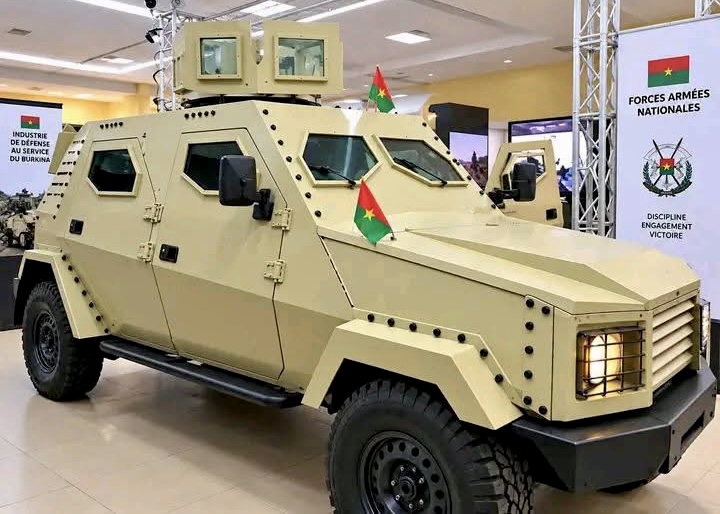
In a bold assertion last September, Burkina Faso’s military leader Ibrahim Traoré announced the production of nearly 300 armored vehicles since November 2025 through Faso Armored, a company shrouded in secrecy. The announcement, made during an interaction with female science laureates, has since sparked intense debate over the veracity of Burkina Faso’s ‘Made in Burkina’ industrial narrative. Critics are now questioning whether Faso Armored’s claim aligns with the realities of national production.
Military sources reject the official narrative
The official account describes Faso Armored as a fully Burkinabè-owned entity responsible for manufacturing armored vehicles for the country’s defense and security forces. However, a high-level military source reveals a different, far less flattering picture. According to this account, the so-called new production is rooted in the repurposing of decommissioned South African-made Casspir vehicles, which were originally deployed in peacekeeping missions in Darfur under the UNAMID framework. Many of these Casspir units were rendered inoperable due to mechanical failures, prompting a localized effort to restore them.
When repairs failed to restore the Casspirs to full functionality, an alternative approach was adopted: salvaging usable components from these vehicles and adapting them to locally available pick-up trucks. This process involved cutting, modifying, and reinforcing structures to create protected vehicle cabins. While this demonstrates a certain level of technical adaptability, it falls short of constituting true armored vehicle production, which requires a robust industrial supply chain and manufacturing infrastructure. The revelation challenges the government’s portrayal of Faso Armored as a groundbreaking national achievement in defense manufacturing.
From Chinese imports to rebranded vehicles: the pattern of fabrication
This isn’t the first time Burkina Faso’s defense narrative has been called into question. In late 2024, images of ‘Made in Burkina’ armored vehicles circulated widely, only to be traced back to imports from China. The vehicles in question, produced by the Chinese manufacturer Norinco, were presented as locally manufactured products, misleadingly framing foreign acquisitions as domestic productions. Social media amplification played a significant role in this campaign, amplifying the illusion of self-sufficiency in defense production.
More recently, the ‘Made in Burkina’ trademark was applied to ITAOUA electric vehicles, which were officially unveiled in January 2025. At the ceremony, officials and media hailed these vehicles as a symbol of Burkina Faso’s technological leap. However, closer inspection revealed that ITAOUA’s models were essentially rebadged versions of existing Chinese designs, specifically the Dongfeng Nano Box and Dongfeng Nammi Box. The vehicle’s chassis, mechanics, and even branding had been repackaged under a Burkinabè label, underscoring a pattern of using rebranded imports to project an image of industrial innovation.
Digital disinformation: a backdrop to the armored claims
The controversy surrounding Faso Armored’s 300 armored vehicles cannot be examined in isolation from the broader context of disinformation tied to Ibrahim Traoré’s regime. Over the years, a network of false narratives has flourished online, ranging from fabricated endorsements by international celebrities to entirely fictional diplomatic meetings. Deepfake videos and AI-generated content have been used to propagate a cultivated image of Traoré as a globally revered leader, with fabricated scenes of him meeting world leaders and receiving accolades. Such fabrications have amplified public skepticism, making it increasingly difficult to separate fact from fiction in official communications. This climate of distrust casts further doubt on the military leadership’s claims regarding armored vehicle production.
AI-generated endorsements fuel public skepticism
Among the most circulated disinformation efforts is a series of deepfake videos featuring prominent global figures, including former U.S. President Barack Obama, singing Traoré’s praises or participating in fictional dialogues with him. Another widely shared video falsely claims a commercial flight attendant requested Traoré to relinquish his seat to a French businessman, further embedding a narrative of international recognition and influence. These instances of disinformation have blurred the lines between reality and fabrication, reinforcing the public’s cautious reception of government claims — including those about Faso Armored’s armored vehicle production.
What’s next for Burkina Faso’s ‘Made in Burkina’ narrative?
The revelations about Faso Armored’s armored vehicles have thrown the government’s industrial narrative into sharp relief. While the regime presents this production as a milestone in national sovereignty and self-reliance, military and independent sources paint a picture of improvisation, recycling, and strategic communication. The question remains: Can Burkina Faso’s ‘Made in Burkina’ claim withstand scrutiny, or will it further erode public trust in official narratives?
The government’s next steps in addressing these concerns will be closely watched. Will Faso Armored open its facilities for independent verification? Will the military leadership provide transparent details about the sourcing of components and the industrial processes involved? Without clear answers, the skepticism surrounding these claims is likely to persist, overshadowing any potential technical achievements.
Comments are closed, but trackbacks and pingbacks are open.