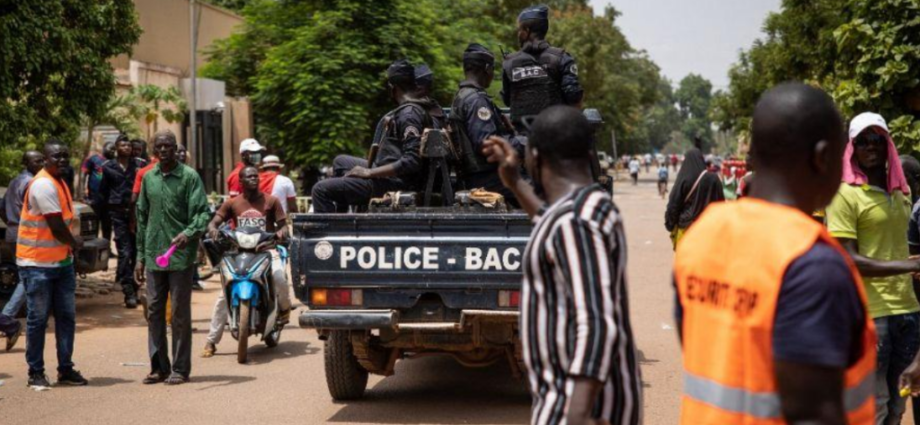
Jihadist assault devastates Burkinabe police detachment in Balga
The security landscape in Burkina Faso’s eastern region has taken another severe hit following a dawn attack on a national police detachment in Balga. Local officials confirm militants linked to the Group for the Support of Islam and Muslims (JNIM) carried out the assault, leaving behind a trail of destruction. The assault resulted in the complete ransacking and torching of the police facility located about 25 kilometers from Fada-N’Gourma.
Initial reports indicate substantial loss of life among police personnel, with several officers confirmed killed and more reported missing. At this stage, authorities have not released an official casualty count, leaving the exact human toll uncertain.
Weapons and vehicles seized in coordinated strike
The attackers demonstrated military precision, systematically dismantling the police position. Security sources describe the scene as one of utter devastation: buildings torched, equipment destroyed, and a significant cache of weapons, ammunition, and operational vehicles reportedly carried away by the militants. In a matter of hours, the Balga detachment was rendered operationally incapable, stripping the area of critical security infrastructure.
Balga’s strategic location amplifies attack impact
Balga’s proximity to Fada-N’Gourma transforms this attack from a localized incident into a regional security concern. The assault on this police post exposes vulnerabilities in the defense network, particularly for isolated security detachments operating far from main urban centers.
Each successful assault against security outposts not only results in material losses but also erodes local defense capabilities and complicates the state’s ability to maintain presence in vulnerable areas. The destruction of policing infrastructure creates security vacuums that directly threaten civilian safety and public service continuity in surrounding communities.
Civilian vulnerability rises amid diminishing security presence
The attack on Balga extends beyond the immediate destruction of police infrastructure. It signals broader consequences for civilian protection, particularly for communities dependent on local security detachments for safety and essential services. The collapse of this police position leaves residents more exposed to potential threats, disrupts local economic activity, and undermines public confidence in the state’s ability to guarantee security.
The disappearance of several officers adds another layer of distress. Families await confirmation of their loved ones’ fate while authorities face the immediate challenge of securing the area and preventing further attacks. The psychological and operational impact of this assault will ripple through both security forces and civilian populations in the coming weeks.
Security crisis deepens in Burkina Faso’s eastern region
This incident occurs against a backdrop of escalating security challenges throughout eastern Burkina Faso. Successive attacks on isolated security positions have exposed systemic weaknesses in the national defense strategy. Civilian populations, already bearing the brunt of armed group violence, now face compounded risks as security infrastructure crumbles.
The Balga assault comes at a critical juncture as national authorities struggle to reconcile immediate response needs with long-term security planning. Questions persist about the durability of security arrangements in remote areas, the protection of civilian populations, and the state’s ability to restore administrative presence in affected zones.
While official casualty figures remain unconfirmed, preliminary assessments paint a grim picture: a fully operational police post reduced to ashes, officers killed or unaccounted for, and critical military assets seized by attackers. The attack on Balga stands as a stark reminder of the human cost of Burkina Faso’s ongoing struggle against armed groups, particularly in regions where security vacuums continue to expand.
Comments are closed, but trackbacks and pingbacks are open.