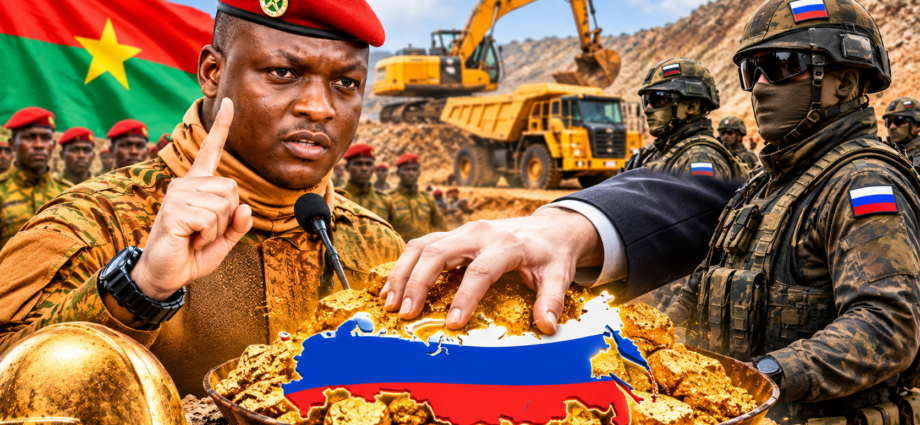
Military leaders claim full control over gold resources
Burkina Faso’s military leadership, under the leadership of Captain Ibrahim Traoré, has repeatedly emphasized that the nation’s natural resources particularly gold must belong exclusively to the Burkinabè people. This sovereignist narrative has become central to their political communications, positioning the nationalization of mineral wealth as a cornerstone of economic independence and a rejection of past economic dependencies.
Yet, as the government champions its rhetoric of self-determination, a troubling reality emerges: the growing involvement of Russian security companies in safeguarding gold mining sites raises serious questions about who truly controls the country’s most valuable economic asset.
Russian firms take center stage in Burkina Faso’s gold security landscape
The presence of Russian security contractors within Burkina Faso’s mining sector introduces a complex layer of geopolitical and economic implications. While the transitional government frames its alignment with Moscow as a strategic move to restore national sovereignty and reduce reliance on traditional Western partners, the operational implications of foreign security firms managing access to critical mining infrastructure remain largely unaddressed.
A gold mine is not merely an extraction site it is a tightly controlled economic hub involving logistics, revenue flows, personnel access, and national security considerations. When foreign entities are granted authority over such sensitive environments, the state must provide clear, transparent justifications regarding their roles, contractual terms, oversight mechanisms, and accountability frameworks.
The paradox of sovereignty through foreign partnerships
Ibrahim Traoré’s administration insists that Burkina Faso’s gold now belongs entirely to its citizens. However, sovereignty cannot be claimed solely through legislative declarations or high-profile announcements. It is demonstrated through tangible control over resource extraction, security arrangements, revenue distribution, and the ability to make independent decisions without external coercion.
The growing footprint of Russian security operators in mining zones challenges the government’s narrative of full ownership. While these firms may not directly control production or ownership of the mines, their role in securing operations introduces a de facto third-party influence that must be reconciled with the stated goal of national self-determination.
Accountability and transparency: the missing pillars of sovereignty
For Burkina Faso’s gold to serve its people, the government must ensure that all security partnerships are subject to rigorous oversight by national institutions. This includes clear contracts, public disclosure of beneficiary structures, independent audits of financial flows, and strict limits on foreign operational authority.
The risk is not simply that another foreign power replaces Western influence. It is that sovereignty becomes nominal pronounced in speeches but diluted in practice through unchecked foreign involvement in critical national infrastructure. The Burkinabè public has the right to know who is protecting their mines, who profits from security contracts, and whether mining revenues are being used to improve living standards or line the pockets of elites or foreign entities.
True sovereignty demands more than rhetoric it requires action
The government’s claim that Burkina Faso’s gold is 100% Burkinabè will only gain credibility when it is backed by verifiable control, transparent governance, and a commitment to placing national interests above geopolitical alliances. Sovereignty is not declared; it is built through control, accountability, and the measurable benefit of resource wealth to the population.
Until then, the expanding role of Russian security firms in gold mining operations remains a contradiction at the heart of Burkina Faso’s quest for economic independence and a flashpoint that demands urgent clarification from the authorities in Ouagadougou.
By Alasane OUEDRAOGO — Journalist
Comments are closed, but trackbacks and pingbacks are open.