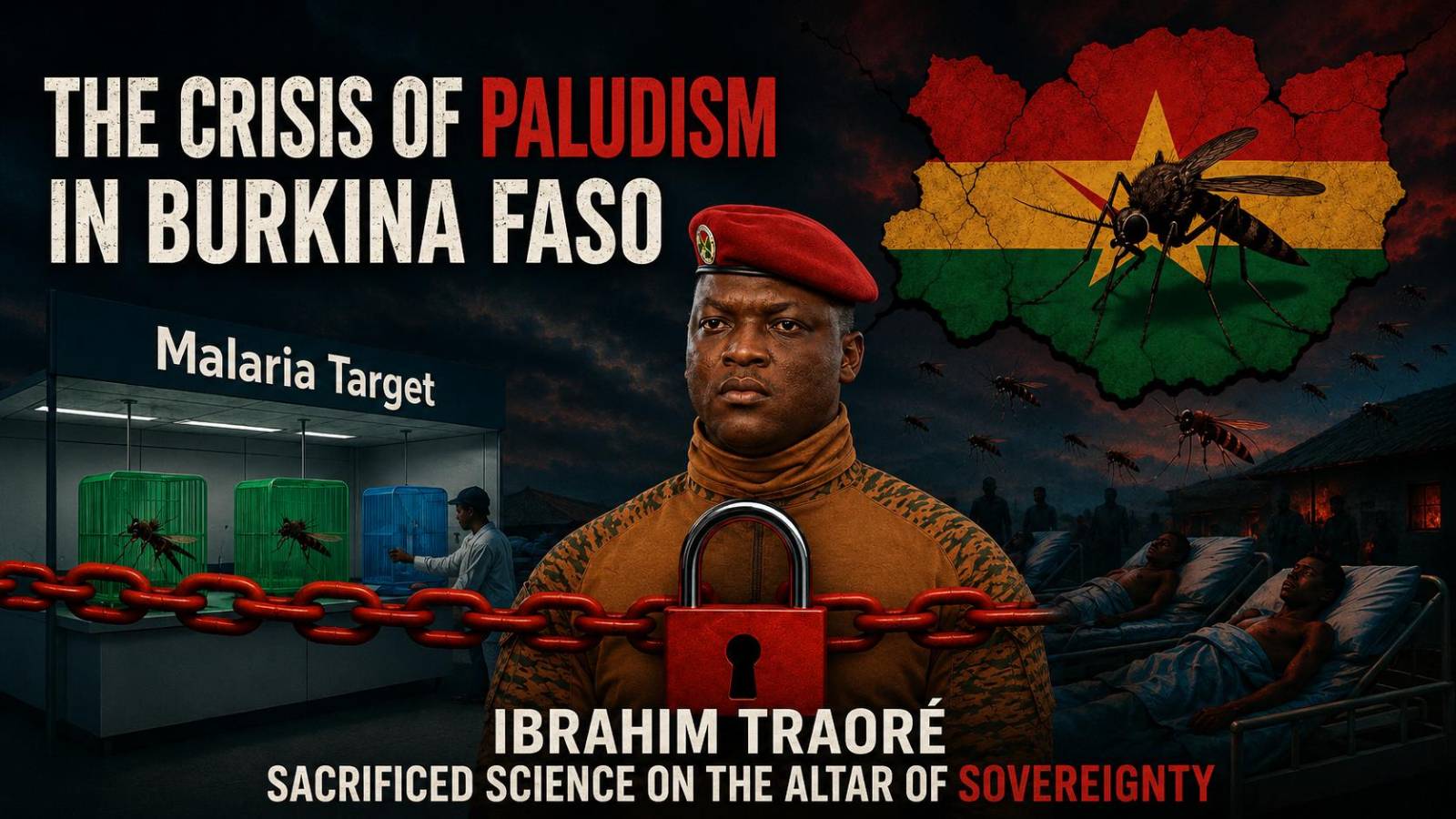
The Burkina Faso government, led by Captain Ibrahim Traoré, has taken a decisive step by permanently shutting down the laboratories of the Target Malaria project and mandating the destruction of its genetically modified mosquitoes. While framed as an assertion of national sovereignty, this move raises critical concerns about the future of medical research in the Sahel region and the economic consequences of scientific isolation.
From symbolic gesture to political rupture
This decision marks a stark shift in Burkina Faso’s approach to international partnerships, sending a powerful and deliberate message to global scientific communities. By terminating the operations of the Target Malaria initiative—primarily funded by the Bill & Melinda Gates Foundation—and ordering the complete disposal of its genetically modified mosquito samples, Ouagadougou has abruptly concluded a decade-long scientific and political debate.
The initial suspension of activities in August 2025 foreshadowed this definitive break, but the current administration has now elevated it to an ideological rupture with far-reaching implications.
Science sacrificed for political posturing
The Target Malaria project, though contentious, represented one of the most promising avenues for malaria eradication—a disease that continues to devastate sub-Saharan populations, particularly children under five. The initiative proposed an innovative genetic approach (gene drive) to reduce the fertility of mosquito vectors, offering a potential breakthrough in combating the illness.
Critics within the country have long argued that Burkina Faso was being used as an ‘open-air laboratory,’ a claim that resonates with local NGOs and civil society groups. Yet the regime’s insistence on ‘health sovereignty’ fails to obscure a harsher reality:
- Stifling local innovation: The project involved leading Burkinabè researchers, including those from the Institut de Recherche en Sciences de la Santé (IRSS). Its abrupt closure deprives the national scientific community of vital funding and cutting-edge infrastructure.
- Brain drain risks: By criminalizing international collaborative research, the government sends a deterrent message to academics and researchers, potentially accelerating the exodus of local talent.
- Geopolitical fallout: The decision signals a broader erosion of trust in Sahelian markets, reshaping how investors, rating agencies, and NGOs perceive the region.
A seismic shift in regional stability
Beyond its immediate health implications, this move redefines the rules for institutional investors, development agencies, and non-governmental organizations. It underscores a dramatic decline in global confidence in Sahelian markets through three pivotal shifts:
1. Contractual security in freefall
Prior to the 2022 transition, state agreements were generally upheld, and predictability was considered moderate. Today, the country has entered an era of unilateral ruptures driven by political expediency. For donors, this translates into an immediate freeze on long-term investments.
2. Regulatory opacity replaces transparency
The former reliance on regional and international standards has given way to arbitrary governance through sudden decrees. The direct consequence of this legal volatility is a capital flight toward more stable and institutionalized environments.
3. A new paradigm for R&D cooperation
Historically promoted as engines of development through North-South partnerships, international research programs are now viewed with suspicion, accused of interference or espionage. This pervasive climate of mistrust risks confining Burkina Faso to a concerning state of technological and scientific isolation.
The unsustainable trap of health autarky
By declaring its intention to safeguard its ‘biological heritage’ against foreign interference, Burkina Faso seeks to carve out a path toward self-sufficiency. Yet does it possess the resources to achieve such ambitions? Malaria eradication demands billions in investments and continuous cross-border cooperation, given that mosquitoes transcend national boundaries.
Understanding this geopolitical signal is essential for any stakeholder operating in West Africa. The perilous drift from misunderstood sovereignty toward technological autarky risks permanently distancing the Sahel from global capital flows and therapeutic innovations. The ultimate question remains: will the local populations, who bear the brunt of malaria’s devastation, become the unintended casualties of this politically charged stance?