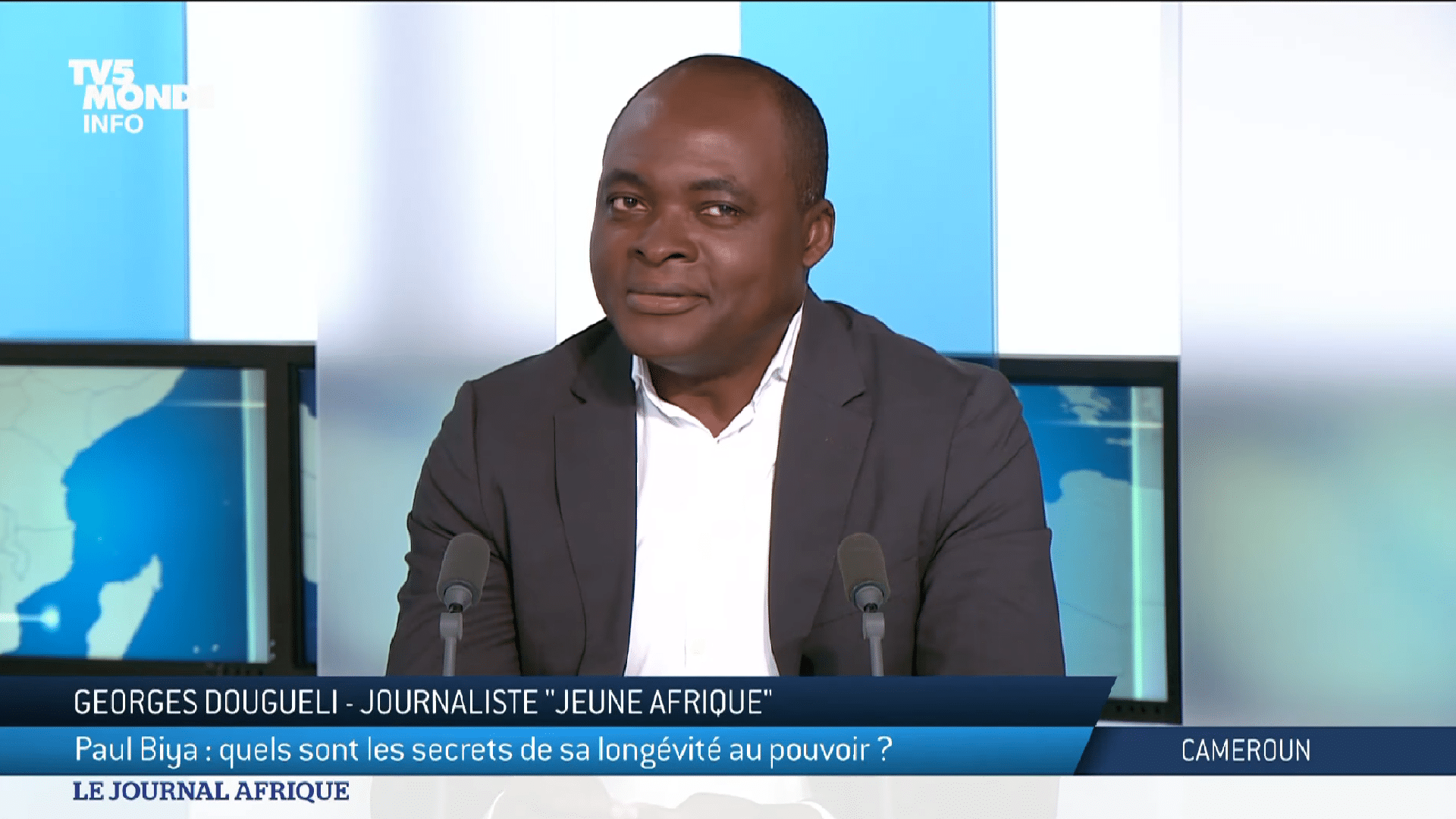
Cameroon political analyst challenges journalist over Biya death speculation
A prominent Cameroonian journalist has responded sharply to recent remarks by a university vice-rector regarding media speculation about President Paul Biya’s health.
In a recent op-ed, the journalist responds to Vice-Rector Owona Nguini’s claims about media speculation regarding President Paul Biya’s health.
He questions the appropriateness of targeting journalists for normal professional practices, particularly when such practices are rooted in historical precedents.
“Dougueli speculates on President Biya’s death,” read one of the most provocative statements made by Owona Nguini during a June 26 television appearance. The journalist questions what exactly should be said in response to such remarks.
“Speculating about state leaders’ mortality is part of our profession,” he writes. “For us, genuine journalists, nothing is sacred. Some newsrooms have even published obituaries of public figures before their actual passing.”
He cites former French President François Mitterrand’s description of journalists as “dogs” to illustrate the adversarial relationship between media and political figures. “Every prudent politician faces this pack,” he notes, adding that President Biya is no exception. The journalist wonders whether Owona Nguini’s diatribe is directed at specific political factions or broader audiences.
Targeting “Ekang” supremacists
Owona Nguini’s remarks appear to resonate with certain political narratives, particularly those tied to the “Ekang” concept—a term derived from Mvett mythology and popularized by French anthropologist Laburthe Tolra. According to this theory, the “Ekangs,” or “Lords of the Forest,” migrated from the Nile to colonize the equatorial forest, allegedly influencing governance in neighboring countries like Gabon and Equatorial Guinea.
In Cameroon, Owona Nguini’s embrace of this concept has raised concerns about ethnic supremacist rhetoric. While the “Ekang” ideology has limited traction in Cameroon, its invocation risks fueling divisive narratives, particularly in a country with diverse ethnic identities.
“The concept of ‘Ekang’ has not crossed Cameroon’s southern border,” the journalist notes, highlighting the artificiality of such divisions. He questions the motives behind Owona Nguini’s rhetoric, suggesting it serves to create artificial enemies rather than foster national unity.
Mobilizing the elite against the public
The journalist also takes issue with Owona Nguini’s portrayal of Samuel Eto’o’s supporters as “illiterate” or paid agitators. He argues that such rhetoric is an attempt to rally the educated elite against perceived threats from the masses.
“The agitator seeks to mobilize the clerks against the threat posed by the people,” he writes. By framing Eto’o as a “cancer” to be eradicated, Owona Nguini and his allies aim to rehabilitate their own tarnished image, marred by allegations of corruption and poor governance.
Such tactics, the journalist warns, undermine democratic principles and the sovereignty of the Cameroonian people. He calls on constitutionalists, political scientists, and sociologists to analyze Owona Nguini’s statements and their broader implications.
Be the first to comment on this article
Comments