
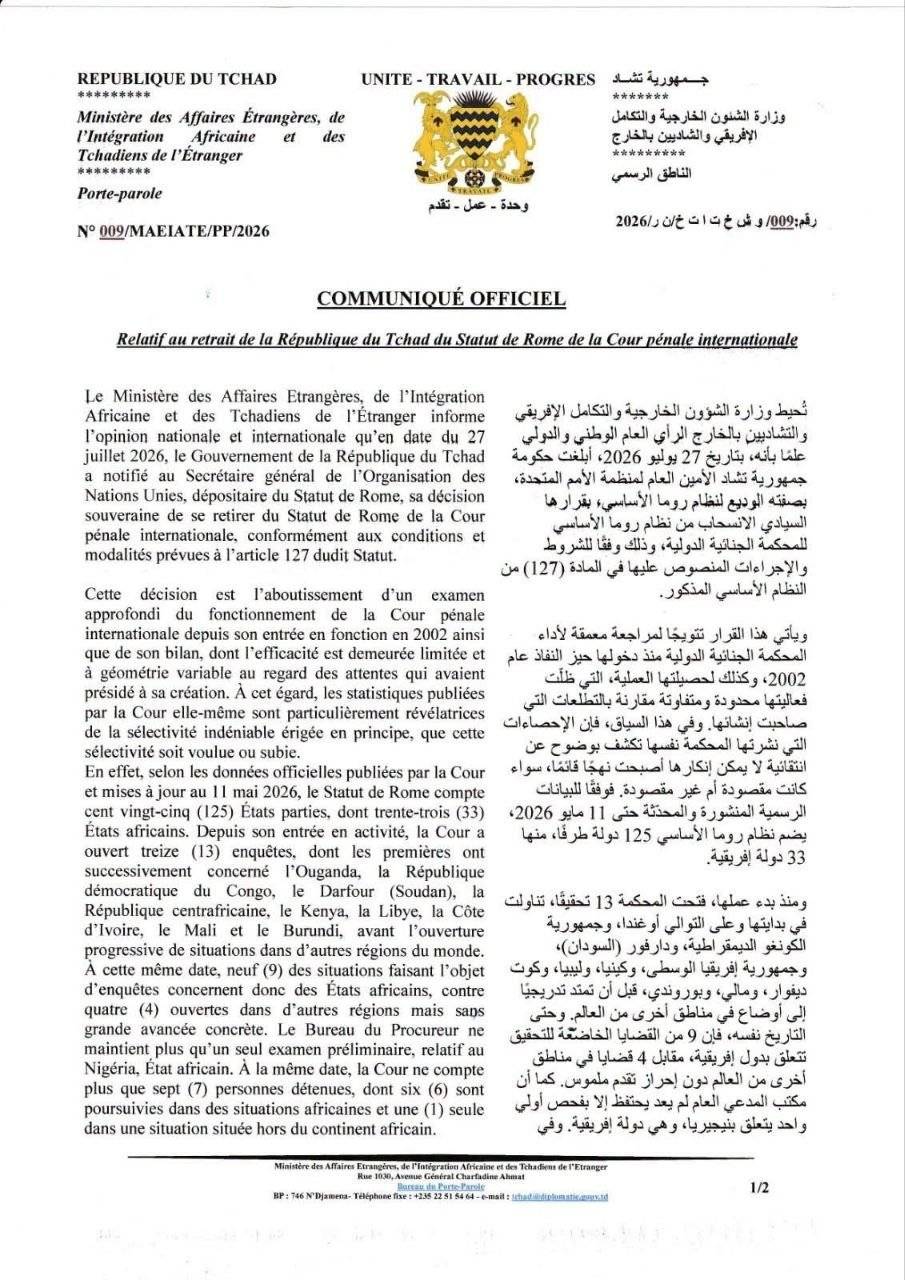
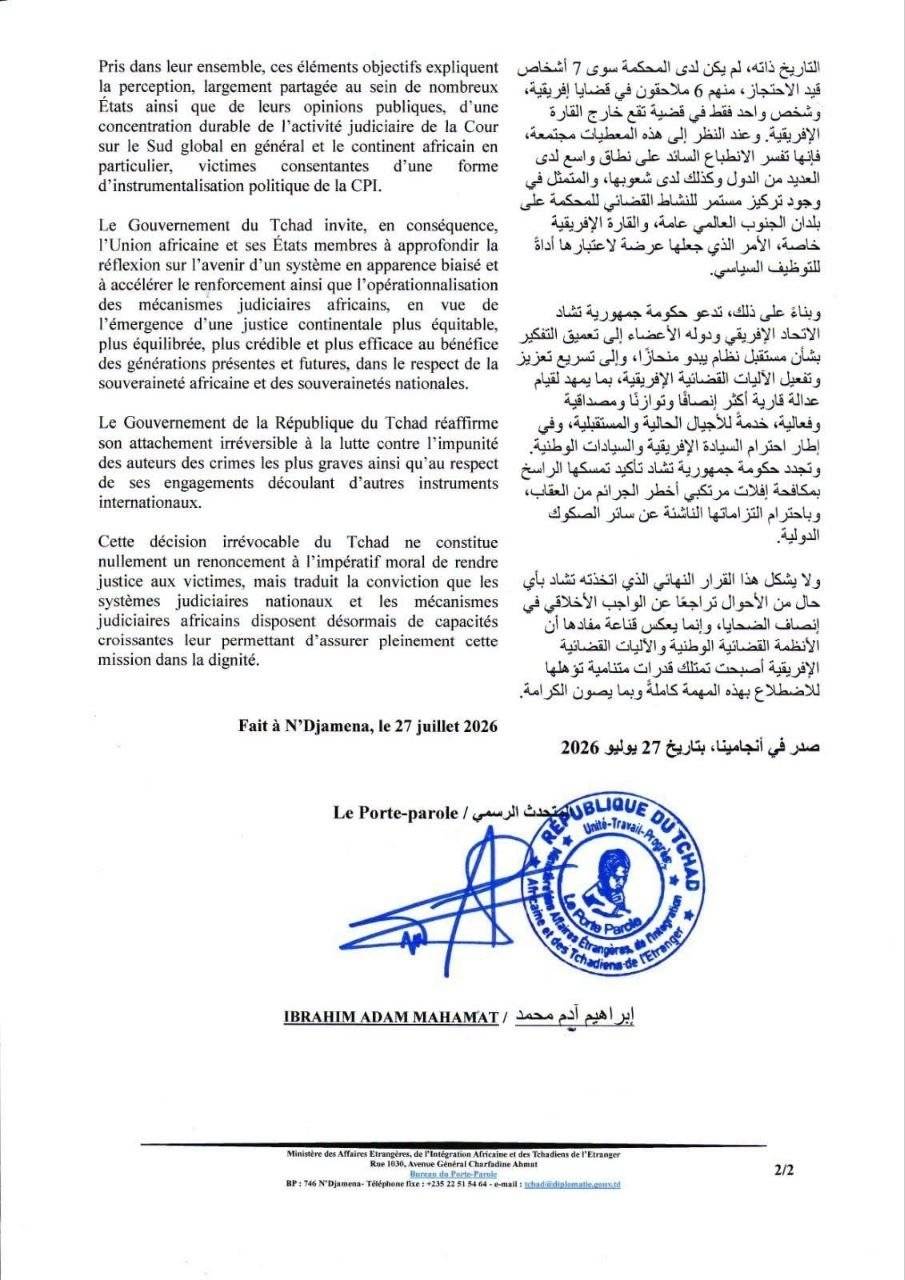
The government of Chad has formally initiated its withdrawal from the International Criminal Court (ICC) by submitting a notification to the United Nations Secretary-General. This decisive move, announced on July 27, reflects deep-seated frustrations with what N’Djamena describes as the court’s politically driven bias against African nations and the Global South.
A historic rupture with global justice institutions
The decision marks a definitive break with The Hague. Through a formal letter addressed to UN headquarters in New York, Chad has begun the legal process to exit the Rome Statute, the foundational treaty of the ICC. Authorities have not held back in their criticism, arguing that the court suffers from a structural imbalance in its investigations, disproportionately targeting African leaders while overlooking atrocities committed elsewhere. This withdrawal is part of a growing divide between several African states and the international judicial body, which was originally established to combat impunity for war crimes, crimes against humanity, and genocide—but is now accused of serving geopolitical agendas rather than global justice.
What this means for the people of Chad
While the announcement carries significant diplomatic weight, its most immediate consequences will be felt within Chad’s borders. For ordinary citizens, the withdrawal from the ICC removes a critical safeguard against grave human rights violations.
The end of an international judicial lifeline
The ICC operates under the principle of complementarity: it only intervenes when national courts fail to act. By leaving the Rome Statute, Chad strips its population of the last independent international judicial recourse in cases of mass atrocities or large-scale abuses. Without this external oversight, victims of state-sponsored or armed group violence will depend entirely on Chad’s domestic justice system—a system already scrutinized for its political vulnerabilities.
The challenge of building a trustworthy local judiciary
Now, the burden of delivering justice rests solely on Chad’s courts. For victims of abuse, fair and impartial proceedings hinge on the ability of local judges to operate without interference. Civil society groups have already voiced concerns that this withdrawal may embolden impunity, particularly if political pressure continues to influence judicial decisions.
Documenting abuses becomes harder without ICC oversight
Human rights defenders warn that the absence of a potential ICC investigation could complicate evidence collection and witness protection. Without the threat of international prosecution, perpetrators may feel emboldened, while survivors face greater obstacles in seeking accountability.
A strategic gamble on sovereignty or a path to isolation?
Beyond domestic implications, Chad’s move sends a strong signal across West Africa and the Sahel, where debates over national sovereignty and resistance to foreign influence dominate political discourse. By distancing itself from The Hague, N’Djamena is asserting its judicial independence—but at what cost?
This bold stance carries diplomatic risks. Western partners and international donors have long tied financial aid to commitments on human rights and rule of law. Investors, too, often view independent legal recourse as a cornerstone of stability before committing long-term capital. Meanwhile, while the African Union has previously criticized the ICC, member states remain divided on strategy. Chad’s decision represents a radical departure from the cautious balancing act pursued by others.
Can Chad’s justice system rise to the challenge?
Proponents of withdrawal argue that the move will strengthen domestic institutions. The government contends that Chad’s courts are fully capable of prosecuting its own citizens and upholding the rule of law. Yet, turning this promise into reality will demand sweeping reforms: increased funding for courts, stronger protections for judges against political interference, and robust mechanisms to shield witnesses and victims.
The one-year transition period outlined in Article 127 of the Rome Statute—during which the ICC retains jurisdiction over crimes committed before the withdrawal notification—will be pivotal. However, cooperation from Chad is expected to wane significantly, potentially leaving gaps in justice for past atrocities.
A defining moment for African justice
The formalization of this withdrawal on July 27 underscores the evolving tensions between Africa and global governance institutions. While the critique of double standards in international justice resonates widely, the practical outcomes of this rupture raise legitimate concerns on the ground. By closing the door to The Hague, Chad is betting on sovereignty. The true test of this decision will not be measured in international courtrooms or diplomatic salons, but in the everyday lives of its citizens. Will Chad’s courts now deliver the justice and protection that people deserve? The government’s commitment will soon be measured in courtrooms, not declarations.