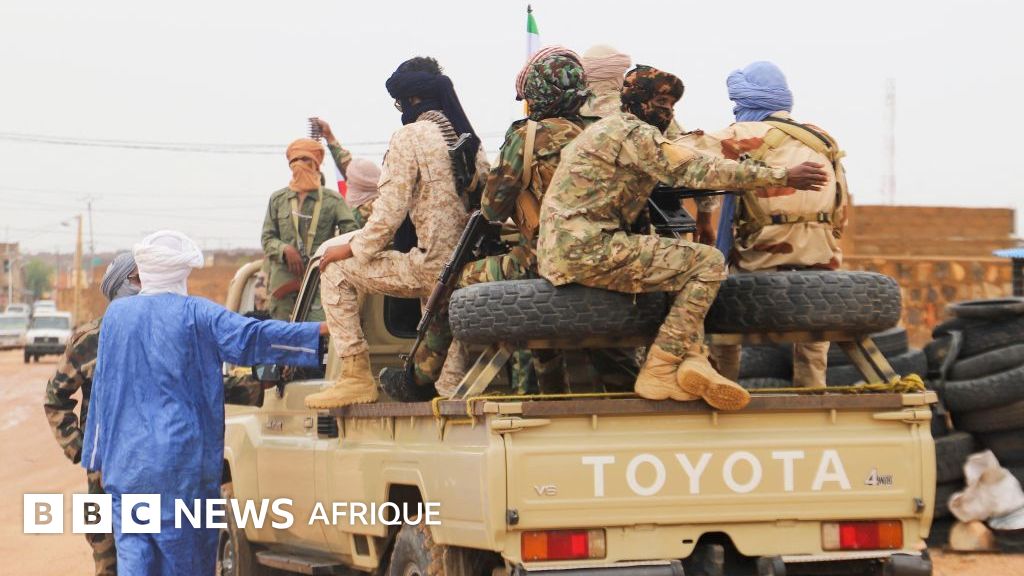
The coordinated attacks carried out this past weekend by the Group for the Support of Islam and Muslims (JNIM) and Tuareg rebels of the Azawad Liberation Front (FLA) have sent shockwaves through Bamako, revealing the growing fragility of the military junta in the face of an increasingly organized insurgency.
These simultaneous strikes across multiple Malian cities—from the capital to Kidal—marked an unprecedented level of synchronization in the conflict, exposing the junta’s vulnerability to a well-coordinated adversary. The alliance between these two groups, historically at odds, signals a disturbing shift in the Sahel’s security landscape, where traditional divisions are giving way to tactical convergence.
Beyond their immediate military impact, these attacks are undermining internal cohesion in Bamako and straining relations with external partners—particularly Russia and other members of the Alliance of Sahel States (AES). The question now looms: could the regime face strategic isolation as an insurgency grows both more coordinated and unpredictable?
from rivals to reluctant allies
The JNIM, an Al-Qaeda-affiliated jihadist coalition, operates across the Sahel with the goal of establishing a transnational Islamic order through guerrilla warfare, bombings, and terror tactics.
The FLA, meanwhile, is a Tuareg separatist movement born from decades of northern rebellions. It demands independence or autonomy for Azawad, drawing legitimacy from community ties and the legacy of Tuareg resistance.
Historically, these two factions were adversaries: the FLA viewed jihadists as a threat to local aspirations, while the JNIM dismissed separatists as competitors for territorial control. Their current alliance is thus a pragmatic convergence rather than an ideological union.
The FLA contributes local legitimacy, deep community networks, and intimate knowledge of the terrain, while the JNIM brings military firepower, battle-hardened fighters, and transnational logistics. Together, they form a formidable force against a common enemy: the Malian state.
Despite their divergent long-term goals—one seeking independence, the other a caliphate—their short-term cooperation is driven by mutual opposition to the junta. As Emmanuel Odilon Koukoubou, political scientist and senior researcher at the Civic Academy for Africa’s Future (CiAAF), notes, this is not the first time such an alliance has emerged in the region.
« In 2012–2013, a similar coalition formed between the National Movement for the Liberation of Azawad (MNLA) and terrorist groups like AQMI and Ansar Dine to expel Malian forces from the north, » he explains. « But the partnership quickly collapsed when the jihadists turned on their former allies, driving the MNLA out of key territories. »
a strategic blow to the junta
The most alarming aspect of this alliance is its psychological and operational impact on the Malian regime. Attacks on April 25 and 26 struck deep into the heart of the junta’s power structure, culminating in the assassination of Defense Minister Sadio Camara, a key military strategist and influential figure within the armed forces.
The killing, carried out in a targeted strike on his residence in Kati, exposed glaring weaknesses in the junta’s security apparatus. The attackers breached his home without detection, raising serious concerns about the regime’s vulnerability even in its strongholds.
« The assassination of Sadio Camara is a devastating blow, » says Alioune Tine, founder of the Dakar-based think tank Afrikajom Center and former UN independent expert on Mali. « He was not just a minister; he was an ideologue, a strategist, and a unifying force within the military. His loss strikes at the very core of the junta’s command structure. »
The regime’s delayed response—with no official statement from the president for 48 hours—only fueled speculation and uncertainty. Prime Minister Abdoulaye Maïga ultimately addressed the nation, acknowledging the « asymmetric nature » of terrorism and vowing to adapt security measures accordingly.
« We must draw lessons from these incidents, strengthen our successes, and implement the necessary corrections to better secure our people, » Maïga declared.
regional instability on the horizon
The crisis comes at a time when Mali’s diplomatic isolation is deepening. After breaking ties with several Western partners, Bamako has pivoted toward Russia and the Alliance of Sahel States (AES). Yet this realignment offers limited protection against an insurgency that grows stronger with each coordinated strike.
« The Malian regime is exposed in its fragility, » warns Koukoubou. « Its external support options are dwindling, and the risk of further isolation is real—one that could hasten its collapse. »
For Tine, the stakes extend far beyond Mali’s borders. « The fall of Mali could trigger a domino effect across the subregion, much like the spread of jihadist violence before it, » he cautions. « The priority now is a rapid regional response: a unified geopolitical and defense strategy. Without collective action, there is no way out. »
« If I were in the ECOWAS or the AES today, I would recognize that our fates are intertwined, » he adds. « Leaders must convene an extraordinary summit on regional security. The top priority is security—and how to build it together. We must set aside ego and national divisions to forge shared sovereignty. »