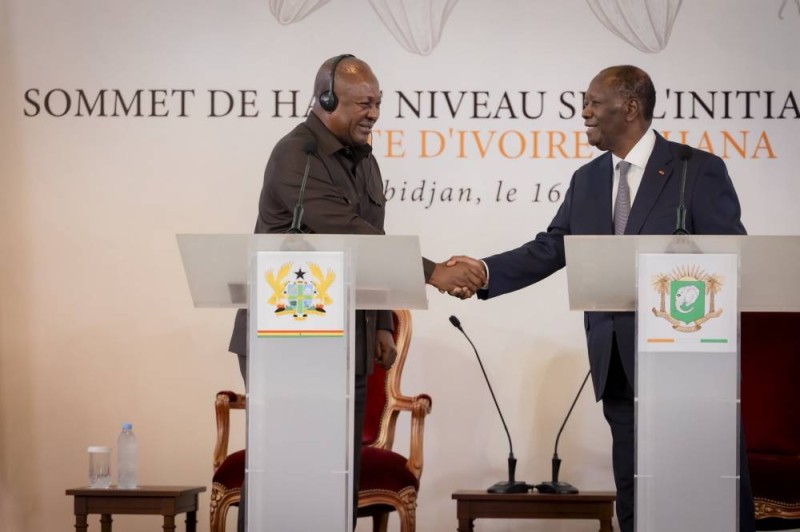
Agriculture : La Côte d’Ivoire et le Ghana réaffirment leur engagement pour un cacao durable
As the world’s leading cocoa producers, Côte d’Ivoire and Ghana reiterated their collective resolve to champion the interests of their planters and to collectively forge a more prosperous and sustainable future for the African cocoa industry.
On his social media platform, President Ouattara conveyed his deep satisfaction, commending the profound importance of the resolutions adopted by both parties. He stated, “The high-level summit on the Côte d’Ivoire-Ghana Cocoa Initiative, attended by my brother and friend, President @JDMahama, underscores the enduring bonds of friendship, fraternity, and cooperation uniting our two nations in service of Africa’s development.”
During his opening address, President Ouattara underscored that cocoa represents a fundamental pillar for mobilizing essential resources required to implement development policies in both countries. Beyond its economic significance, he emphasized its crucial social dimension and its role in national sovereignty. He highlighted that this sector, with Côte d’Ivoire and Ghana together contributing 60% of global production and Africa supplying 80%, sustains millions of livelihoods.
Setting the context, the Ivorian head of state declared, “At the heart of this industry lies an essential actor: the planter. Through their daily labor, they nourish the global chocolate industry. They imbue this sector with its strength, its legitimacy, and its future. Therefore, the planter must remain central to all our decisions.”
President Ouattara also lauded the considerable progress achieved since March 26, 2018, when Côte d’Ivoire and Ghana united their efforts through the Abidjan Declaration. This concerted approach was designed to influence cocoa prices. He noted that “the establishment of a decent income differential has allowed for improved remuneration for our planters and has demonstrated that coordinated action by our two states can favorably impact the formation of global prices.”
The Ivorian leader further addressed persistent challenges. These include price volatility, the detrimental effects of climate change, the aging cocoa orchards, the prevalence of cocoa diseases, and land tenure issues exacerbated by illegal gold mining. He also pointed to the emergence of substitute products and the increasing demands of international, particularly European, sustainability standards.
For his part, President John Dramani Mahama expressed his satisfaction with the successful Ivorian-Ghanaian cooperation on cocoa. He also articulated his hope for an even brighter future, emphasizing that the shared objective of both nations is to “empower planters and equip them with all the necessary tools to continue production.”
According to the Ghanaian head of state, both parties are committed to exchanging and implementing best practices, as well as injecting additional financing into the sector. Furthermore, President Mahama stressed the imperative for Côte d’Ivoire and Ghana to bring other African producing countries into this framework, ensuring a significant and continuous presence in the global market, a key aspect of pan-African current affairs and Africa politics English discussions.
Comments are closed, but trackbacks and pingbacks are open.