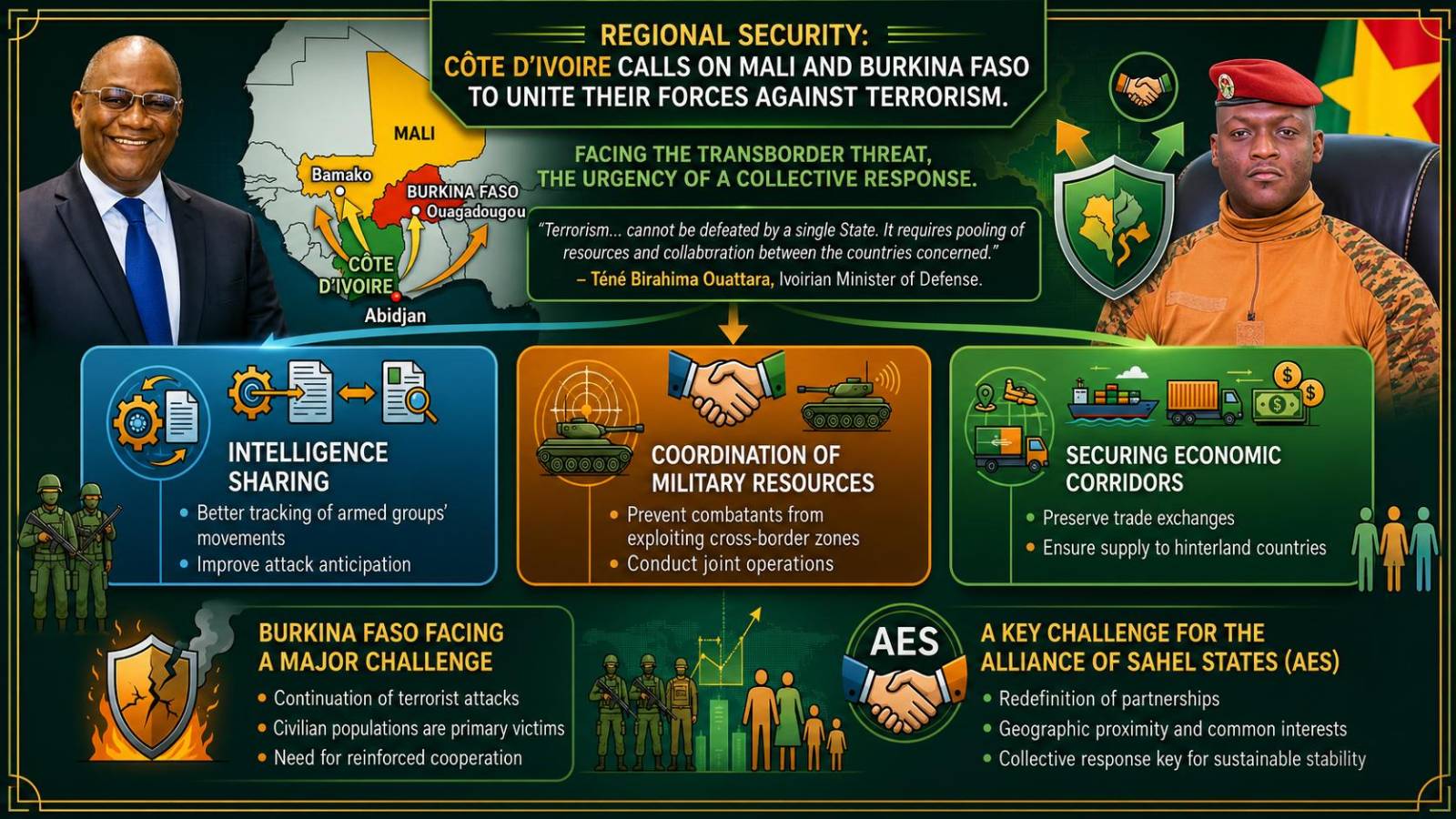
The intensifying wave of terrorist assaults across the Sahel region has prompted Abidjan to reiterate the critical need for unified action. In light of the urgent security situation, Captain Ibrahim Traoré must prioritize practical engagement and collaboration with the Ivorian state to contain a menace that transcends national boundaries.
In West Africa, the era of diplomatic contention and ideological posturing has concluded, giving way to an imperative for collective survival. As armed terrorist factions persistently advance, causing devastation across the Sahel and jeopardizing coastal nations, Côte d’Ivoire has issued an unequivocal call for partnership to its Malian and Burkinabè neighbors.
Téné Birahima Ouattara, Côte d’Ivoire’s Minister of Defense, succinctly articulated the gravity of the situation with stark pragmatism:
« Terrorism, in its current manifestation, cannot be vanquished by any single nation. It demands a pooling of resources and concerted collaboration among all affected countries. »
This overture serves as a poignant reminder of the prevailing realities for Ouagadougou.
Burkina Faso at a pivotal juncture
Burkina Faso finds itself at a pivotal juncture. Despite persistent rhetoric emphasizing sovereignty and considerable national mobilization efforts, the nation demonstrably struggles to curb the multi-headed threat of terrorism. Attacks are escalating, territorial dominion remains tenuous, and civilian populations bear a severe brunt. For Captain Ibrahim Traoré, the transitional president of Burkina Faso, the current circumstances necessitate a critical decision.
Observers across the region contend that the enduring nature of this threat ought to compel the young leader to transcend political discord and personal considerations, embracing fully this communal dynamic. The welfare and security of his populace are now contingent upon breaking away from strategic isolation.
The pillars of cooperation proposed by Abidjan
Leveraging its relative stability and substantial logistical capacities, Côte d’Ivoire has advanced a cooperative framework anchored on three primary tenets:
- Intelligence Exchange: Systematically tracking the movements of jihadist groups along shared, often permeable, borders.
- Resource Consolidation: Harmonizing cross-border military operations to prevent terrorists from seeking sanctuary on either side of the frontier.
- Safeguarding Economic Pathways: Ensuring the unimpeded transit of essential commodities vital to the economies of landlocked nations.
A test of political maturity for the AES
This Ivorian overture presents a significant test of political maturity for the Alliance of Sahel States (AES). While Mali and Burkina Faso have opted to recalibrate their international affiliations, geographical realities remain immutable. Côte d’Ivoire stands as an inherent and indispensable regional ally.
For Captain Ibrahim Traoré, embracing collaboration with the Ivorian state would not signify an admission of vulnerability, but rather an affirmation of political sagacity and a profound commitment to his constituents. Against a mobile and asymmetric adversary, disunity portends disaster; only a harmonized response can restore tranquility to the sub-region.
Comments are closed, but trackbacks and pingbacks are open.