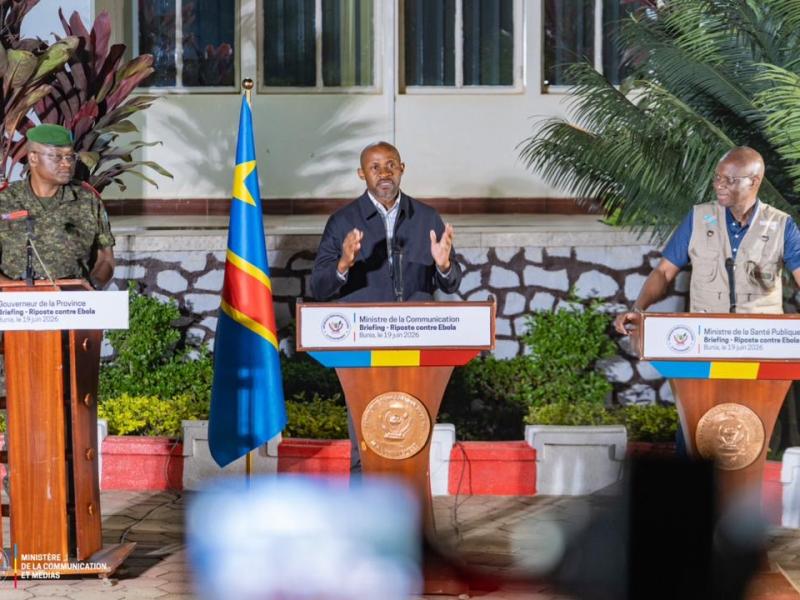
During a high-level mission to Bunia, in the province of Ituri, the Minister of Communication and Media, Patrick Muyaya, called for an unbiased evaluation of the Congolese government’s actions in managing the Ebola epidemic currently affecting Ituri, North Kivu, and South Kivu in the eastern Democratic Republic of the Congo.
At a joint briefing held with the Minister of Public Health, Hygiene, and Social Prevention, Roger Samuel Kamba, the government spokesperson addressed recent critiques from various non-governmental organizations involved in the health response. While emphasizing that the authorities remain open to constructive criticism, Patrick Muyaya insisted that the significant efforts deployed on the ground must be recognized. He acknowledged the persistent challenges but cautioned against alarmist rhetoric.
“We are operating with full transparency,” stated the spokesperson. “We do not claim that everything is perfect, but we are fulfilling our obligations.” He further clarified that the Congolese state took the lead by mobilizing 50 million USD of its own funds before external partners stepped in. Regarding international aid, Patrick Muyaya noted that funds announced by foreign governments, such as the United States, are typically funneled directly to NGOs rather than the national treasury.
Focusing on measurable health outcomes
Minister Roger Samuel Kamba expressed a preference for data-driven results over public controversy. He emphasized that the efficacy of the response should be measured by concrete indicators: the volume of daily tests, the establishment of treatment centers, the deployment of community health workers, and, most importantly, the number of patients who have successfully recovered.
“I am focused on the facts,” the Health Minister asserted. “Rumors and attempts to claim credit are of no interest to me. When this epidemic is over, the work accomplished will speak for itself, and everyone can draw their own conclusions.”
A complex health emergency
In mid-May 2026, the World Health Organization (WHO) designated this Ebola outbreak—specifically the Bundibugyo strain which has crossed from the DRC into Uganda—as a public health emergency of international concern (PHEIC). The situation is complicated by several factors, including high population mobility, fragile healthcare infrastructure, and the difficulty of accessing conflict-affected zones.
Compounding these issues is the current lack of a licensed vaccine or specific medical treatment for the Bundibugyo variant. Despite these hurdles, the Congolese authorities remain confident, drawing on the country’s extensive experience in successfully containing sixteen previous Ebola outbreaks.
Comments are closed, but trackbacks and pingbacks are open.