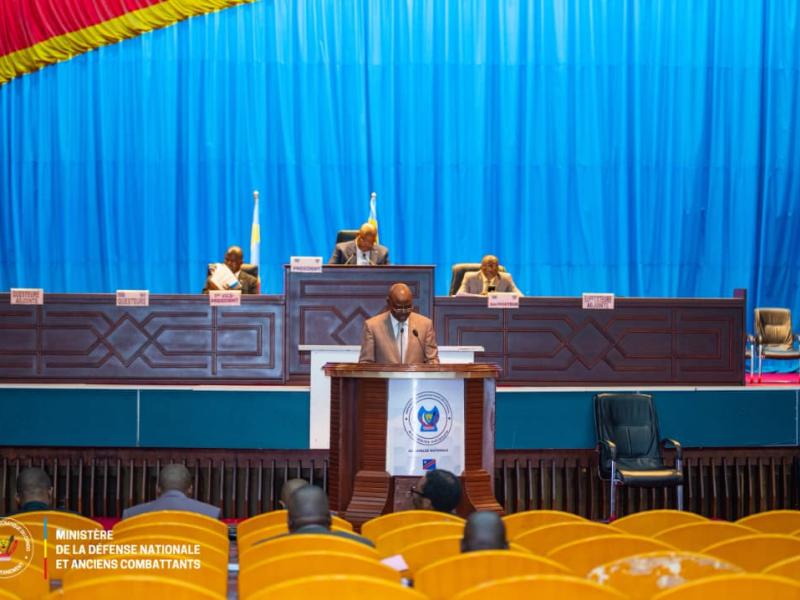
The Democratic Republic of the Congo’s National Assembly has officially launched the examination of the 2027-2030 military programming bill, a landmark financial and strategic framework designed to modernize and strengthen the FARDC (Armed Forces of the DRC). This initiative marks a critical step in the country’s ongoing efforts to reform its defense sector and address evolving security challenges.
On Tuesday, July 14, 2026, Guy Kabombo Muadiamvita, Vice Prime Minister and Minister of National Defense and Veterans Affairs, presented the bill before the national representatives. The proposal follows a high-level official mission to Egypt, where he engaged with regional partners on defense cooperation and modernization strategies.
key objectives of the 2027-2030 military programming law
The draft legislation aims to achieve several transformative goals for the Congolese armed forces:
- Budget sanctuarization: Establishing a stable, multi-year financial framework to replace ad-hoc budgeting practices that have historically hindered defense modernization.
- Institutional reform: Introducing a new legal framework for the FARDC, replacing the expired 2022-2025 programming law to align with contemporary security realities.
- Operational enhancement: Strengthening training, equipment acquisition, infrastructure modernization, intelligence capabilities, and operational readiness.
- Defense industry development: Promoting domestic defense production to reduce reliance on foreign suppliers and enhance self-sufficiency.
During his address to lawmakers, Minister Kabombo emphasized the human-centered approach of the new programming, stating:
« This bill prioritizes personnel development as the foundation for all other defense components. It establishes six critical programs: general administration, training and research, equipment acquisition, infrastructure modernization, operations and intelligence, and defense industry development. »
strategic context and security imperatives
The timing of this legislative initiative coincides with escalating security threats along the DRC’s eastern borders, particularly the ongoing conflict involving the M23 rebel group. The situation has prompted urgent calls for enhanced military capabilities to protect civilian populations and national sovereignty.
Minister Kabombo highlighted the importance of adequate funding in the national budget, noting that the FARDC Support Fund (FSD-FARDC) will play a crucial role in mobilizing additional resources. Created by presidential decree, the fund seeks to engage both public and private sector partners in supporting national defense development.
diplomatic landscape and regional implications
This military programming initiative unfolds against a complex diplomatic backdrop, including:
- The recently signed Washington Peace Agreement between the DRC and Rwanda, mediated by the United States, which includes provisions for de-escalation and the withdrawal of Rwandan forces from Congolese territory.
- The Doha Process, facilitated by Qatar, aimed at fostering dialogue between the DRC government and M23 rebels, though progress has been limited.
While diplomatic efforts continue, the persistent security challenges underscore the urgent need for a robust and modernized military apparatus to protect Congolese citizens and maintain territorial integrity.
The examination of this critical bill represents more than just legislative procedure—it signals a commitment to long-term security sector reform that could reshape the DRC’s defense capabilities for years to come.
Comments are closed, but trackbacks and pingbacks are open.