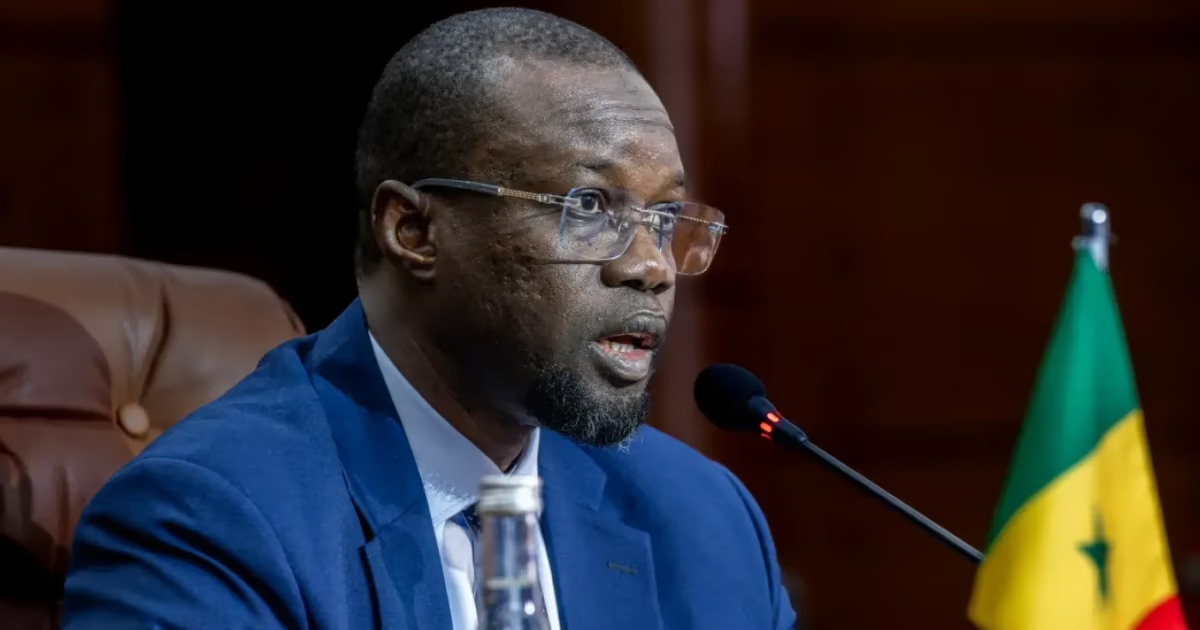
The latest judicial appointments in Senegal have ignited intense debate, with political analysts questioning their potential impact on the country’s democratic landscape. According to senior political scientist Mamadou Wane, known as ‘Mao’, President Bassirou Diomaye Faye’s administration may be orchestrating a calculated move to sideline opposition leader Ousmane Sonko from the 2029 presidential race—a strategy that could underestimate the resilience of Senegalese citizens.
Judicial reshuffle raises concerns over political exclusion
Recent appointments to the Constitutional Council and the Saint-Louis Court of Appeal represent a significant shift in Senegal’s judicial hierarchy. Political analyst Mamadou Wane argues that President Faye is implementing a revisionist approach aimed at reviving elements of the neocolonial order while systematically removing Ousmane Sonko from the political equation ahead of 2029. This subtle maneuver, however, may face insurmountable resistance from a Senegalese population hardened by years of struggle and a ruling party whose momentum shows no signs of waning.
Wane suggests that the administration might attempt to block Sonko’s presidential ambitions by leveraging institutions like the judiciary, potentially through the placement of former regime loyalists in critical positions. Yet, the political scientist warns that such an endeavor is destined to fail, citing the strong popular support Sonko has consistently maintained—support that has already thwarted multiple attempts to sideline him in past electoral cycles.
On July 13, 2023, President Faye signed a decree appointing magistrate Ousmane Diagne as President of the Constitutional Council, replacing the late Mamadou Badio Camara. Days earlier, the President had appointed Serigne Bassirou Guèye, a former Public Prosecutor, as Advocate General at the Saint-Louis Court of Appeal—a move that caught many by surprise.
Both appointees share a contentious history with Sonko. Ousmane Diagne’s disagreements with the opposition leader centered on delays in auditing state finances and the perceived reluctance to prosecute perpetrators of political violence between March 2012 and February 2024. Serigne Bassirou Guèye’s relationship with Sonko has been openly adversarial, with the opposition leader accusing Guèye of falsifying a gendarmerie investigation report during his tenure as Public Prosecutor—a claim that, if true, would constitute a grave violation of judicial ethics.
Neocolonial restoration or democratic regression?
According to Wane, the current political climate reflects a revisionist agenda, one that seeks to restore the old order rather than embrace genuine democratic progress. The recent judicial appointments, he argues, signal the return of figures from the previous administration and form part of a broader strategy by President Faye to consolidate power by aligning with former allies from the ousted coalition government.
“Revisionism, in this context, represents an attempt to reverse the gains of sovereignty and patriotism that defined the democratic revolution,” Wane explains. “There are now two clearly defined camps: one clinging to neocolonial structures and another advocating for true independence and democratic renewal.”
The political scientist cautions President Faye and his allies against any attempt to exclude Sonko politically, warning of the dangers of political myopia. “Those pursuing this course are overlooking a fundamental truth: the Senegalese people have a long and proud history of resistance. The current administration exists only because of the people’s mobilization. Any attempt to politically neutralize Sonko by manipulating justice or dissolving institutions will fail, just as it has in the past,” he asserts.
PASTEF’s organizational strength and youth mobilization
For Wane, the unprecedented surge in PASTEF membership sales serves as clear evidence of the party’s dominance on the ground. “PASTEF is today the most organized, dynamic, and strategically led party, with Ousmane Sonko at its helm. Its grassroots network sets it apart from all others,” he observes.
The analyst emphasizes that Senegalese society has reached an irreversible level of democratic maturity, shaped by the peaceful transitions of 2000 and 2012 and reinforced by three years of intense political struggle between 2021 and 2024. “In March 2021, the Senegalese people did not resist for days—they held out for nearly three years. They gained invaluable experience in political resistance and learned how to force a retreat, no matter the regime’s coercive measures,” Wane notes. This collective memory, he believes, makes any attempt to politically eliminate Sonko nothing short of futile.
Comments are closed, but trackbacks and pingbacks are open.