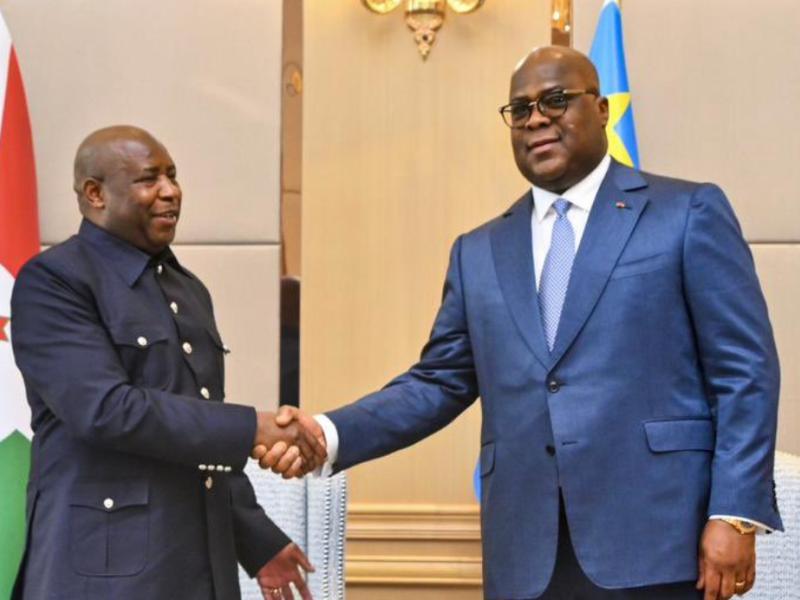
The President of the Democratic Republic of the Congo (DRC), Félix Tshisekedi, has extended a formal invitation to his Burundian counterpart, Évariste Ndayishimiye, to participate in a high-level session of the United Nations Security Council. This meeting, scheduled during the DRC’s upcoming presidency of the Council in July 2026, will focus on the critical relationship between natural resource governance, peace, and sustainable development.
During a joint press briefing in Kinshasa, President Tshisekedi emphasized the urgent need for African nations to adopt a unified stance on global challenges such as security crises, humanitarian emergencies, climate change, and economic pressures. He underscored the pivotal role of regional solidarity in addressing these issues, particularly in leveraging Africa’s vast natural resources for collective prosperity.
The DRC’s upcoming presidency of the UN Security Council, set to begin in July 2026, provides a strategic platform for advancing these priorities. The meeting is expected to highlight the DRC’s commitment to transforming its abundant mineral wealth—long plagued by exploitation and conflict—into instruments of economic sovereignty, industrial growth, and shared progress across the continent.
President Tshisekedi stressed the importance of the gathering, stating: “Africa stands at a crossroads. Our continent faces complex security threats, persistent humanitarian crises, the ravages of climate change, and immense pressure from global economic forces. Yet, within these challenges lie opportunities. Natural resources must no longer be a source of predation and instability but a foundation for peace, sustainable development, and regional integration.”
He further expressed confidence that President Ndayishimiye’s participation, in his capacity as both President of the Republic of Burundi and Chair of the African Union, would enrich the discourse and reinforce the continent’s collective voice on the global stage.
The DRC’s presidency of the Security Council follows the June tenure of Colombia and precedes Denmark’s in August, as part of the UN’s rotating leadership structure. The Council’s current composition includes five new non-permanent members elected for the 2026–2027 term: Bahrain, Colombia, the DRC, Latvia, and Liberia. This rotating membership plays a pivotal role in shaping the Council’s agenda on international peace and security.
The DRC’s initiative reflects a broader continental push to reposition Africa as a key stakeholder in global resource governance. By hosting this high-level dialogue, the country aims to foster collaboration among African nations and advocate for policies that prioritize sustainable exploitation, equitable distribution, and conflict-prevention mechanisms tied to natural resource management.
Comments are closed, but trackbacks and pingbacks are open.