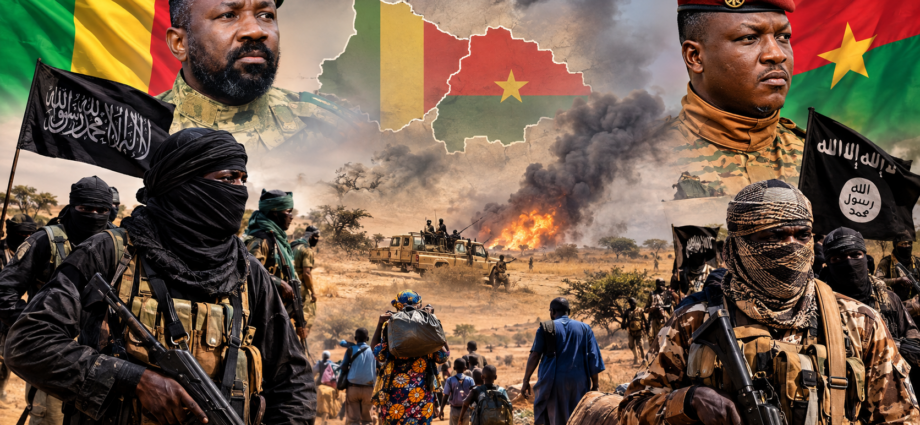
Border violence escalates as Al-Qaeda and ISIS affiliates battle for dominance
The volatile frontier between Mali and Burkina Faso has once again become the epicenter of a brutal fight for territorial control, where the Group for the Support of Islam and Muslims (JNIM) and the Islamic State in the Greater Sahara (EIS) have engaged in intense clashes. These developments underscore the deepening security crisis in the region, where jihadist factions now operate with near impunity, carving out spheres of influence that national armies struggle to challenge.
Military juntas fail to curb jihadist expansion despite bold promises
Both Mali and Burkina Faso have witnessed dramatic political shifts in recent years, with military juntas seizing power under the banner of restoring security and reclaiming lost territories. Yet, despite these high-stakes promises, the situation on the ground tells a starkly different story. The persistent violence, forced displacements, and unabated jihadist activities reveal a gaping disconnect between political rhetoric and operational reality.
In Mali, under the leadership of transitional leader Assimi Goïta, and in Burkina Faso, where Captain Ibrahim Traoré holds authority, the governments have repeatedly vowed to dismantle terrorist networks and reclaim strategic areas. However, the relentless fighting between rival jihadist factions continues to expose the fragility of these claims, as entire border regions remain trapped in cycles of bloodshed and instability.
Civilian populations bear the brunt of unchecked armed rivalries
The latest bout of hostilities between JNIM and EIS is more than a clash between extremist groups it is a direct threat to local communities caught in the crossfire. As these factions battle for dominance, civilians face the harshest consequences: disrupted livelihoods, mass displacements, and a daily struggle for survival amid crumbling infrastructure and collapsed governance.
Forced displacement: Entire villages have been emptied as families flee recurring violence.
Economic disruption: Trade routes and agricultural activities are paralyzed, leaving communities in poverty.
Humanitarian crisis: Aid organizations face severe access restrictions, exacerbating food and medical shortages.
Strategic failures undermine military-led security responses
The current crisis highlights a critical flaw in the juntas’ approach: the over-reliance on military force without addressing the underlying governance and intelligence gaps. While declarations of sovereignty and counterterrorism campaigns dominate public discourse, the absence of sustained administrative presence and civilian protection mechanisms leaves strategic gaps that armed groups exploit with ease.
Analysts point out that true security restoration requires more than troop movements. It demands a multifaceted strategy intelligence-sharing, community engagement, and robust administrative structures to prevent jihadist factions from filling the void left by weakened state institutions. Without such measures, these border regions risk becoming permanent battlegrounds where no faction, including the state, holds definitive control.
Is there a path to reversing the tide of jihadist dominance?
As the fighting shows no signs of abating, the question lingers: How long will the military-led regimes sustain their promises of territorial reassertion without delivering tangible security? The recent border clashes serve as a grim reminder that declarations of victory are premature when armed groups continue to dictate the terms of engagement on the ground.
For the international community and regional stakeholders, the challenge is clear: supporting Sahelian states in transition requires more than declarations of solidarity. It necessitates concrete assistance in building resilient institutions, empowering local governance, and ensuring that civilian lives not just military gains become the priority of long-term stabilization efforts.
By Alasane OUEDRAOGO — Journalist
Comments are closed, but trackbacks and pingbacks are open.