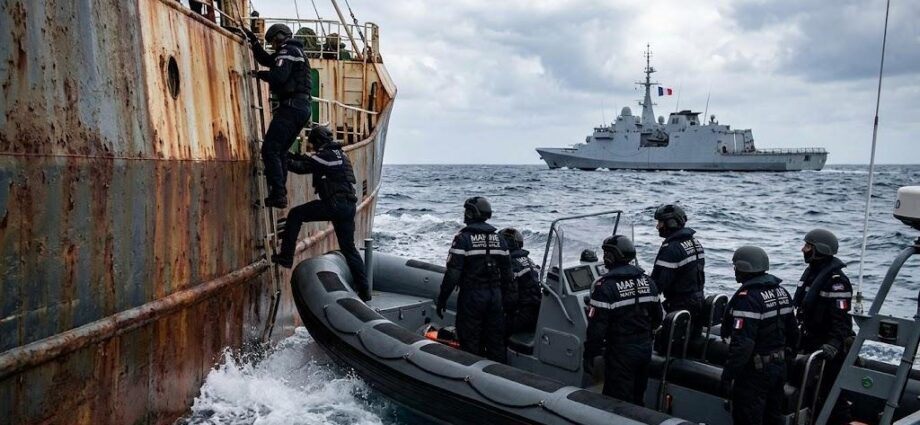
The interception of the DF Peak by French naval forces off the coast of La Réunion in October 2026 has exposed the sophisticated tactics employed by Russia’s so-called shadow fleet to evade international sanctions. Beyond the headlines of a high-seas seizure, the operation reveals the vulnerabilities in maritime governance and the unintended consequences of flag state oversight.
Behind the seizure: uncovering the DF Peak’s double life
The DF Peak, a 244-meter tanker intercepted 830 kilometers south of La Réunion, was operating under what French authorities describe as a compromised Beninese flag. The vessel’s journey—from Venezuela near Madagascar—paints a picture of a ship that has systematically erased its paper trail. Originally registered as the NS Captain under Russian ownership, it later became the Kaliningrad in 2024 before adopting its current identity and flag in 2025.
This pattern of flag hopping is a hallmark of the shadow fleet: a network of vessels repurposed to transport sanctioned oil under the cover of jurisdictions with lax enforcement. The French operation, initiated under the authority of international maritime law, underscores how state-level sanctions are being undermined by maritime subterfuge.
The legal labyrinth: what Benin’s maritime code reveals
Cotonou’s role in this affair is far from accidental. Under Benin’s maritime law, a vessel must demonstrate a genuine economic or operational link to the country to fly its flag. The DF Peak’s documentation appears to violate this principle, raising questions about the integrity of Benin’s ship registry.
If investigations confirm the use of a fraudulent Beninese flag, it would constitute a severe breach of sovereignty. The nation’s maritime code mandates the immediate deregistration of vessels found in violation, particularly those linked to illicit trade or safety violations. As a signatory to the UN Convention on the Law of the Sea, Benin is legally obligated to enforce its maritime regulations—or risk becoming a haven for sanctions-busting operations.
From an international perspective, France’s intervention aligns with its right to inspect vessels under Article 110 of the Montego Bay Convention, given credible suspicions of falsified documentation. Meanwhile, Benin retains the authority to seek judicial cooperation from France to investigate potential complicity by shipping intermediaries or vessel owners in bypassing national registration laws.
The shadow fleet phenomenon: a global game of regulatory whack-a-mole
The DF Peak case is not an isolated incident but a symptom of a larger systemic issue. The shadow fleet thrives on opacity, leveraging a web of shell companies, non-compliant insurance policies, and covert cargo transfers to obscure the origin and destination of sanctioned oil. These vessels often operate in dark zones where maritime surveillance is minimal, making enforcement a persistent challenge.
For Benin, the stakes are high. The interception serves as a wake-up call to overhaul its ship registry, ensuring it does not become an unwitting partner in global sanctions evasion. Without rigorous oversight, the country risks reputational damage and potential sanctions of its own—especially if its flag is exploited by networks tied to illicit trade.
Key takeaways
- Fraudulent flags are a critical tool for the shadow fleet, allowing sanctioned vessels to masquerade as compliant ships under the guise of a foreign registry.
- Benin’s maritime code requires ships to prove a real economic link to the country—a standard the DF Peak may have failed to meet.
- The Montego Bay Convention empowers nations like France to inspect suspicious vessels in international waters, a provision central to this case.
- Shell companies and insurance gaps enable the shadow fleet to bypass sanctions, creating a regulatory blind spot that demands urgent attention.
The DF Peak seizure is more than a military operation; it is a test of whether the global community can close the loopholes that allow sanctions to be systematically undermined. For Benin, the challenge now lies in proving that its maritime flag is not for sale to the highest bidder in the shadow trade.
Comments are closed, but trackbacks and pingbacks are open.