The Malian junta’s misplaced trust in Russian mercenaries fuels insurgency and economic collapse
When the Malian military leadership invited Russian mercenary forces into the country in 2021, their strategic focus shifted sharply toward suppressing Touareg rebels in the northern regions. Analysts now argue this redirection of military resources inadvertently granted breathing space to extremist factions—namely the Group for the Support of Islam and Muslims (GSIM) and the Islamic State in the Greater Sahara (ISGS)—allowing them to expand operations and choke off critical trade routes, plunging local economies into disarray.
The joint operations led by the Africa Corps, the Russian mercenary unit now active in Mali, have relied on heavy-handed tactics. Thousands of civilians, predominantly from ethnic minorities, have been killed in mass raids and summary executions under suspicion of rebel or terrorist affiliation. Far from crushing resistance, these brutal campaigns have swollen the ranks of militant groups, as grieving communities turn to extremism for protection and retaliation.
“While the junta fixated on reclaiming remote desert outposts from Touareg factions, the GSIM quietly consolidated its influence closer to Bamako,” explains security analyst Wassim Nasr. “Their obsession with retaking the North became propaganda gold for the insurgents. Every village they destroyed became another recruiting ground.”
The breakdown of peace and the rise of extremism
In January 2024, the Malian transitional government formally abandoned the Algiers Accords, the 2015 peace agreement between the former democratic government and the National Liberation Front of Azawad (FLA). This decision followed a dramatic military campaign in November 2023, when Malian forces, backed by Wagner Group mercenaries, seized the Touareg stronghold of Kidal—a move that further alienated local populations and pushed civilians toward militant groups.
Meanwhile, as government forces pursued the Touareg minority, the GSIM and ISGS—both affiliated with Al-Qaeda and the Islamic State respectively—were making alarming gains in central Mali. Their expanding control has culminated in a creeping encirclement of Bamako, crippling supply lines from neighboring Senegal and Côte d’Ivoire and strangling the capital’s economy.
The junta’s pivot toward Russian mercenaries came after severing military cooperation with France, which had led the Barkhane and Serval counterterrorism missions for over a decade. These French-led operations had helped stabilize northern Mali and laid the groundwork for the Algiers Accords. Yet, the junta’s decision to expel the United Nations Multidimensional Integrated Stabilization Mission in Mali (MINUSMA) in late 2023 left a dangerous vacuum. In its place, Russian mercenaries and Malian troops launched sweeping offensives against suspected terrorists, culminating in one of the most notorious atrocities: a three-day assault on the village of Moura in central Mali, where hundreds of Fulani civilians were executed by Wagner fighters.
The Moura massacre, along with subsequent raids on communities accused of harboring militants, has eroded public trust in both the junta and its Russian allies. Rather than deterring recruitment, these abuses have driven more young men into the arms of militant groups like the GSIM, ISGS, and FLA. The analyst Nasr notes a glaring absence of development initiatives under the junta. “Their only infrastructure project is hate: ‘We hate France. We hate the West.’ There are no schools built. No roads repaired. No hospitals opened.”
Military setbacks and the mercenaries’ retreat
By July 2024, the tide had turned. In the northern commune of Tin Zaouatine, Touareg fighters ambushed a joint Malian-Russian convoy, forcing Wagner forces to flee into territory controlled by the GSIM. The ambush resulted in heavy losses: nearly 50 Malian soldiers and over 80 mercenaries killed. “That was the moment Wagner stopped being Wagner,” says Nasr. “The label changed, but the tactics didn’t improve.”
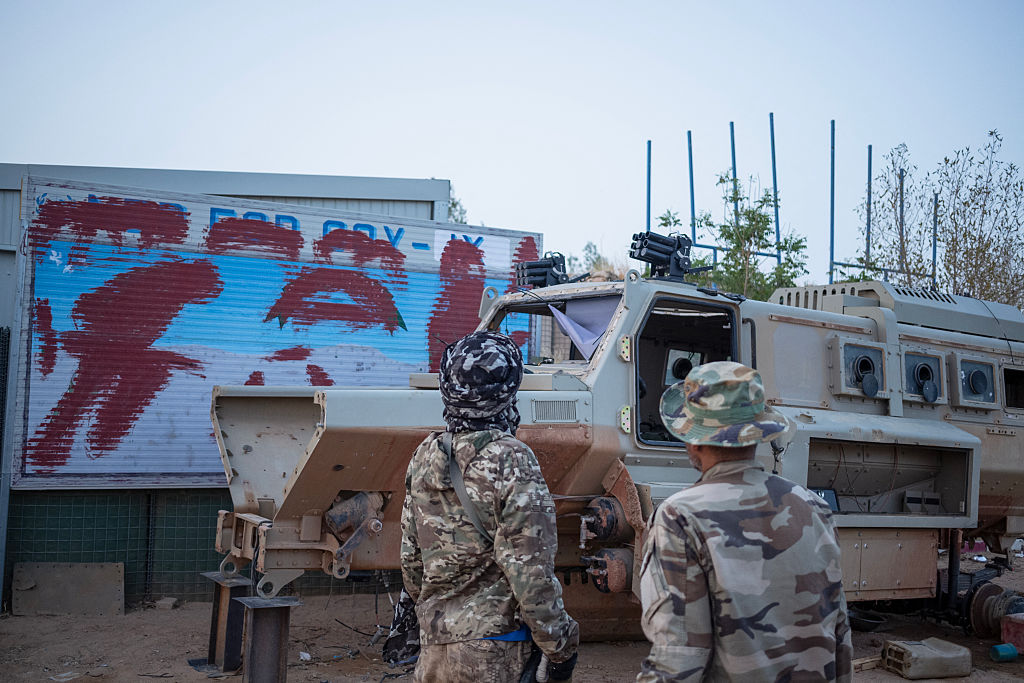
Following the defeat, Wagner announced its withdrawal from Mali. Its successor, the Africa Corps—staffed largely by former Wagner veterans—took over operations but with reduced aggressiveness. The unit now operates primarily from fortified bases, relying on drone surveillance to guide Malian patrols rather than engaging directly on the ground.
“They still move out occasionally, but their confidence has evaporated,” observes Nasr. The shift became evident in late April 2024, when the Africa Corps joined Malian troops in an attempt to repel a joint GSIM-FLA assault on Kidal. As the militants advanced, the mercenaries fled, and Kidal fell to the FLA. On the same day, a separate attack claimed the life of Mali’s Minister of Defense.
With battlefield losses mounting, the Africa Corps has recalibrated its mission—no longer focused on defeating insurgents, but on preserving the junta’s grip on power. The GSIM’s influence now stretches perilously close to Bamako, threatening key infrastructure like the international airport and critical fuel supply routes. Despite the growing peril, the junta shows no inclination toward dialogue with militants. Instead, it clings to the mercenaries as its sole lifeline. “They have no other option. They’re isolated, besieged, and terrified. They keep paying because the Africa Corps is their last insurance policy.”