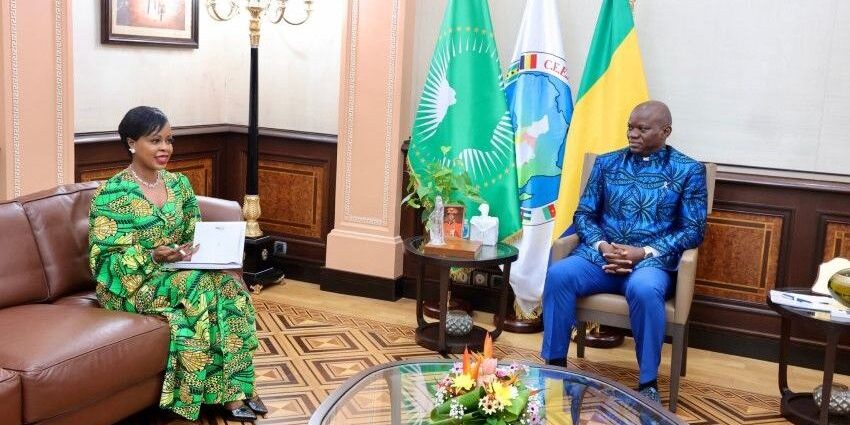
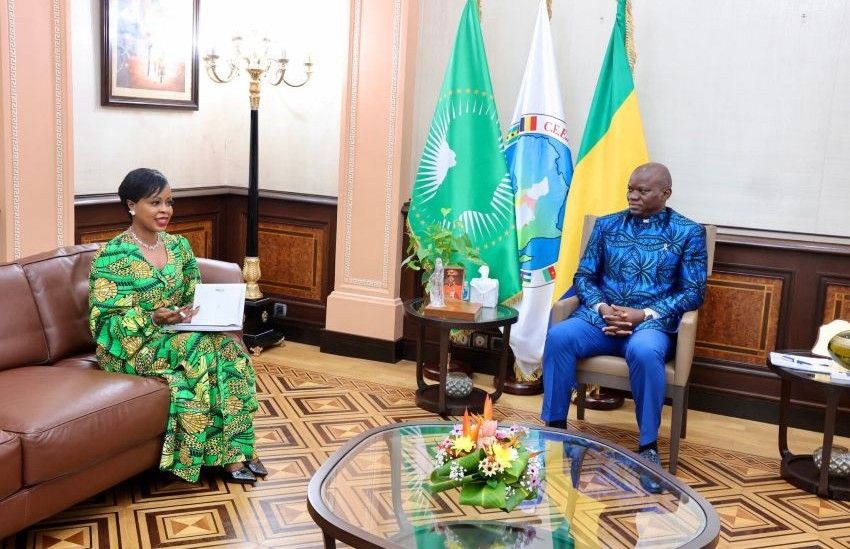
Libreville, Sunday, October 4, 2026 — The real story behind Gabon’s latest skills push isn’t the headline number of 400 trainees, but the quiet shift in how the country defines economic power. On October 2, 2026, President Brice Clotaire Oligui Nguema met with Zenaba Gninga Chaning, Minister of Trade, SMEs and SMIs, who presented a package of programmes focused on training, job placement and youth support. The first concrete outcome: 400 young people will be trained in Libreville before a gradual rollout across all nine provinces.
The meeting reflects a deeper calculation. Gabon has long relied on oil, roads and industrial equipment as markers of progress. Now, the government is testing whether human skills can function as strategic infrastructure — a less visible asset that determines whether the rest actually works.
Why this decision matters more than it looks
Behind the announcement lies a practical dilemma. Gabon wants to diversify its economy and give national companies a bigger role in creating value. But that goal runs into a hard constraint: without enough technicians, entrepreneurs and professionals, a more productive economy simply cannot function.
The programme is therefore not just an insertion scheme. It is an attempt to answer a structural question that has quietly shaped economic policy for years: how do you build a productive economy when the skills base is too thin to sustain it?
From diplomas to real economic output
The emphasis on technical and practical trades is deliberate. The first 400 beneficiaries are not expected merely to earn a qualification. They are meant to convert that training into a job, a revenue-generating activity or a business.
This marks a break from a model where training ends with a certificate. The aim is to install a more demanding chain: skill, insertion, production, income and value creation.
The announced mechanism includes support beyond the classroom — technical assistance, access to financing and project monitoring. That link is critical. Across many African economies, the biggest obstacle to entrepreneurship is not a lack of ideas or know-how, but the difficult transition from qualification to economic viability. In August, the government had already outlined a framework built on three pillars: train, support and finance, with guarantee and financing mechanisms for young project leaders.
The strategic ambition: producing more with national talent
Behind the training policy sits a broader ambition: increasing Gabonese participation in national value chains.
The stated goal is to support SMEs and SMIs, promote local production and strengthen national capacity, while gradually reducing reliance on external skills where they can be developed at home.
This issue carries particular weight in sectors where the country invests or seeks to invest more: infrastructure, energy, oil and gas, digital, industry, technical services and raw material processing. Developing these activities depends not only on capital. It also requires a workforce able to install, operate, maintain, manage and eventually innovate.
A signal sent days earlier in Port-Gentil pointed in the same direction. During a visit to the Oil and Gas Institute, the head of state stressed the need to strengthen scientific, technical, oil, gas and energy training to meet growing corporate demand and reduce dependence on certain programmes taken abroad.
The coherence is clear: economic sovereignty is not just about controlling resources. It requires having the people capable of turning them into value.
From 400 pioneers to a change of scale
The first cohort of 400 young people is less an end point than a full-scale test. The planned expansion from Libreville to the nine provinces will be decisive. A national skills policy cannot work if it reproduces an excessive concentration of opportunities in the capital.
The challenge will also be adapting training to each territory’s economic reality. The needs of an oil basin, a farming area, a mining zone or an urban hub are not the same. Provincial expansion must therefore be designed as much as a territorial development policy as an employment policy.
It is above all the post-training period that will reveal the programme’s real reach. How many young people will actually find jobs? How many will create viable activities? How many businesses will grow thanks to newly available skills? And what share of these new activities will genuinely strengthen local value chains?
These indicators will matter more than the number of people trained.
Gabon is opening a less spectacular construction site than physical infrastructure, but one that may prove just as decisive. A road connects territories; a power plant fuels the economy; a port facilitates trade. But it is skills that allow these infrastructures to function, businesses to grow and investments to produce lasting returns.
Treating human capital as strategic infrastructure means recognising that economic transformation will only be sustainable when Gabonese people themselves have the capacity to design it, build it and capture its value.
Comments are closed, but trackbacks and pingbacks are open.