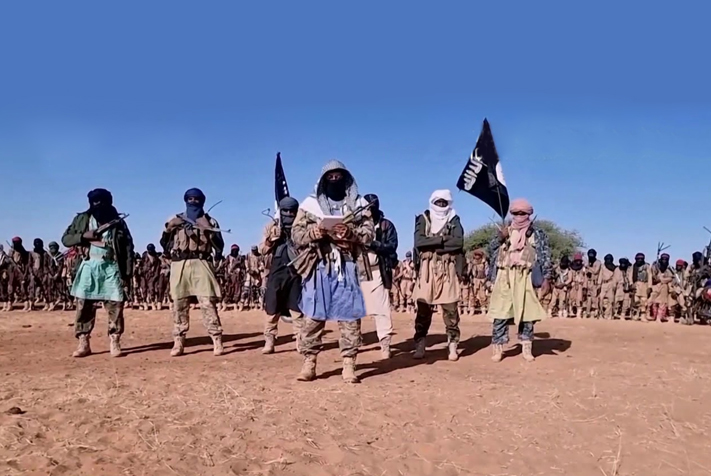
Despite the JNIM’s growing prominence, the Islamic State’s Sahel Province maintains a firm grip on Mali’s northeast, particularly in Gao and Ménaka regions.
The Islamic State in the Greater Sahara (ISGS), now known as the Islamic State Sahel Province (ISSP), continues to exert control over key areas in Mali, especially in the Gao region’s Ansongo district and the Ménaka region. These zones, including the so-called ‘3T’ localities—Talataye, Tin-Hama, and Tessit—as well as Labbezanga, remain the epicenter of the group’s operational activity, where it establishes territorial dominance and exerts relentless pressure on local communities.
Leadership dynamics
The ISSP is currently led by Abou Al-Bara, who took over after the death of Adnan Abu Al-Walid Sahraoui in 2021. While the exact command structure remains somewhat unclear, the group has significantly altered its tactics since 2020. Shifting away from large-scale public executions and mass terror, the ISSP now focuses on targeted territorial control and localized governance, minimizing high-profile attacks that could draw international attention. This approach includes efforts to win over local populations through a mix of coercion and perceived service provision.
Malian military operations against the ISSP show no signs of slowing down. In a recent strike, the Malian Armed Forces (FAMa) conducted an airstrike in Bara, Ansongo district, on the night of May 14-15, 2026, neutralizing a key operational leader of the ISSP and several affiliated fighters. This operation underscores the persistent pressure on the group’s strongholds while highlighting its ability to regroup along border areas and sustain its logistical networks.
Strategic operations and regional influence
The ISSP continues to target critical localities along the Mali-Niger corridor, including Talataye, Tin-Hama, Tessit, Labbezanga, and Ménaka. By controlling the movement of people and goods, the group reinforces its dominance over these regional pathways, maintaining influence over local armed factions. This strategy not only secures its operational base but also extends its reach into neighboring countries.
The ongoing rivalry between the ISSP and JNIM remains a defining feature of Sahel’s security landscape. While the JNIM has gained visibility through high-profile attacks, such as those on April 25, 2026, around Bamako and other parts of Mali, the ISSP’s threat has not diminished. The two groups operate under distinct strategies: JNIM leans toward spectacular, media-driven attacks, whereas the ISSP focuses on subtle territorial control, community pressure, and securing strategic axes. The fragile truce that once limited direct clashes has eroded since 2020, though recent military offensives have temporarily shifted the groups’ priorities toward a common adversary—the Malian state—without any formal peace agreements in place.
Escalating threats and local impact
Recent data from ACLED, as of May 15, 2026, reveals that 86% of the Islamic State’s global activity in the first quarter of 2026 occurred in Africa, with a notable rise in armed drone strikes, motorized attacks, and economic pressures on both urban and rural areas. The ISSP has specifically targeted civilian and military infrastructure along the Ménaka-Ansongo-Tessit axis and Labbezanga, exploiting local weaknesses to impose its de facto authority. The February 7, 2026, attack on a civilian convoy near Kobé, 35 kilometers from Gao, serves as a stark example of this strategy.
International security cooperation has led to the elimination of several high-profile ISSP figures, including Abu-Bilal Al-Minuki, neutralized on May 16, 2026, during a joint operation in the Lake Chad basin involving Nigerian and U.S. forces. Despite these setbacks, the ISSP’s threat persists in northern Mali, particularly in the ‘3T’ localities and Labbezanga, where its territorial control and influence over local armed groups remain entrenched.
The ISSP leverages the media spotlight often turned toward the JNIM and other factions to consolidate its position, tighten its grip on populations, and maintain relentless pressure on Malian forces. Its sophisticated territorial organization and operational tactics demonstrate that the threat is deeply rooted, necessitating sustained and intensified efforts, particularly along the Mali-Niger border.