
From symbolic allegiance to ideological reconsideration
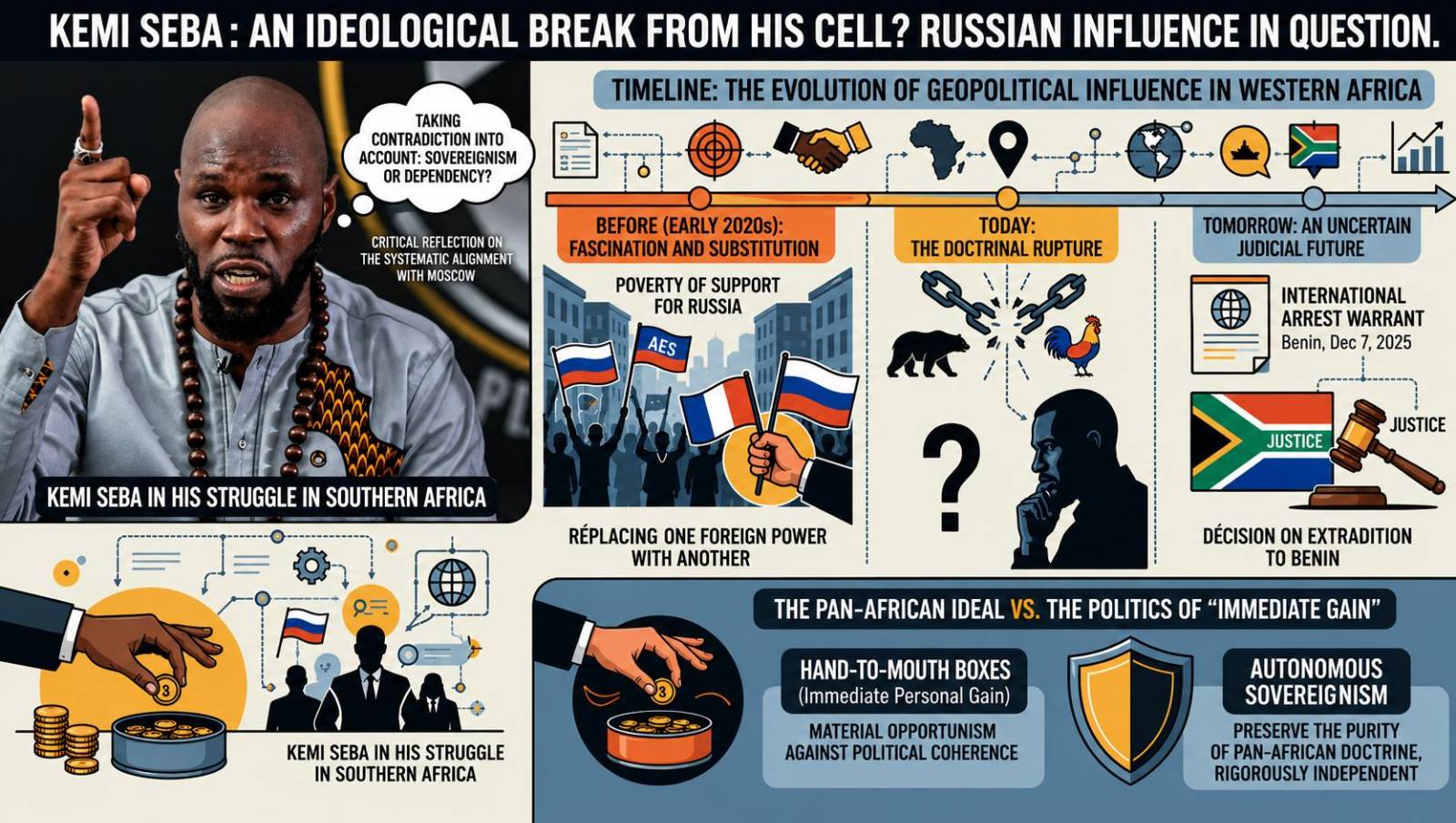
Over recent years, the political landscape across several African nations—particularly those within the Alliance of Sahel States (AES)—has witnessed a striking phenomenon. Public demonstrations echoing sovereignist ideals have increasingly featured Russian flags and chants endorsing Moscow, positioning the Eurasian power as an essential alternative to long-standing Western influences.
Yet beneath this wave of enthusiasm lies a growing skepticism. Even among movements advocating total independence, questions arise about the sustainability of such alignments. A prominent figure in contemporary Pan-Africanism, Kemi Seba, appears to be undergoing a significant ideological shift—one that challenges this trend—from within the confines of his cell in South Africa.
The illusion of replacing one dependence with another
The pursuit of new international partnerships is a legitimate diplomatic strategy for any state or political movement. However, the temptation to substitute one foreign power for another risks undermining the very sovereignty these movements claim to uphold. Replacing France’s historical influence with that of Russia does not signify liberation; it merely shifts the axis of dependency.
Observers suggest that Kemi Seba has begun to recognize this paradox. The Pan-African ideologue now questions the validity of an uncritical alignment with Moscow, rejecting any form of new protectorate—even one framed as anti-Western.
Pan-African ideals versus the politics of short-term gain
This critical stance has exposed a divide within sovereignist movements. While some support for Russia stems from a genuine desire for geopolitical rupture, other dynamics appear driven by more pragmatic—even opportunistic—interests.
Kemi Seba strongly opposes this trend, which he describes metaphorically as the cultivation of “boîtes à ragoût“—a reference to prioritizing immediate material gain over long-term political coherence. By rejecting what he terms ideological mercenarism, he seeks to uphold the doctrinal integrity of a Pan-Africanism defined by autonomy and principle.
A suspended political and judicial fate in Pretoria
This doctrinal introspection occurs against the backdrop of a personal crisis for the activist. Having been targeted by an international arrest warrant issued by the government of Benin in connection with the alleged coup attempt of December 7, 2025, Kemi Seba remains incarcerated in South Africa.
The activist’s future is no longer solely a matter of ideological debate but now hinges on judicial proceedings. The South African judiciary is poised to rule on Benin’s extradition request. Will this period of detention mark a definitive rupture in his political discourse, or merely a reconfiguration of Pan-Africanist thought? The coming weeks will be pivotal—not only for Kemi Seba’s personal trajectory but also for the movements he inspires across the continent.
