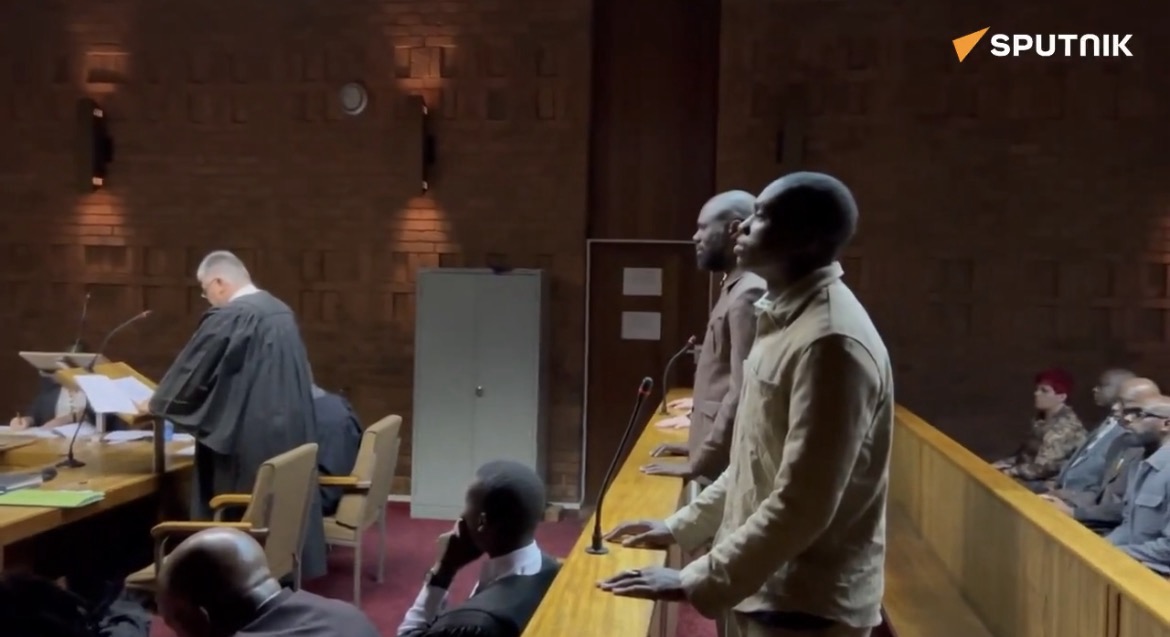
South African judiciary rejects activist’s arguments
Activist Kemi Seba, a Franco-Béninois national, remains incarcerated after the South African judiciary ruled on April 29 to deny his release. The court dismissed all defenses presented by his legal team, including a diplomatic passport that lacked official accreditation. With two international arrest warrants issued by Bénin hanging over his head, Seba’s legal prospects appear increasingly bleak. The case has been adjourned until May 11, leaving the activist in a precarious position.
A verdict grounded in legal rigor
Contrary to the expectations of his supporters, who had hoped for bail, the presiding judge ruled against Seba’s provisional release. The court cited two primary concerns: the high risk of flight and the severity of the international charges against him. This decision underscores a shift from Seba’s confrontational activism to the unyielding procedural standards of South African courts.
The diplomatic passport gambit fails
The defense’s attempt to invoke diplomatic immunity through a questionable passport proved ineffective. The court clarified that a diplomatic travel document—without proper accreditation from South African authorities—holds no legal weight. Seba was unable to provide an official mission order authorizing his presence in the country on behalf of a sovereign state. Consequently, the document was deemed equivalent to a standard passport, and the judge dismissed it as a tactical diversion.
Bénin’s extradition warrants loom large
The core of Seba’s predicament stems from his legal troubles in West Africa. Bénin has issued two international arrest warrants for the activist, whom it accuses of serious offenses warranting a state-led pursuit. South Africa’s decision to uphold his detention signals its intent to evaluate the validity of these extradition requests. This development places Seba in unprecedented legal jeopardy, far removed from public attention and his usual advocacy platforms.
From militant rhetoric to legal reality
Seba has long cultivated an image as a political prisoner, using each court appearance to amplify his anti-establishment narrative. However, South Africa’s judicial system, with its deep-rooted adherence to international conventions, appears impervious to such tactics. By prioritizing legal compliance over media spectacle, Pretoria has drawn a clear boundary between activism and the rule of law.
An uncertain future ahead
The coming weeks will focus on assessing the legitimacy of Bénin’s extradition demands. Should the South African judiciary find the conditions for extradition met, Seba could face deportation to Cotonou. Stripped of his French nationality months ago after publicly burning his passport, he now lacks consular protection and freedom of movement. The April 29 hearing served as a stark reminder of the limits of his influence.
The case has grown even more complex following leaked audio recordings, which suggest Seba was allegedly involved in a plot to destabilize Bénin. The recordings reportedly detail plans for a coup timed around the Vodun Days celebrations, with potential civilian casualties. For the activist, the era of fiery speeches has given way to the quiet solitude of Pretoria’s prison corridors.
Comments are closed, but trackbacks and pingbacks are open.