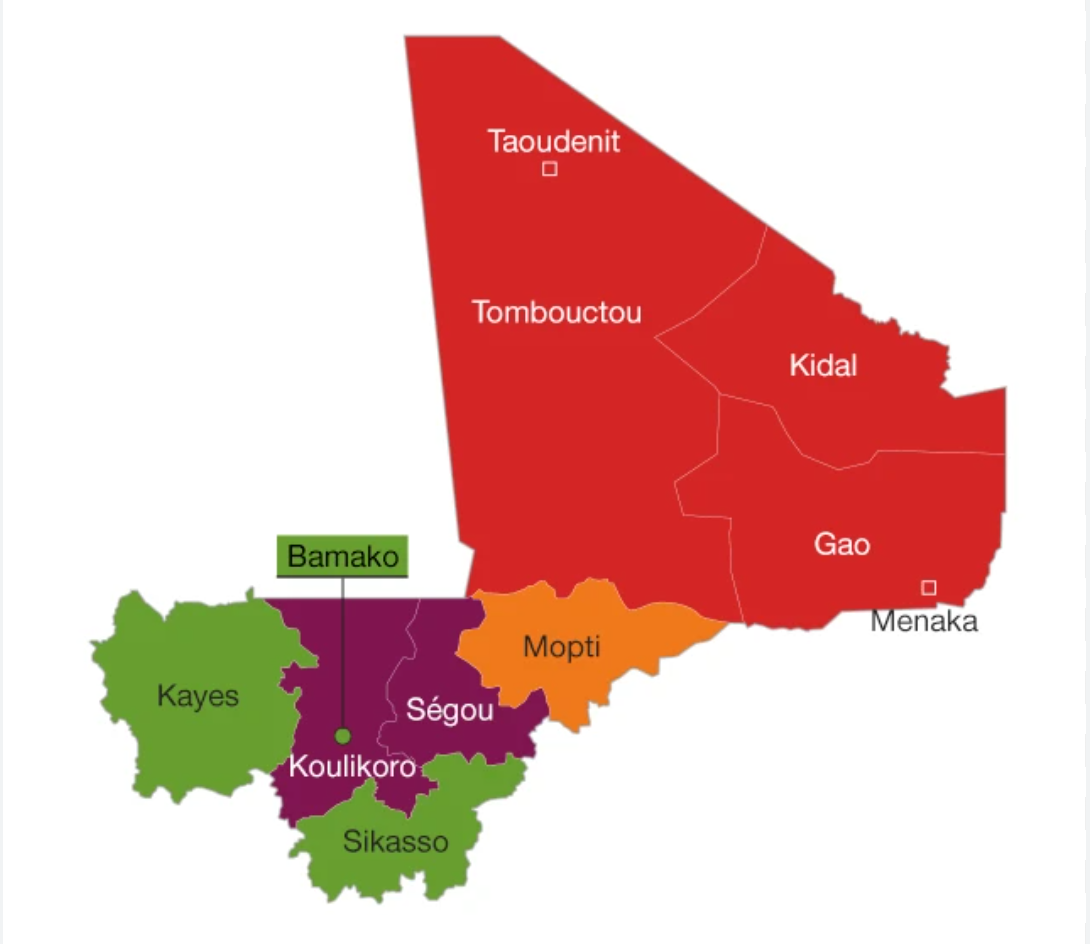
In Bamako, a palpable sense of relief has settled over the capital as two critical supply convoys delivered fuel and heavy weaponry, easing months of supply chain strain. Yet, just beyond the city’s perimeter, Mali’s central regions remain gripped by relentless insecurity, where armed groups continue to tighten their stranglehold on key transportation arteries.
Bamako’s lifeline: strategic supply routes prove resilient
After weeks of heightened anxiety over fuel shortages and logistical bottlenecks, Bamako experienced a significant breakthrough in late July. Two major convoys successfully navigated treacherous routes, bypassing militant strongholds to deliver essential resources to the capital.
The first breakthrough came on July 24, when a fleet of hundreds of fuel tankers arrived in Bamako after a daring overland journey through Kayes. The convoy’s safe passage marked a critical tactical success, thwarting militant attempts to disrupt the capital’s energy supply and ensuring the continued operation of essential infrastructure.
A new military corridor reshapes regional logistics
The momentum continued the following day when Mali took delivery of advanced military hardware transported via an unconventional route. A Russian-flagged cargo ship, the Mikhail Britnev, docked in Lomé, Togo, before the shipment was rerouted through Burkina Faso and into Mali via Sikasso. This alternative path avoided high-risk zones and demonstrated Mali’s evolving logistical adaptability in the face of militant threats.
The delivery included an array of state-of-the-art weaponry intended to bolster the capabilities of the Malian Armed Forces (FAMa) and their Russian allies. Among the equipment were 3 infantry fighting vehicles (BMP-2), 8 BMP-3 units, 14 mine-resistant ambush-protected vehicles (MRAPs), 4 BTR-82 armored personnel carriers, 2 anti-aircraft systems, and a substantial fleet of logistical trucks and tactical motorcycles.
Central Mali’s worsening crisis: highways become death traps
While Bamako benefits from newfound stability, the situation in central Mali has deteriorated sharply. The national highway RN16, a vital artery between Sévaré and Gao, has become a battleground for militants who exploit its vulnerability to launch devastating attacks.
On July 25 and 26, a joint FAMa and Africa Corps convoy heading toward Gao was ambushed near Hombori. Militants deployed improvised explosive devices (IEDs) along the Wami to Agoufou stretch, destroying or disabling several vehicles. The attack underscored the jihadist group’s deep territorial control and the persistent challenges faced by government forces in securing secondary supply routes.
JNIM’s multi-pronged offensive stretches military resources
The JNIM’s campaign extends beyond the Sévaré-Gao axis. In a separate incident, militants targeted a FAMa convoy between Niafunké and Tonka, while a counteroffensive near Niono on July 26 forced Africa Corps units to retreat. These coordinated strikes highlight the group’s ability to strike at will across vast swathes of central Mali.
Kouakourou’s fall: a humanitarian and military setback
The crisis in central Mali reached a new low on July 19 when the JNIM seized control of a military outpost in Kouakourou, a strategic village in the Djenné district. The loss of the position dealt a severe blow to Mali’s territorial governance and triggered a swift—but ultimately insufficient—air response.
On July 21, the military launched heavy airstrikes, claiming to have neutralized five armed motorcyclists and destroyed a logistics vehicle. However, ground forces were unable to retake the town, which remains under militant control. The inability to reclaim Kouakourou has left civilians in the area exposed to ongoing violence and humanitarian deprivation.
Mass displacement fuels a growing humanitarian emergency
The fall of Kouakourou and the absence of a decisive military counteroffensive have triggered a mass exodus. Thousands of residents have fled their homes, abandoning farms and properties to escape escalating violence. The influx of internally displaced persons has overwhelmed neighboring communities in the Mopti region, where reception capacities were already stretched to their limits.
A strategic imbalance persists
Mali’s military strategy now faces a critical paradox: while the capital and major cities benefit from enhanced security and fresh military assets, the countryside remains mired in conflict. The arrival of advanced weaponry may strengthen Bamako’s defenses, but it remains unclear whether these resources can translate into sustainable territorial gains against a resilient and adaptive adversary like the JNIM. The coming weeks will be pivotal in determining whether Mali’s logistical triumphs can translate into lasting security improvements beyond its urban strongholds.