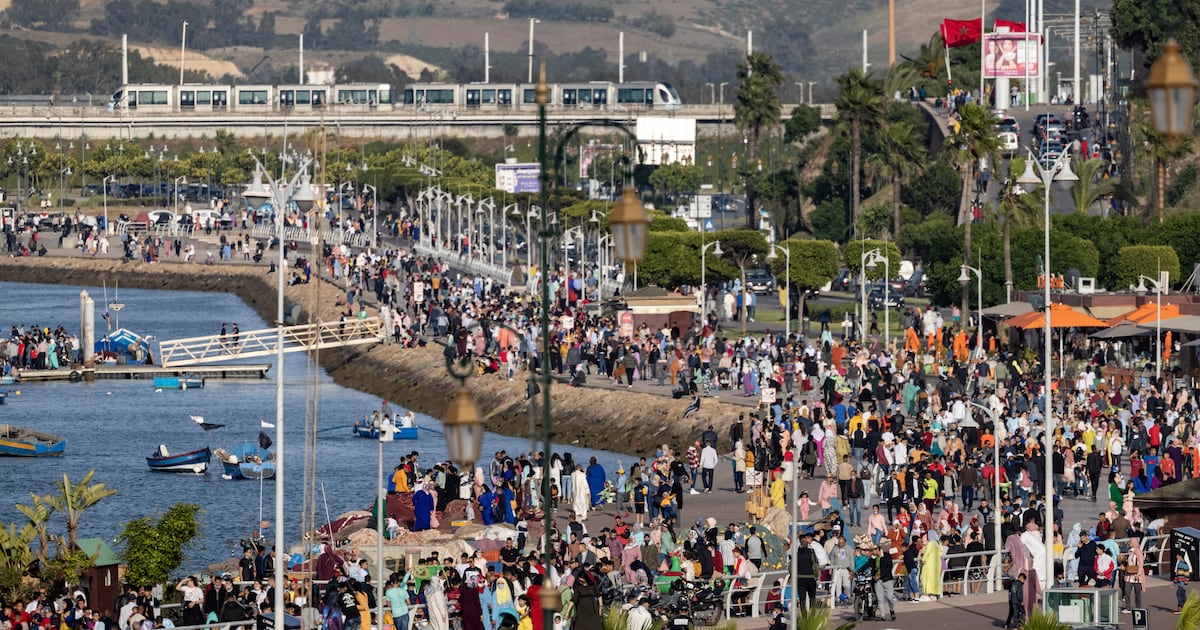
Morocco’s High Commission for Planning has released new demographic projections for the period between 2024 and 2060, offering a detailed look at how the country’s population might evolve under different scenarios involving fertility, mortality, and migration trends.
Under the medium-term scenario, the population is expected to rise from 36.8 million in 2024 to 43.3 million by 2060, marking a 17.8% increase over 36 years. This translates to an average annual addition of 182,000 inhabitants, signaling a gradual slowdown compared to past decades of steady growth.
The annual population growth rate, currently at 0.7% in 2024, is projected to decline steadily, approaching zero by 2060. This trend suggests Morocco is entering a phase of near demographic stagnation, a significant shift from the continuous growth observed in previous generations.
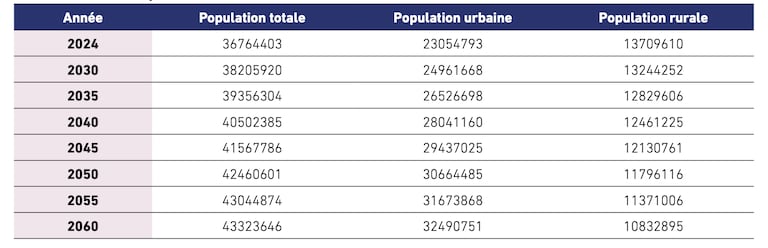
Urban areas are set to expand dramatically, with the urban population reaching nearly 32.5 million by 2060—representing about three-quarters of the total population. In contrast, the rural population is expected to shrink to around 10.8 million. The commission warns that this urbanization trend will intensify challenges related to housing, infrastructure, and social services, making it essential to implement targeted public policies to prevent territorial imbalances.
At the same time, the institution emphasizes the need to revitalize rural areas by improving living conditions, retaining young people, and leveraging local resources. These efforts aim to maintain social and territorial cohesion as Morocco undergoes significant demographic changes.
Fewer births, fewer students by 2060?
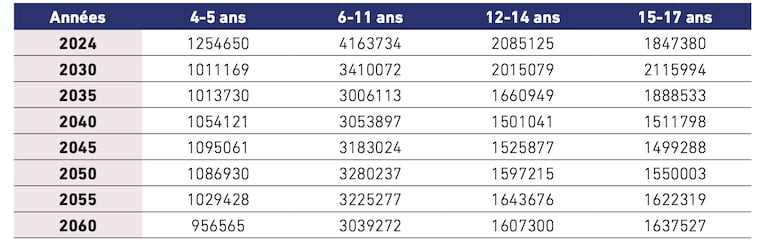
A decline in fertility rates is expected to lead to a sharp reduction in the number of young people. The preschool-age population (4-5 years) is projected to drop by 23.8%, from 1.25 million in 2024 to 0.96 million in 2060. Similarly, the primary school-age group (6-11 years) will decrease by 27%, from 4.16 million to 3.04 million.
The middle school cohort (12-14 years) will shrink by 22.9%, from 2.08 million to 1.61 million, while the 15-17 age group—comprising both young workers and secondary school students—will see a 11.4% decline, from 1.85 million to 1.64 million.
The commission views this demographic contraction as an opportunity for educational reform. With fewer students to accommodate, resources previously allocated to expanding school infrastructure could be redirected toward enhancing teaching quality, improving curricula, and strengthening pedagogical support.
Working-age population grows unevenly
The working-age population (15-59 years) is projected to increase from 22.08 million in 2024 to nearly 24.96 million in 2060, a 13.1% rise equivalent to an average annual addition of around 80,190 people. However, this growth will be unevenly distributed between urban and rural areas.
In cities, the working-age population is expected to surge by 34.4%, from 14.2 million to 19.1 million, driven largely by rural-to-urban migration. In rural areas, however, it will decline by 25.4%, from 7.9 million to 5.9 million. The commission cautions that this urban concentration will place significant pressure on labor markets, particularly in cities struggling to absorb an influx of workers from rural regions.
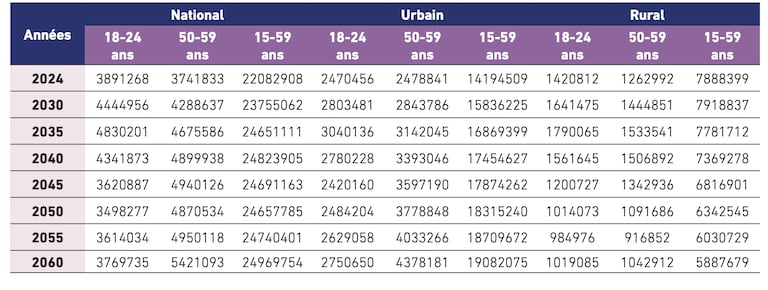
The 18-24 age group, which represents the main pool of new labor market entrants, is projected to decline slightly by 3.1% nationally, from 3.89 million to 3.77 million, though this trend will vary due to migration patterns. In urban areas, this group will grow by 11.3%, from 2.47 million to 2.75 million, while in rural areas, it will shrink by 28.3%, from 1.42 million to 1.01 million.
The 50-59 age group will experience a notable increase of 44.9% nationally, rising from 3.74 million to 5.42 million. This growth will be driven by a 76.6% rise in urban areas, compared to a 17.4% decline in rural regions.
These trends indicate that Morocco still has a window of opportunity where the working-age population continues to grow faster than dependent age groups—both the young and the elderly. However, this window is expected to close gradually as the proportion of people aged 60 and over increases, making it increasingly important to maximize the productivity of the available workforce before the effects of aging accelerate.
A quarter of the population will be 60 or older by 2060
The number of people aged 60 and above is projected to double from 5 million in 2024 to 10.9 million in 2060, with an average annual growth rate of 2.2%. By then, this age group will represent 25.2% of the total population, up from 13.6% in 2024, 9.4% in 2014, and just 8% in 2004. This means their demographic weight will triple over a span of just over 50 years.
The aging trend will be particularly pronounced in urban areas, where the number of seniors will increase 2.5 times, from 3.18 million to 8.06 million. In rural areas, the growth will be more modest, with the population aged 60 and over rising 1.6 times, from 1.81 million to 2.83 million.
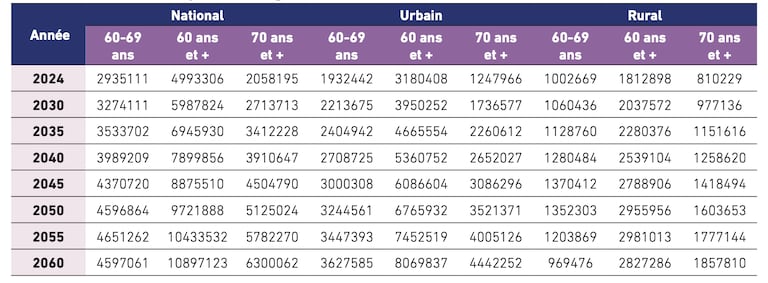
The commission attributes this disparity to two key factors: internal migration patterns that concentrate older adults in cities, where they often relocate for work and remain after retirement, and higher mortality rates in rural areas, which limit the growth of the elderly population in the countryside.
The 70 and older age group will experience even more dramatic growth, tripling from 2.06 million in 2024 to 6.3 million in 2060—an average annual increase of about 118,000 people. In cities, the number of septuagenarians will surge by 256%, from 1.25 million to 4.44 million, while in rural areas, the rise will be more moderate, from 0.81 million to 1.86 million.
This trend is closely linked to the decline in fertility that began in 1975, marking the start of Morocco’s demographic transition, as well as significant reductions in mortality rates. Migration flows have played a smaller but still relevant role. Generations born after 1975 will begin reaching retirement age around 2035, which will further accelerate the aging process in the decades to come.
Public policies must adapt now
The commission stresses that the rapid aging of the population will lead to an increase in the dependency ratio—the number of dependents (both young and elderly) relative to the working-age population. This shift will pose major challenges, including the financial sustainability of pension systems, the need for expanded healthcare services for an older population, and the preservation of intergenerational solidarity at a time when rural exodus and urbanization are weakening traditional family bonds.
The High Commission for Planning emphasizes that demographic aging is an inevitable and enduring structural trend, regardless of the scenario considered. For the institution, this transformation demands immediate action to redesign public policies in education, employment, territorial planning, and social protection—all aimed at supporting a Morocco that will grow more slowly but age more rapidly.
Comments are closed, but trackbacks and pingbacks are open.