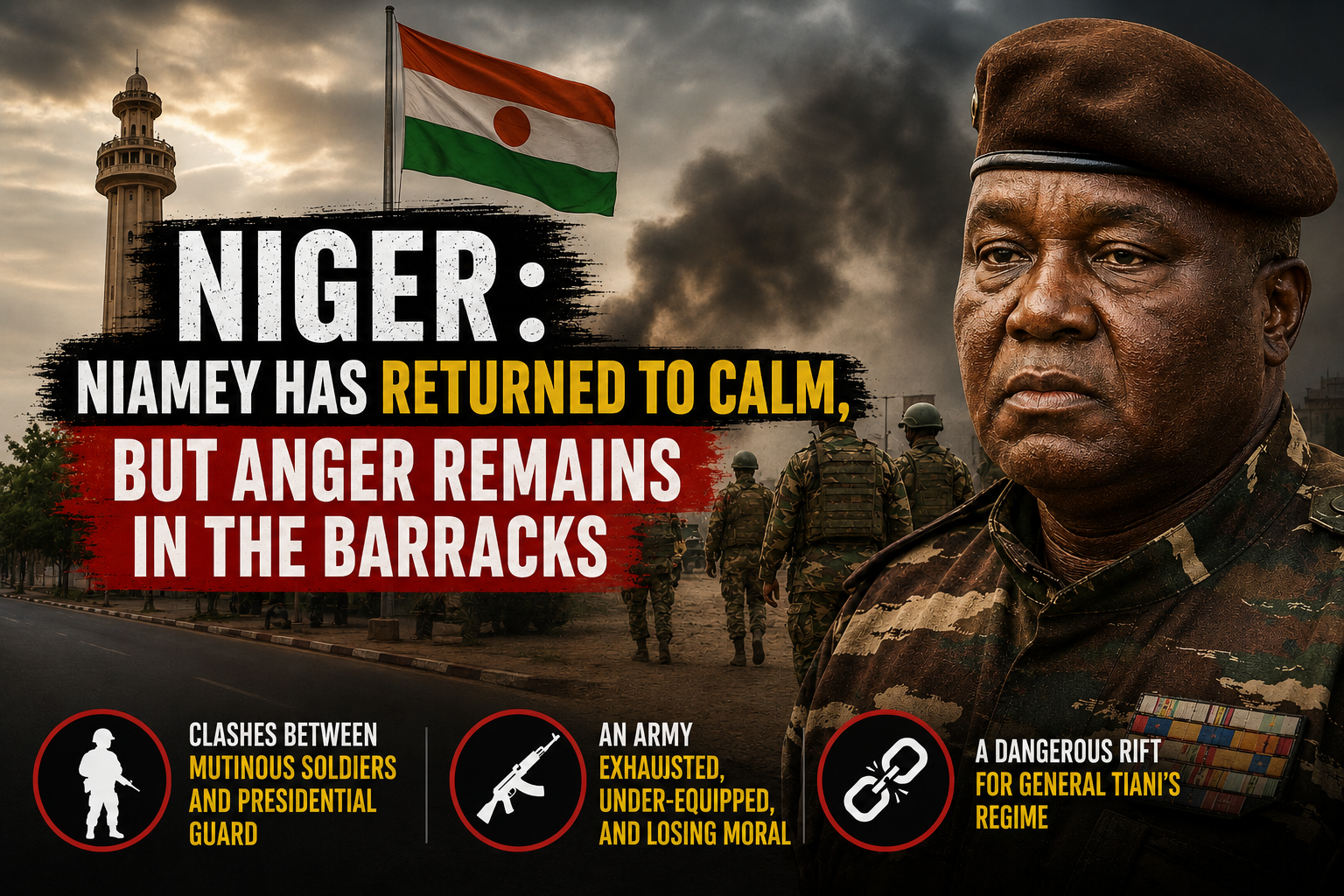
A sense of quiet has returned to Niamey this Monday, August 31st. Yet, beneath the re-established calm in the streets, a palpable tension lingers across the Nigerien capital following a weekend of extraordinary intensity, marked by explosions and automatic weapon fire. The confrontations, which erupted on Friday night into Saturday and continued throughout Saturday, pitted mutinous soldiers against elements of the presidential guard, supported by Russian forces from Africa Corps.
At present, General Abdourahamane Tiani, president of the National Council for the Safeguard of the Homeland (CNSP), maintains absolute silence. The junta’s official communication seeks to downplay the significance of these events, characterizing them merely as a “mood swing,” while no detailed official casualty report has yet been released.
However, reducing these clashes to a momentary disturbance risks obscuring the profound underlying causes of the unrest. When a segment of the military tasked with defending a regime turns against its own hierarchy, the issue extends far beyond a simple barracks incident. It directly calls into question the state of the armed forces, their operational conditions, and the trust between soldiers and their command.
A deep-seated anger
Beyond the terse official narrative, the reality on the ground paints a far more troubling picture. The fury that gripped a portion of the troops does not appear to be spontaneous. It may represent the accumulated expression of a feeling of abandonment among men who have been deployed for years in the country’s most perilous regions.
The assessment is particularly severe for military personnel routinely exposed to attacks from jihadist groups: human casualties, operational exhaustion, difficult rotations, supply challenges, and a pervasive sense of lacking the resources commensurate with the government’s stated ambitions.
A soldier can accept the inherent risks of combat. It is far more challenging for them to accept fighting with the conviction that they lack the necessary means to survive and protect their comrades.
It is precisely this frustration that warrants scrutiny, beyond the realm of political communication.
Sovereignty claims versus front-line realities
At the core of the resentment also lies a disparity between the sovereignist rhetoric championed by the CNSP and the harsh realities faced by units engaged in the field.
Since the junta’s ascent to power, the regime has positioned military sovereignty and a break from certain traditional partners at the center of its discourse. The enhancement of national capabilities and the engagement with new partners, notably Russian entities, have been presented as pivotal components of the new security strategy.
Yet, for the soldiers directly combating in threatened zones, the fundamental question remains far simpler: do they genuinely possess the necessary means to hold their positions and return alive from their missions?
Aging or insufficient weaponry, a dearth of appropriate vehicles, logistical hurdles, resupply difficulties, and deficiencies in operational support can transform every engagement into an additional ordeal.
Against highly mobile armed groups capable of swiftly exploiting vulnerabilities and striking isolated positions, every material inadequacy can lead to tragic consequences.
When front-line fatigue reaches the barracks
The problem, therefore, is not solely material; it is profoundly human.
An army engaged for an extended period in asymmetric warfare inevitably accumulates fatigue. When losses recur, attacks persist, and results appear insufficient despite promises of reconquest, troop morale can progressively deteriorate.
Frustration can then morph into defiance towards the hierarchy.
What transpires within the barracks must thus be regarded as an indicator of the security situation itself. A demoralized, exhausted army, or one convinced of inadequate support, becomes increasingly difficult to mobilize effectively over the long term.
The Niamey uprising, regardless of its precise final toll, thus unveils a crucial question: how long can a military institution endure the divergence between stated political objectives and the daily realities of its soldiers?
A fracture between power and combat units?
The anger of the mutineers could also signify a widening rift between the military’s high command and certain operational units.
On one side, the leadership emphasizes sovereignty, resistance to external pressures, and the reorganization of the security apparatus. On the other, soldiers directly confronting attacks may deem these responses insufficient given the urgency of the field.
This perceptual disparity poses a significant danger to any military regime.
For the true foundation of a power structure originating from the armed forces does not rest solely on the units tasked with protecting the leaders. It relies, above all, on the cohesion of the entire military institution.
When this cohesion begins to fray, the problem becomes as much political as it is military.
The role of Russian forces also raises questions
The presence of Russian Africa Corps elements alongside the presidential guard during the clashes adds another dimension to the episode. The deployment of foreign partners had been presented precisely as a means to bolster Niger’s security sovereignty and diminish its reliance on Western allies.
However, if foreign forces must intervene in a crisis pitting Nigerien military personnel against each other, it raises an awkward question: can the proclaimed enhancement of sovereignty truly compensate for the internal fragilities of the military apparatus?
An external partner can provide personnel, equipment, or expertise. However, it cannot sustainably replace the cohesion of a national army, the trust between troops and their command, nor can it resolve the structural problems of the front single-handedly.
Tiani’s silence will not erase the unease
General Tiani’s silence in the face of such a sensitive event may also fuel further inquiries. In a context where the junta tightly controls its communication, the absence of a precise report and the characterization of the event as a mere “mood swing” leave many unanswered questions.
Crucially, the more a power attempts to minimize a military crisis, the greater the risk of allowing questions about its true scope to proliferate.
Therefore, the return to calm in the streets of Niamey does not necessarily signify a return to calm within the barracks.
The gunfire may have ceased, but the deep-seated reasons for discontent do not vanish with the silence of arms.
An alarm signal for the junta
This episode should primarily compel the authorities to confront a fundamental reality: the war against jihadist groups is not won solely through political speeches, diplomatic alliances, or changes in partners.
It is also won with soldiers who are properly equipped, adequately supported, appropriately resupplied, and convinced that their hierarchy genuinely appreciates the sacrifices they make.
Should the unease persist, the question will no longer be merely how to contain a sporadic mutiny. It will be essential to understand why military personnel come to challenge their own command.
Niamey has regained its tranquility. Yet, within the barracks, anger may continue to simmer. And for the Tiani regime, this might be the true warning from this weekend: the danger does not solely emanate from the jihadist front. It can also arise from the fissures appearing within the very apparatus intended to protect the government. This is critical African news today, highlighting deep-seated issues in Africa politics English current affairs.
Comments are closed, but trackbacks and pingbacks are open.