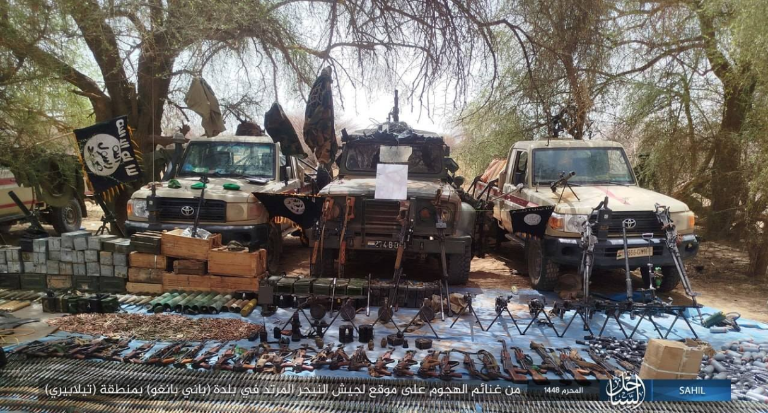
A wave of terror swept across Niger on Wednesday, June 24, 2026, as the État islamique au Sahel (EIS), also known as EI Sahel, launched two simultaneous and exceptionally violent assaults on military detachments in Inates and Banibangou. The assailants claimed a preliminary toll of at least 80 lives, with dozens of vehicles destroyed and heavy equipment captured. Beyond these grim statistics, the attacks have choked the daily life and local economies of these border regions with fear.
A coordinated and deadly offensive
The synchronized nature of the attacks on that Wednesday, June 24, 2026, leaves little doubt about the meticulous preparation by the terrorists. The assaults occurred at a time when troop movements are most challenging to anticipate, as the assailants descended upon the positions of Nigerien defense and security forces.
In Inates, a locality tragically accustomed to high-intensity conflicts within the volatile “three borders” area (Niger, Mali, Burkina Faso), the impact was particularly brutal. EI Sahel asserted responsibility for the deaths of at least 70 soldiers, the destruction of 22 military vehicles, and the capture of 24 others. Moments later, in Banibangou, a second terrorist column executed a similar assault, resulting in at least 10 fatalities, 16 vehicles destroyed, and 6 captured.
This dual offensive underscores the armed group’s alarming capacity for projection and freedom of movement, despite ongoing joint operations in the region, largely capitalizing on porous borders.
Economic paralysis: deserted markets and cut-off routes
Beyond the heavy price paid by the Nigerien army, these June 24 attacks have delivered a devastating blow to the economy of the Tillabéri region. Banibangou and Inates are not merely strategic military outposts; they serve as vital economic lifelines for supplying civilian populations.
When violence erupts, commerce often grinds to a halt. Goods trucks cease circulation, and the prices of essential commodities have reportedly doubled within 48 hours.
The economic repercussions of this double tragedy manifest in three primary areas:
- The crippling of weekly fairs: These markets, crucial financial engines for the region, facilitate the exchange of livestock and cereals. Today, they lie deserted, abandoned due to fears of further raids.
- The blockade of road networks: The theft and destruction of nearly 70 vehicles in total (both military and logistical) deprive the region of secure transport options, further isolating these communities from the rest of the country.
- The abandonment of agricultural lands: With the rainy season approaching, farmers and herders are reluctant to venture far from secured urban centers, posing a direct threat to medium-term food security.
Grief and the resilience of local communities
Across Niamey and Tillabéri, emotions run high. Victims’ families demand answers, while survivors from Banibangou recount apocalyptic scenes. EI Sahel’s strategy extends beyond targeting the state’s security apparatus; it aims to break the morale of the populace, forcing them into submission or exodus.
Yet, despite the pervasive fear, voices are rising to advocate for resilience and heightened national solidarity. Calls for blood donations are multiplying in the capital’s hospitals to support the evacuated wounded, and civil society urges the government not to abandon these peripheral territories in favor of urban centers alone.
What future for Niger’s security strategy?
These attacks in Inates and Banibangou acutely highlight questions regarding the effectiveness of surveillance systems and early warning mechanisms. For the ruling junta and military command, this setback necessitates a swift re-evaluation of on-the-ground tactics.
An imperative focus must be placed on rebuilding public trust. Without minimal economic security and the reopening of commercial routes, military presence alone will prove insufficient to stabilize the zone. The challenge in the coming weeks will thus be twofold: repelling the terrorist threat through extensive counter-offensives, while simultaneously injecting economic life into regions teetering on the brink of financial collapse.
Comments are closed, but trackbacks and pingbacks are open.