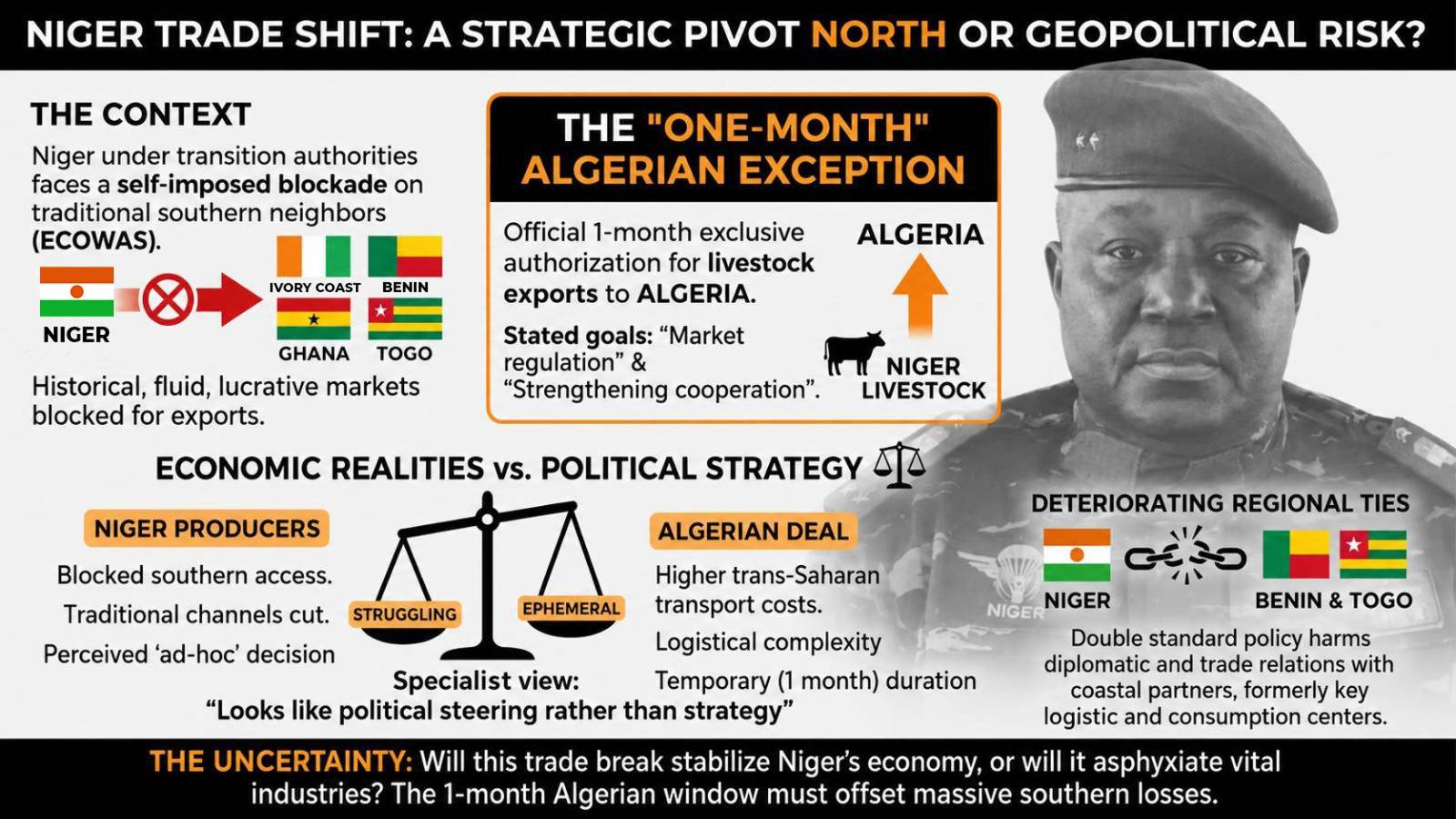
In a West African landscape increasingly strained by geopolitical divisions, Niger’s recent trade decisions have sparked sharp reactions among regional economists and analysts. While commercial borders remain tightly controlled or outright closed for exports to the Gulf of Guinea nations—including Côte d’Ivoire, Bénin, Ghana, and Togo—the transitional government in Niamey has unexpectedly carved out a temporary path northward.
An exceptional window for Algerian trade
The Nigerien authorities have officially approved a one-month exemption permitting livestock exports to Algeria. Authorities frame this move as part of an initiative to “regulate the domestic market” while fostering “enhanced economic cooperation” between Niamey and Algiers. Yet behind the official rhetoric, the decision reveals a more intricate and potentially damaging economic reality for local producers.
Local producers face uncertainty
Economic actors and observers are questioning the long-term logic of this uneven trade policy. For decades, the Gulf of Guinea has served as the primary, most accessible, and most profitable market for Nigerien livestock. Redirecting exports toward Algeria, albeit temporarily, raises concerns about the sustainability of the pastoral sector, already battered by recurring crises.
“Closing doors to traditional southern markets while opening a brief northern corridor seems less like a calculated economic strategy and more like a reactive political maneuver,” notes an expert on Sahelian cross-border trade flows, speaking on condition of anonymity.
Regional relations strain under divergent trade policies
This policy of selective market access is increasingly eroding diplomatic and fraternal ties with neighboring coastal states. Countries such as Bénin and Togo, long-standing logistical hubs and key consumers for Nigerien goods, now find themselves sidelined in favor of a Saharan axis that presents greater logistical hurdles. The decision has left many questioning whether Niamey’s leadership is prioritizing geopolitical realignments over the economic stability of its own producers.
With only a 30-day window to Algeria, the question remains: Can this temporary route offset the losses from blocked markets in Côte d’Ivoire, Bénin, or Ghana? Early assessments suggest the answer is uncertain. The high cost of trans-Saharan transport could absorb a significant portion of expected profits, leaving local herders—already vulnerable—to bear the brunt of the fallout.
A gamble with high stakes for Niger’s economy
The move underscores a broader shift in Niger’s foreign economic strategy, one that risks destabilizing vital sectors rather than strengthening them. As the one-month permit unfolds, the true impact on the country’s pastoral economy—and its regional relationships—will become clearer. Will this gambit stabilize Niger’s finances, or will it ultimately suffocate the very industries it claims to support? The coming weeks will hold the answer.