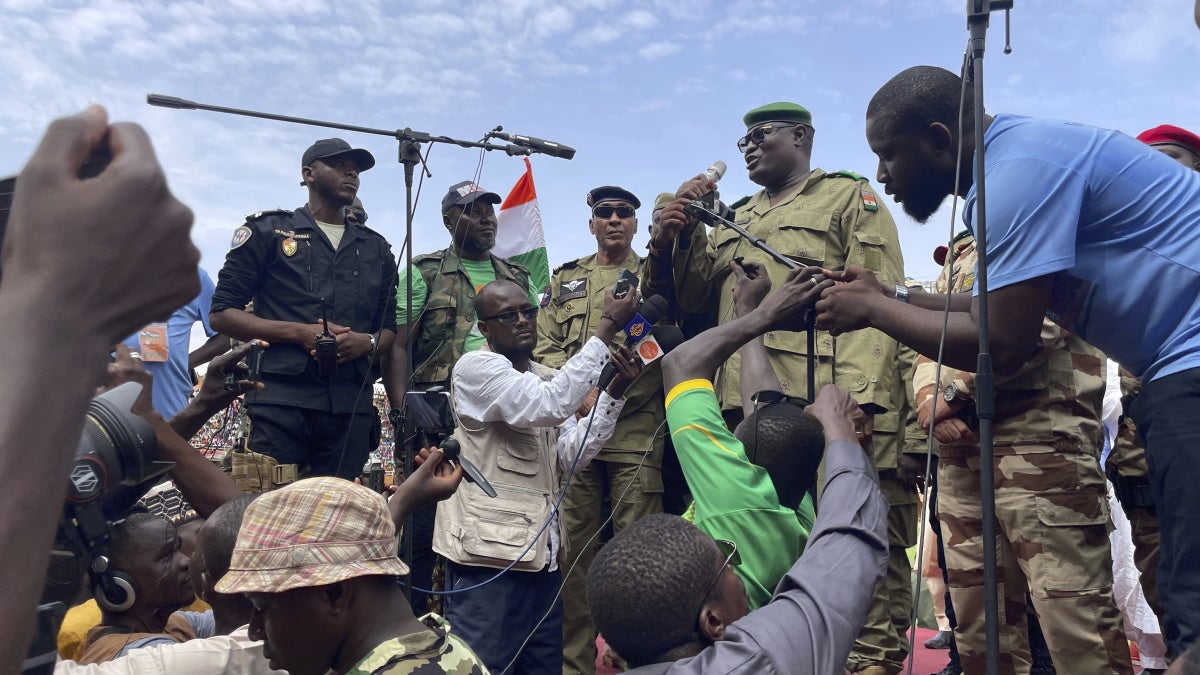
Military junta tightens grip on dissent as Niger marks coup anniversary
Nairobi – Since seizing power in Niger one year ago, the military junta has systematically suppressed opposition voices, independent media and peaceful dissent, according to joint findings by Amnesty International, Human Rights Watch and the International Federation for Human Rights (FIDH).
The deposed government officials, including former President Mohamed Bazoum, face arbitrary detention without due process. At least 30 close associates and officials have been jailed, while the junta continues to block scrutiny of military spending despite pledges to combat corruption. Human rights organizations are calling for the immediate release of all political detainees and urgent restoration of fundamental freedoms.
«One year after the coup, Niger’s military authorities are doubling down on repression rather than advancing human rights or the rule of law», said Samira Daoud, Regional Director for West and Central Africa at Amnesty International. «The junta must immediately release Mohamed Bazoum and all others detained for political reasons and guarantee their right to a fair trial.»
Coup timeline and regional fallout
On July 26, 2023, General Abdourahamane Tiani and other officers from the National Council for the Safeguard of the Homeland (CNSP) overthrew President Mohamed Bazoum, who had been democratically elected in 2021. Bazoum, his family and cabinet members were detained at the presidential palace in Niamey.
In response, the Economic Community of West African States (ECOWAS) imposed sanctions on July 30, including economic measures, travel bans and asset freezes targeting junta leaders. The African Union suspended Niger from all activities on August 22, 2023. By January 2024, Niger, Burkina Faso and Mali announced their withdrawal from ECOWAS, and sanctions were lifted on February 24, 2024.
Legal persecution and erosion of rights
Bazoum remains detained without trial, facing charges of high treason and threats to national security. In September 2023, he filed a case with the ECOWAS Court of Justice in Abuja, alleging human rights violations. The court ruled in December 2023 that his detention was arbitrary and demanded his release. Despite this, Niger’s State Court lifted Bazoum’s presidential immunity on June 14, 2024, in a process criticized for violating international fair trial standards.
At least 30 former officials, including ministers and presidential advisors, have been arbitrarily arrested. Many were held incommunicado by intelligence services before being transferred to high-security prisons on baseless charges. Four were released on bail in April, while others face military tribunal charges of endangering state security despite their civilian status.
Media crackdown and censorship
Since the coup, media freedom in Niger has deteriorated sharply. Journalists face harassment, arbitrary arrests and forced self-censorship. Key cases include:
- Samira Sabou, a blogger and journalist arrested on September 30, 2023, at her mother’s home in Niamey. Her whereabouts were unknown for a week before she was transferred to Niamey’s criminal investigations unit. Charged with disseminating data likely to disrupt public order, she was released pending trial.
- Ousmane Toudou, a journalist and former communications advisor to Bazoum, arrested on April 13, 2024, after criticizing the coup on social media. He faces charges of conspiracy against state security and remains in pretrial detention.
- Soumana Maiga, editor of L’Enquêteur, arrested on April 24, 2024, after publishing an article about alleged Russian surveillance in Niger. Detained for threatening national defense, he was released on July 9, 2024, pending trial.
- Tchima Illa Issoufou, BBC Hausa correspondent, reported receiving threats from security forces accusing her of destabilizing Niger through her coverage of Islamist attacks in Tillabéri. She fled the country in May 2024 after online harassment.
On January 29, 2024, the Interior Minister suspended the Maison de la Presse, an independent media organization, replacing it with a government-controlled media management committee. These actions violate Niger’s obligations under the African Charter on Human and Peoples’ Rights and the International Covenant on Civil and Political Rights, both ratified in 1986.
Suppression of civil society and legal manipulation
On May 29, 2024, the Justice Minister issued a directive banning human rights organizations from visiting prisons, contravening both national and international law, including the UN Convention Against Torture, which Niger ratified in 1988.
On June 12, 2024, the government amended the 2019 cybercrime law to reinstate prison sentences for online expression offenses, reversing earlier reforms that replaced imprisonment with fines for defamation. Human rights defenders warn this change will silence dissent and target activists.
«The surge in attacks on journalists over the past year reveals the junta’s determination to muzzle press freedom and access to information», said Drissa Traoré, Secretary-General of FIDH. «The cybercrime law revision is a dangerous setback that could silence critical voices and further target human rights defenders.»
Military spending secrecy amid corruption concerns
On February 23, 2024, General Tiani signed an ordinance exempting military spending from public oversight. The decree removes defense-related procurement, services and acquisitions from public accounting laws, shielding them from scrutiny. This move undermines anti-corruption efforts and erodes transparency in a sector already vulnerable to mismanagement.
«Public scrutiny of military activities is vital not only to restore civilian democratic rule and hold authorities accountable, but also to prevent the loss of public resources to corruption and mismanagement», said Ilaria Allegrozzi, Senior Sahel Researcher at Human Rights Watch. «The junta must commit to transparency by immediately disclosing verifiable financial information on military expenditures.»
Comments are closed, but trackbacks and pingbacks are open.