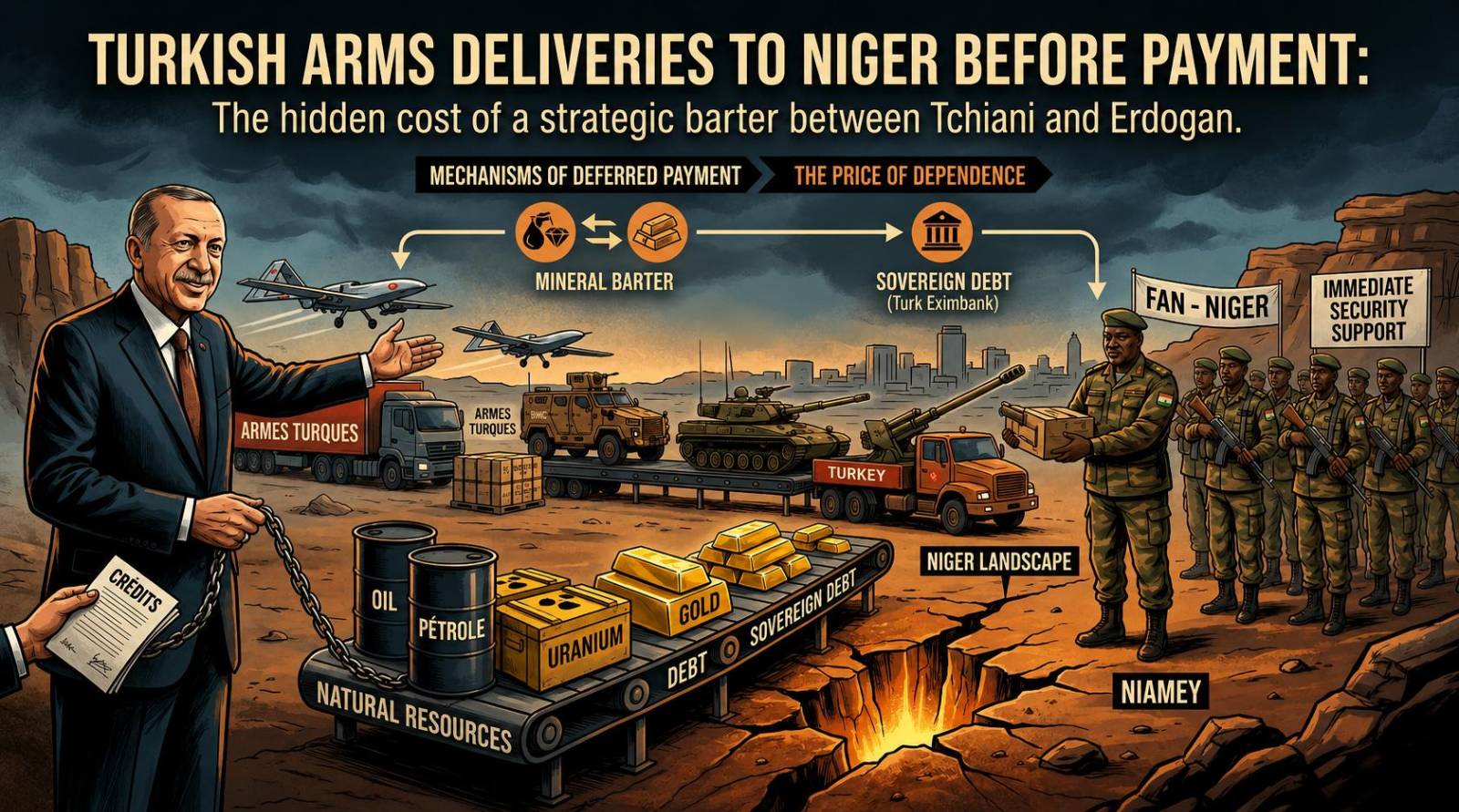
During his official visit to Ankara, General Abdourahamane Tchiani brought to light a significant arrangement: President Recep Tayyip Erdogan had authorized the transfer of military hardware to Niger prior to any financial settlement. While Niamey’s administration presents this as a gesture of solidarity, this departure from the stringent norms governing the international arms trade exposes the intricate workings of a collaboration that may encumber a portion of Nigerien sovereignty.
Within the realm of defense equipment transactions, the notion of “full credit” devoid of upfront guarantees is largely a misconception. Typically, defense manufacturers mandate substantial advance payments before the dispatch of any equipment. Consequently, the declaration made on June 4, 2026, by Niger’s transitional leader, conceals a sophisticated economic and geopolitical landscape where genuine gratuity is absent.
The financial implications: Unveiling deferred payment strategies
Global commerce operates on an unwavering principle: all delivered goods are ultimately compensated for, through various means. To circumvent Niamey’s immediate financial constraints, several compensatory mechanisms are reportedly being employed behind the scenes:
- Resource Exchange (The “Armaments for Minerals” Framework): Niger’s subsurface boasts some of West Africa’s most abundant reserves of uranium, petroleum, and gold. By agreeing to an early delivery of military provisions, Ankara effectively secures, in return, exploration rights or exclusive mining concessions for its national enterprises.
- Sovereign Credit Line Indebtedness: These sophisticated systems are not gratuitous transfers. Invoices are likely collateralized by loans extended through financial entities such as the Turk Eximbank. Consequently, Niger’s pressing security challenges are being transformed into a protracted financial obligation to Ankara.
The cost of reliance: A bargain for national sovereignty
General Tchiani perceives this strategic partnership as indispensable for bolstering the Nigerien Armed Forces (FAN) following the withdrawal of Western military contingents. Nevertheless, this ostensibly pragmatic short-term decision places a substantial encumbrance on the nation’s long-term trajectory.
The ramifications of accumulating debt are clear: By accepting advanced Bayraktar TB2 drones, armored vehicles, and communication systems on credit, Niamey potentially grants Turkey direct influence over its future economic and extractive resource policies.
Potential strategic concessions
- Access with preferential terms to Niger’s uranium and petroleum reserves.
- Establishment of Turkish logistical hubs or military facilities.
- Automatic diplomatic backing from Ankara within the Sahel region.
Erdogan’s strategic vision: Solidifying Turkish influence in the Sahel
For President Recep Tayyip Erdogan, the financial flexibility extended to military administrations across the Sahel represents a highly lucrative geopolitical investment, designed to achieve three primary objectives:
- To definitively displace Western powers from the vital Sahelian expanse.
- To counteract burgeoning Russian influence, particularly through entities like Africa Corps, by positioning Turkey as an indispensable technological provider.
- To secure robust markets for its rapidly advancing defense industry, which serves as a potent emblem of contemporary Turkish power.
Immediate political triumph, uncertain economic future
General Tchiani has secured an immediate internal political success by acquiring weaponry without depleting the national treasury. However, the perception of independence confronts the stark reality of material reliance. Positioned between security arrangements potentially involving Moscow and technological indebtedness to Ankara, Niger has not truly deviated from external influence dynamics; rather, it has merely exchanged creditors, at a price yet to be fully quantified for the Nigerien populace.