preserving Mali’s ancient manuscripts: unesco and savama-dci launch capacity building
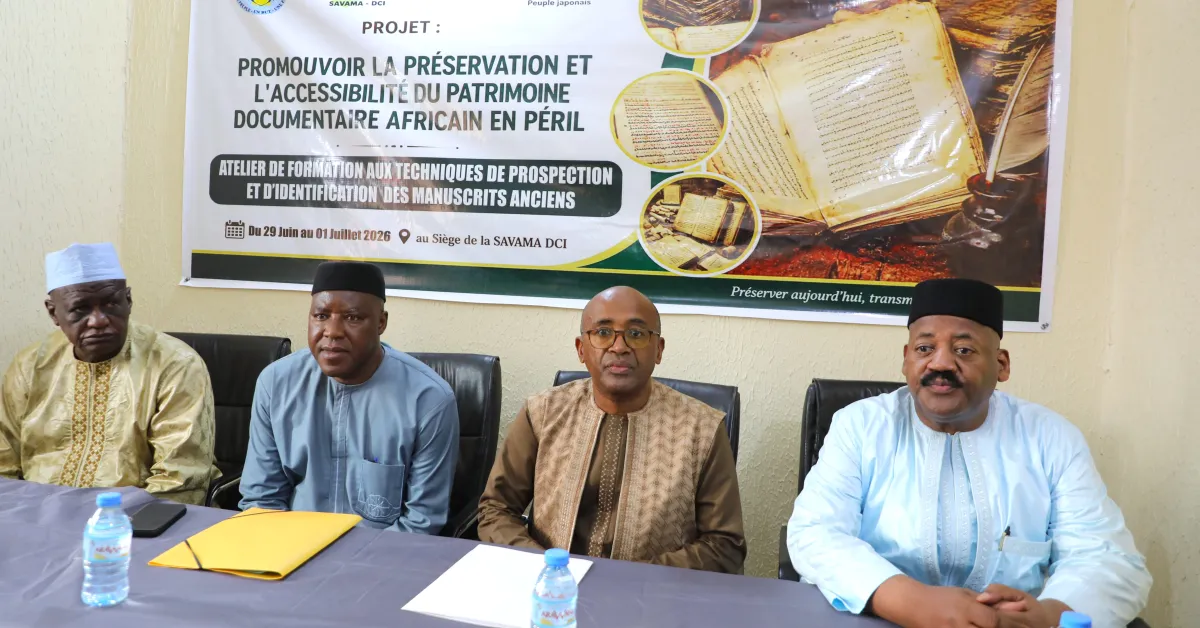
Under the banner of the project « Promoting the preservation and accessibility of endangered African documentary heritage », a significant capacity-building initiative has commenced with the inauguration of a series of training workshops focused on Mali’s precious ancient manuscripts.
Driven by the UNESCO Mali Bureau in collaboration with the NGO SAVAMA-DCI, this crucial undertaking aims to equip over 70 individuals—including agents from families who are custodians of these historical texts, as well as students and researchers—with enhanced skills to better safeguard and promote this invaluable heritage.
The ancient manuscripts of the Sahel region, particularly those found in Mali, represent an unparalleled repository of knowledge, illuminating the rich historical and intellectual legacy of the African continent. Confronted by threats stemming from security crises and the impacts of climate change, their preservation has emerged as a top priority for national authorities and their international partners.
It is with this urgent perspective that the current project seeks to build upon previous programs, refining practices for the conservation, accessibility, and valorization of this imperiled documentary heritage.
The comprehensive training curriculum is structured through several sequential workshops:
The inaugural workshop, taking place from June 29 to July 1, 2026, is dedicated to advanced techniques for prospecting and identifying ancient manuscripts. Participants will gain the expertise required to locate, pinpoint, and recognize manuscripts held within families, libraries, and various other conservation sites.
The subsequent workshop, scheduled from July 2 to July 4, 2026, will delve into inventory methods and the creation of systematic repertoires. Attendees will master the skills to collect, organize, and accurately describe manuscript-related information, alongside developing standardized descriptive entries.
These two complementary sessions, inaugurated on June 29, 2026, by the representative of the Minister of Handicrafts, Culture, Hotel Industry and Tourism, alongside the Acting Head of the UNESCO Mali Bureau and the Executive President of the NGO SAVAMA-DCI, are designed to cover the entire spectrum of ancient manuscript management. This ranges from their initial identification to their thorough systematic documentation, directly benefiting 15 agents from families who are entrusted with these ancient texts.
« The Department of Handicrafts, Culture, Hotel Industry and Tourism pledges its unwavering support for the successful execution of this project and will pay particular attention to its anticipated outcomes and broader impacts, » affirmed Mamadou Cissé, technical advisor and representative of the Minister in charge of Culture.
Ali-Mohamed Sinane, the Acting Head of the Bureau, emphasized the profound significance of the endeavor: « To preserve ancient manuscripts is to safeguard our collective memory, our identity, and our shared history. It is also to bequeath to future generations an intellectual legacy of immeasurable worth. I express my sincere hope that these workshops will be rich in exchanges, learning, and commitment, and that they contribute significantly to the efforts dedicated to protecting Mali’s documentary heritage. »
Upon the conclusion of these initial two workshops, participants will be proficient in conducting field missions, accurately identifying manuscripts, describing them, and contributing to their integration into structured inventory systems.
This training program, which will extend over the coming months to include students and researchers focusing on critical editing and translation of ancient manuscripts, marks a pivotal moment in strengthening national capabilities for the protection and valorization of Mali’s ancient manuscripts.
Through these workshops, UNESCO and its partners, notably the Government of Japan, reaffirm their steadfast commitment to preserving African documentary heritage. The overarching goal is not only to safeguard these cultural treasures for future generations but also to elevate their public recognition as historical assets of immense importance.
Comments are closed, but trackbacks and pingbacks are open.