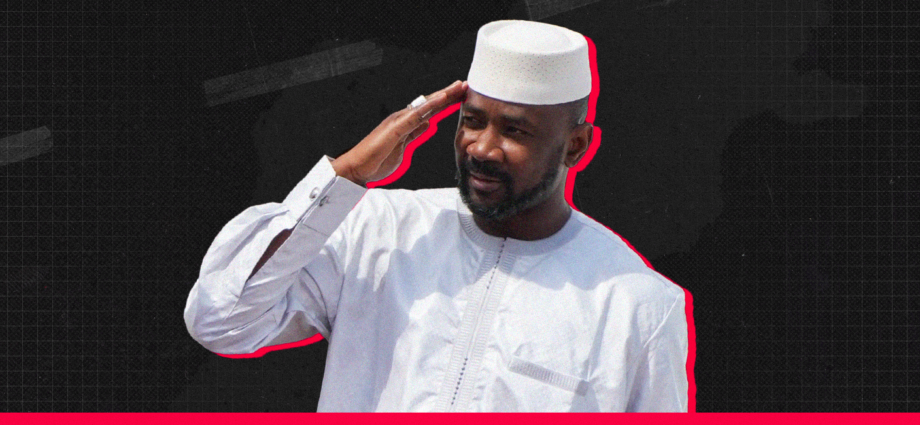
Press freedom decline in Mali under transitional government
Recent suspension of a live call-in show and the arrests of journalists Chahana Takiou and Abderhmane Keïta this June highlight the severe repression faced by media professionals in Mali. Over nearly six years of transition under Assimi Goïta’s regime, press freedom conditions have deteriorated sharply as authorities weaponize the justice system against critical voices. Reporters Without Borders (RSF) warns of the worsening state of press freedom in Mali, already weakened by deteriorating security conditions, and urges authorities to halt these repressive measures to restore full access to information for the public.
June has been a challenging month for journalists in Mali. Since June 19, listeners can no longer voice concerns on “Allo Klédu”, a live call-in program broadcast by the private radio station Klédu. The High Authority for Communication (HAC) suspended the show for two months, claiming that “several broadcasts violated the limits of audiovisual communication.” A decision widely seen as unjustified and abusive.
Also in June, the day after the Pan-African Media Forum (held June 3-6 in Bamako to promote press freedom and defend African media), the editor-in-chief of 22 Septembre, Chahana Takiou, and the editor-in-chief of Le Témoin, Abderhmane Keïta, were arrested. This brings the number of detained journalists in Mali to three, all charged under the cybercrime law. Chahana Takiou faces allegations of “damaging state credibility through the judiciary,” while Abderhmane Keïta is accused of “regionalist offenses aimed at undermining national unity and state credibility.” These latest crackdowns underscore the increasingly repressive climate facing journalists in the country, which has plummeted 22 places in five years in RSF’s World Press Freedom Index, dropping from 99th to 121st place.
“Before General Goïta’s coup, Mali was a West African leader in media freedom. But for nearly six years, it has faced not only worsening security threats but also systematic press freedom violations affecting all media outlets: international outlets suspended, local press silenced or forced into ‘patriotic reporting,’ arrested journalists, weaponized cybercrime laws, financial and logistical obstacles… RSF calls on General Goïta to end this repression of media professionals and release Youssouf Sissoko, Chahana Takiou, and Abderhmane Keïta.”
The detention of the two journalists has drawn sharp criticism from the press corps. The Maison de la Presse, in a statement, lamented that despite efforts to foster better relations between the media and judiciary, the latter has “failed to create an environment of peace and understanding.”
Over the past five years, journalists have faced multifaceted pressures, caught between authorities and armed groups. The Malian government has intensified efforts to enforce patriotic reporting, leveraging repressive legislation and a media regulatory body—the HAC—that often rules in favor of the regime.
The cybercrime law weaponized against journalists
Chahana Takiou and Abderhmane Keïta—whose trials are scheduled for July 27 and August 17, respectively—are not the first journalists targeted under the cybercrime law. Earlier, in March 2026, Youssouf Sissoko, editor-in-chief of L’Alternance, was sentenced to two years in prison and fined one million CFA francs (€1,525) by the National Cybercrime Unit for publishing a critical opinion piece about Niger’s transitional leader, General Abdourahamane Tiani. The law has also been used to detain Boubacar Traoré, editor-in-chief of L’Empire, in November 2025 for defamation after an article implicated the owner of Petro-Bama in a land dispute.
From censorship of international media to gagging local press
In March 2022, the suspension of Radio France Internationale (RFI) and France 24 across Mali marked the beginning of an overt crackdown on international media. Since then, four French outlets have been suspended in addition to RFI and France 24: TV5 Monde, France 2, and most recently TF1 and LCI.
Repression has since spread to Malian media. The suspension of Allo Klédu is the latest in a series of measures. In 2025, radios Aadar Koïma (Gao), Aadar Koukia (Ansongo), and Radio Kayira (Kolondiéba) were suspended for three months for criticizing military conduct or relaying dissent against authorities.
Before this, in 2022, Joliba TV News was suspended for two months following an editorial deemed too critical of the junta. In 2024, the HAC went further, suspending the channel for six months after a complaint from Burkina Faso’s media regulator. This suspension symbolized a shift toward aligned narratives among the Alliance of Sahel States (AES—Mali, Niger, Burkina Faso). Despite financial strangulation, Joliba TV News resumed broadcasting on June 30, 2025.
Self-censorship thrives under threat of retaliation
Years of repression have fostered widespread self-censorship, as documented in RSF’s 2023 report In the Skin of a Journalist in the Sahel. The muted coverage of the April 25, 2026, attacks illustrates this trend. While international outlets confirmed the assassination of Defense Minister Sadio Camara, many national media delayed reporting to avoid reprisals from the military hierarchy.
Economic stranglehold: a press sector on the brink
The crisis deepens with the collapse of public funding for media. Since January 2021, the state press subsidy, introduced in 1996 to support private media growth, has been discontinued. Previously capped at 200 million CFA francs (€300,000) annually, its withdrawal has crippled independent and private outlets already struggling with precarious conditions.
Adding to the strain, the ban on several NGOs and the departure of international organizations—key advertising partners for media—has further squeezed revenues.
Deteriorating security: one journalist killed, seven abducted by armed groups
Over the past five years, journalists have faced abductions and killings by armed groups, particularly in central and northern Mali. The Support Group for Islam and Muslims (GSIM/JNIM) is a leading perpetrator:
- In April 2021, freelance French journalist Olivier Dubois—correspondent for Libération and Le Point—was abducted in Gao and only released on March 20, 2023.
- In 2020 and 2021, journalists Hamadoun Nialibouly and Moussa M’Bana Dicko were abducted in central Mali; their cases remain unresolved.
- In 2023, Abdoul Aziz Djibrilla (radio Naata) was killed, Harouna Attino (radio Alafia) was injured, and Saleck Ag Jiddou and Moustapha Koné (directors of Radio Coton Ansongo) were abducted—all remain missing.
- In October 2025, two ORTM journalists, Daouda Koné and cameraman Salif Sangaré, were abducted between Sévaré and Konna and later released on December 29.
Comments are closed, but trackbacks and pingbacks are open.