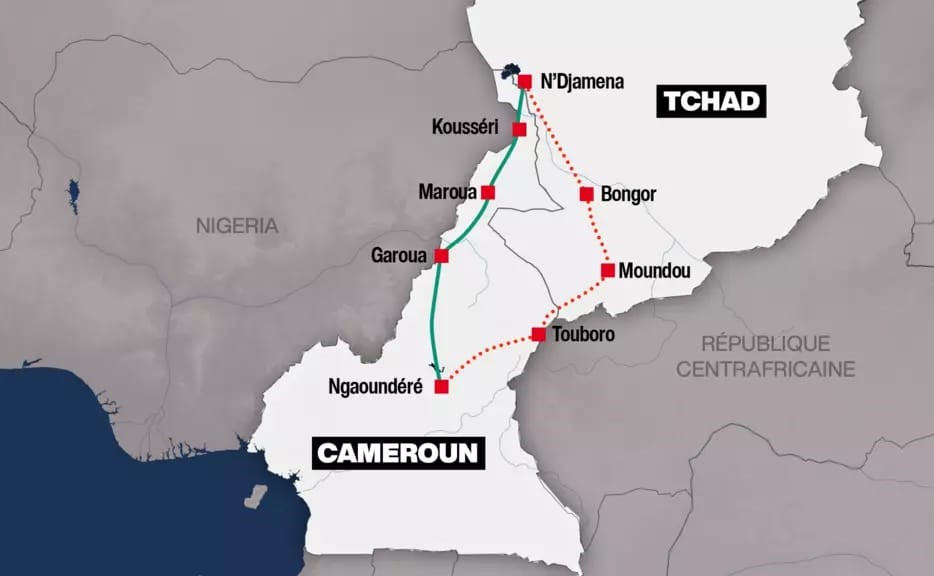
The controversy surrounding the Cameroon-Chad railway project has taken a sharp turn after N’Djamena publicly rejected the route proposed by Yaoundé, exposing the flaws in unilateral decision-making for regional integration initiatives. Beyond technical disagreements, this dispute highlights the complex web of economic, geopolitical, and territorial considerations shaping this infrastructure that could redefine trade flows between Cameroon, Chad, and beyond.
The friction erupted when Cameroon’s steering committee for major projects, chaired by the country’s president, approved a railway corridor linking Ngaoundéré to N’Djamena via Garoua, Figuil, Maroua, and Kousséri before crossing into Chad. While Cameroonian authorities presented this as the most logical choice for economic, technical, and territorial reasons, Chadian officials swiftly pushed back.
In an official statement released shortly after, Chad’s Ministry of Transport emphasized that no final route had been jointly approved by both nations. N’Djamena argued that multiple options remained under discussion as part of ongoing bilateral studies and consultations. This disagreement, while seemingly technical, underscores the persistent challenges in managing cross-border infrastructure projects across the subregion.
a transformative project with regional significance
The proposed railway, spanning over 900 kilometers according to preliminary studies, aims to directly connect Cameroon’s rail network to landlocked Chad, where more than 80% of external trade currently transits through the Douala-N’Djamena corridor. This infrastructure aligns with the Central African Economic and Monetary Community’s (CEMAC) strategy for developing multimodal corridors, supported by international technical and financial partners. With an estimated cost of billions of dollars, it would rank among the most significant infrastructure investments ever undertaken between the two countries.
Beyond transportation, the project promises to streamline the movement of hydrocarbons, cotton, livestock, grains, construction materials, and containerized goods from Cameroon’s ports in Douala and Kribi. Proponents anticipate reduced logistics costs, enhanced business competitiveness, and smoother trade flows across the Cameroon-Chad basin. The railway could also mitigate Chad’s long-standing vulnerability stemming from its reliance on Cameroonian trade routes.
economic interdependence versus national priorities
For both nations, the stakes extend far beyond mere transportation. Chad, a landlocked country, depends heavily on Cameroon’s corridor for its external trade, with a significant portion of imports routed through Douala before being transported overland to N’Djamena. This logistics dependency has historically posed economic risks.
Studies suggest a modern rail link could substantially cut logistics costs, speed up goods circulation, and improve business competitiveness. Unlike road transport, which incurs high maintenance costs and is vulnerable to climate-related disruptions, rail offers a more sustainable solution. For Cameroon, the project presents an opportunity to leverage its port infrastructure in Douala and Kribi, reinforcing their role as natural gateways to the Sahel hinterland.
The true battle, however, lies not in the technical specifications but in securing economic benefits. The route approved by Yaoundé favors a path through Cameroon’s northern regions before reaching N’Djamena. This choice aims to enhance infrastructure development in northern cities like Garoua, Maroua, and Kousséri while addressing territorial imbalances within Cameroon. For Chadian officials, however, this route fails to adequately serve key agricultural and productive zones in their country, risking uneven distribution of the project’s long-term benefits.
regional integration at the crossroads of national sovereignty
This episode underscores the persistent hurdles facing economic integration in Central Africa. Despite pro-integration rhetoric, major infrastructure projects often remain mired in nationalistic decision-making. Yet, the economic viability of a cross-border corridor hinges on its ability to balance the interests of all stakeholders.
International experience shows that successful regional infrastructure typically emerges from shared governance frameworks from the earliest planning stages. Decisions on financing, route selection, technical standards, and operations are made collaboratively to ensure political buy-in from all partners. Without such cooperation, the risks of project delays or abandonment rise significantly, as seen in other stalled initiatives across the continent.
The Cameroon-Chad railway dispute arrives at a critical juncture, as African nations increasingly seek to strengthen regional connectivity. The outcome of these negotiations could set a precedent for how future cross-border projects are managed, with implications for trade, investment, and economic resilience across the subregion.
Comments are closed, but trackbacks and pingbacks are open.