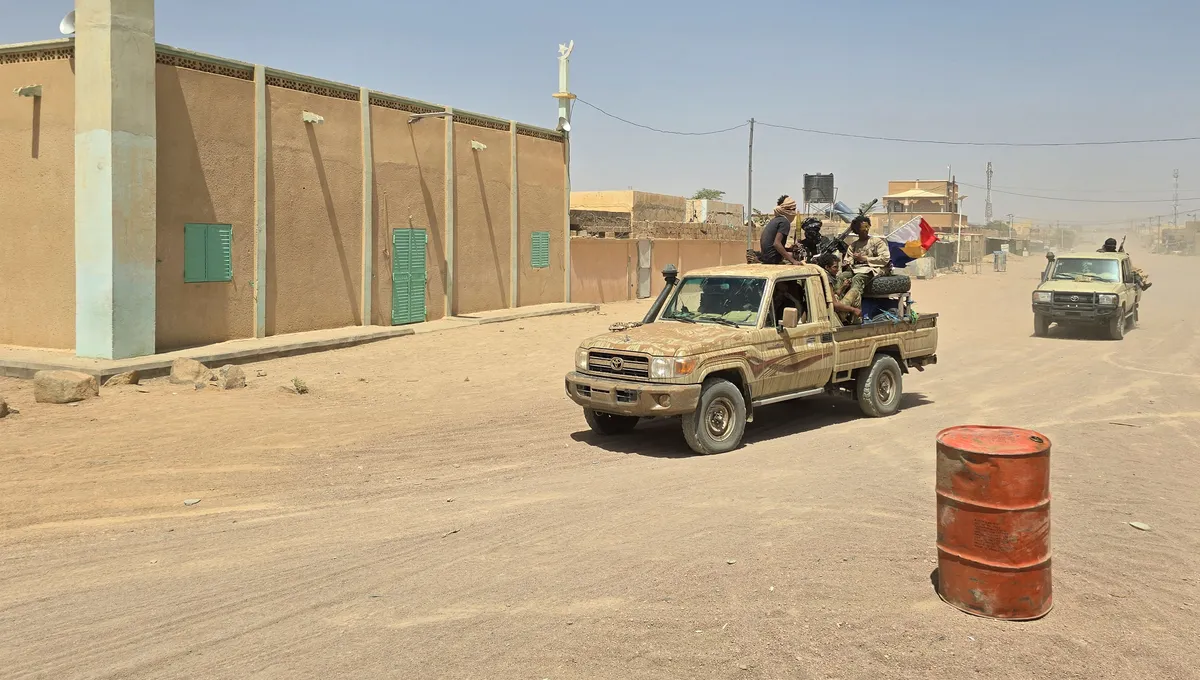
The recent withdrawal of Russian forces from Kidal in northern Mali has sent shockwaves through the Malian junta, marking a significant strategic setback. Video footage captured a convoy of Russian military vehicles exiting the city without firing a single shot, handing over control to Tuareg rebels allied with jihadist groups.
This unexpected retreat follows coordinated attacks by the Group for the Support of Islam and Muslims (JNIM) across multiple regions, including the capital Bamako. In a surprising move, the jihadists explicitly requested that Russian forces refrain from intervening, signaling potential future cooperation between the two sides.
Russia’s passive response raises questions about its military strategy in Mali
The Africa Corps—Russia’s replacement for the disbanded Wagner Group—has maintained a perplexing silence as Mali faces its most severe security crisis in five years. With around 2,500 Russian troops stationed in the country, their inaction during the recent offensive highlights a critical failure in protecting the Malian regime, which had previously ousted French forces in 2022, hoping for a Russian-led security revival.
regime under siege as security crisis deepens
The Malian government has suffered severe blows, including the assassination of the powerful Defense Minister in a targeted attack on his residence. Simultaneous assaults by jihadists and rebels across key regions suggest a widening power vacuum, with insurgents gaining control over vast territories.
The fall of Kidal carries profound symbolic weight. Once a stronghold of Tuareg separatists, it was recaptured in 2023 by Malian forces with Russian support, following the departure of French and UN troops. This victory had bolstered the prestige of Colonel Assimi Goïta, the junta leader, but the recent loss underscores the fragility of the regime’s security architecture.
regional stability at risk as jihadist influence grows
The situation in Mali poses a dual threat: the potential fragmentation of the country between Tuareg separatists in the north and competing jihadist factions vying for territorial dominance. The JNIM, an Al Qaeda-affiliated group, has regional ambitions, raising concerns for neighboring countries like Niger and Burkina Faso—both members of the Sahel Alliance with Mali. A collapse of the Malian regime could trigger further instability across West Africa, with coastal nations already facing jihadist incursions.
a decade of failed security strategies
Since France intervened in 2014 to prevent a jihadist takeover of Bamako, Malian forces, backed by international support, had managed to reclaim northern territories. However, the subsequent years saw growing frustration among the population, culminating in military coups, the expulsion of French forces, and the arrival of Russian mercenaries. Yet, despite these shifts, Mali remains mired in crisis, with its people bearing the brunt of failed policies and shifting alliances.
As Mali grapples with this escalating turmoil, the withdrawal of Russian forces from Kidal serves as a stark reminder of the challenges ahead. The junta’s reliance on external military support has proven insufficient, leaving the nation at a critical crossroads in its fight against insurgency and instability.